
AskSia
Plus

直线 y=1 与双曲线 y=x1 相交于点 A1, 与双曲线 y=x2 相交于点 B1, 直...
Mar 9, 2024

直线 y=1 与双曲线 y=x1 相交于点 A1, 与双曲线 y=x2 相交于点 B1, 直线 y=2 与双曲线 y=x1 相交于点 A2, 与双曲线 y=x2 相交于点 B2, 则四边形 A1 B1 B2 A2 的面积为 __; 直线 y=n 与双曲线 y=x1 相交于点 An, 与双曲线 y=x2 相交于点 Bn, 直线 y=n+1 与双曲线 y=x1 相交于点 Aa+1, 与双曲线 y=X2 相交于点 Bn+1, 则四边形 AnBnBn+1An+1 的面积为

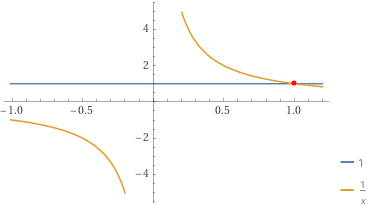
Generated Graph
Solution by Steps
step 1
To find the area of the quadrilateral A1B1B2A2, we need to find the coordinates of the points A1, B1, A2, and B2
step 2
From the asksia-ll calculator result, the intersection point A1 of the line y=1 and the hyperbola y=x1 is at x=1. Thus, A1 has coordinates (1,1)
step 3
The intersection point B1 of the line y=1 and the hyperbola y=x2 is at x=2. Thus, B1 has coordinates (2,1)
step 4
The intersection point A2 of the line y=2 and the hyperbola y=x1 is at x=21. Thus, A2 has coordinates (21,2)
step 5
The intersection point B2 of the line y=2 and the hyperbola y=x2 is at x=1. Thus, B2 has coordinates (1,2)
step 6
The quadrilateral A1B1B2A2 is a trapezoid with bases A1A2 and B1B2, and the height is the distance between these bases, which is B1B2−A1A2=2−1=1
step 7
The length of base A1A2 is the difference in the x-coordinates of A2 and A1, which is 21−1=−21
step 8
The length of base B1B2 is the difference in the x-coordinates of B2 and B1, which is 1−2=−1
step 9
The area of the trapezoid is given by the formula 21×(base1+base2)×height
step 10
Substituting the lengths of the bases and the height, the area is 21×(−21+(−1))×1=21×(−23)×1=−43. Since area cannot be negative, we take the absolute value, which is 43
Answer
43
Key Concept
Area of a Trapezoid
Explanation
The area of a trapezoid is calculated using the formula 21×(base1+base2)×height, where base1 and base2 are the lengths of the two parallel sides, and height is the distance between them.
Solution by Steps
step 1
To find the area of the quadrilateral AnBnBn+1An+1, we need to find the coordinates of the points An, Bn, An+1, and Bn+1 for a general n
step 2
The intersection point An of the line y=n and the hyperbola y=x1 is at x=n1. Thus, An has coordinates (n1,n)
step 3
The intersection point Bn of the line y=n and the hyperbola y=x2 is at x=n2. Thus, Bn has coordinates (n2,n)
step 4
The intersection point An+1 of the line y=n+1 and the hyperbola y=x1 is at x=n+11. Thus, An+1 has coordinates (n+11,n+1)
step 5
The intersection point Bn+1 of the line y=n+1 and the hyperbola y=x2 is at x=n+12. Thus, Bn+1 has coordinates (n+12,n+1)
step 6
The quadrilateral AnBnBn+1An+1 is a trapezoid with bases AnAn+1 and BnBn+1, and the height is the distance between these bases, which is BnBn+1−AnAn+1=n+1−n=1
step 7
The length of base AnAn+1 is the difference in the x-coordinates of An+1 and An, which is n+11−n1
step 8
The length of base BnBn+1 is the difference in the x-coordinates of Bn+1 and Bn, which is n+12−n2
step 9
The area of the trapezoid is given by the formula 21×(base1+base2)×height
step 10
Substituting the lengths of the bases and the height, the area is 21×(n+11−n1+n+12−n2)×1
step 11
Simplifying the expression for the area, we get 21×(n(n+1)1−2n+n+n(n+1)2−4n+2n)
step 12
Further simplifying, we find the area to be 21×(n(n+1)3)
Answer
2n(n+1)3
Key Concept
Area of a Trapezoid with Variable Bases
Explanation
The area of a trapezoid with variable bases can be found by substituting the expressions for the bases and the height into the trapezoid area formula. The bases are determined by the x-coordinates of the intersection points of the lines and hyperbolas for a given n.
© 2023 AskSia.AI all rights reserved