
AskSia
Plus

下午 5:10 6月3日周一
50%
MAST10007
Semester 2,2023
Linear Algebra
Question 6 (13 ...
Jun 3, 2024



Solution by Steps
step 1
To determine if S is linearly independent or dependent, we need to examine the row-reduced form of matrix A
step 2
The row-reduced form of A is given as B=1000amp;0amp;1amp;0amp;0amp;−1amp;2amp;0amp;0amp;0amp;0amp;2amp;0amp;1amp;0amp;−2amp;0
step 3
Since B has a row of zeros, the rank of A is less than the number of columns
step 4
Therefore, the set S is linearly dependent
Answer
The set S is linearly dependent.
step 1
To determine if S spans P3, we need to check if the rank of A is equal to the dimension of P3
step 2
The dimension of P3 is 4
step 3
The rank of A (or B) is 3, as there are 3 non-zero rows in B
step 4
Since the rank is less than 4, S does not span P3
Answer
The set S does not span P3.
step 1
To find a basis for span(S), we need to select the linearly independent vectors from S
step 2
From the row-reduced form B, the pivot columns correspond to the linearly independent vectors
step 3
The pivot columns in B are the 1st, 2nd, and 4th columns
step 4
Therefore, the basis B is {p1,p2,p4}
Answer
The basis B for span(S) is {p1,p2,p4}.
step 1
The dimension of span(S) is equal to the number of vectors in the basis B
step 2
From part (c), the basis B has 3 vectors
Answer
The dimension of span(S) is 3.
step 1
The polynomials not in B are p3 and p5
step 2
To find the coordinate vector of p3, express it as a linear combination of p1,p2,p4
step 3
Solve the system: c1p1+c2p2+c4p4=p3
step 4
Similarly, find the coordinate vector of p5
Answer
The coordinate vectors are found by solving the linear combinations.
step 1
To determine if {p1,p3,p5} is linearly independent, form a matrix with these vectors as columns
step 2
Row reduce the matrix to check for linear independence
step 3
If the matrix has a row of zeros, the set is linearly dependent
Answer
The set {p1,p3,p5} is linearly dependent.
Key Concept
Linear Independence and Span
Explanation
Linear independence is determined by the row-reduced form of the matrix. The span is determined by the rank of the matrix.

Solution by Steps
step 1
A matrix A is Hermitian if A=A†, where A† is the conjugate transpose of A
step 2
Given A=(2iamp;−iamp;2), we find A† by taking the transpose and then the complex conjugate:
step 3
A†=(2−iamp;iamp;2)
step 4
Since A=A†, A is a Hermitian matrix
step 1
To find the eigenvalues, solve the characteristic equation det(A−λI)=0
step 2
A−λI=(2−λiamp;−iamp;2−λ)
step 3
det(A−λI)=(2−λ)(2−λ)−(−i)(i)=λ2−4λ+3=0
step 4
Solving λ2−4λ+3=0 gives λ1=3 and λ2=1
step 1
For λ1=3, solve (A−3I)v=0:
step 2
(A−3I)=(−1iamp;−iamp;−1)
step 3
Solving (−1iamp;−iamp;−1)(xy)=(00) gives v1=(−i1)
step 4
For λ2=1, solve (A−I)v=0:
step 5
(A−I)=(1iamp;−iamp;1)
step 6
Solving (1iamp;−iamp;1)(xy)=(00) gives v2=(i1)
step 1
The eigenvectors form the columns of U: U=(−i1amp;iamp;1)
step 2
Normalize the columns of U to make it unitary:
step 3
U=21(−i1amp;iamp;1)
step 4
The diagonal matrix D contains the eigenvalues: D=(30amp;0amp;1)
step 5
Verify A=UDU−1:
step 6
U−1=U†=21(i−iamp;1amp;1)
step 7
A=21(−i1amp;iamp;1)(30amp;0amp;1)21(i−iamp;1amp;1)=(2iamp;−iamp;2)
Answer
(a) A is a Hermitian matrix.
(b) The eigenvalues are λ1=3 and λ2=1.
(c) The eigenspaces are spanned by v1=(−i1) for λ1=3 and v2=(i1) for λ2=1.
(d) U=21(−i1amp;iamp;1) and D=(30amp;0amp;1) such that A=UDU−1.
Key Concept
Hermitian Matrix
Explanation
A Hermitian matrix is equal to its conjugate transpose. The eigenvalues of a Hermitian matrix are real, and the matrix can be diagonalized using a unitary matrix.

Solution by Steps
step 1
Given the linear transformation T:M2,2→M2,2 defined by T(A)=PA where P=[11amp;1amp;2], we need to find T([acamp;bamp;d])
step 2
Compute the product P[acamp;bamp;d]:
P[acamp;bamp;d]=[11amp;1amp;2][acamp;bamp;d]=[a+ca+2camp;b+damp;b+2d]
step 3
Therefore, T([acamp;bamp;d])=[a+ca+2camp;b+damp;b+2d]
Answer
T([acamp;bamp;d])=[a+ca+2camp;b+damp;b+2d]
Key Concept
Linear Transformation
Explanation
A linear transformation T applied to a matrix A can be computed by multiplying A with a given matrix P.
Solution by Steps
step 1
To find the matrix representation of T with respect to the basis B, we need to apply T to each basis vector in B and express the result as a linear combination of the basis vectors
step 2
Apply T to E11:
T(E11)=PE11=[11amp;1amp;2][10amp;0amp;0]=[11amp;0amp;0]
This can be written as E11+E21
step 3
Apply T to E12:
T(E12)=PE12=[11amp;1amp;2][00amp;1amp;0]=[00amp;1amp;2]
This can be written as E12+2E22
step 4
Apply T to E21:
T(E21)=PE21=[11amp;1amp;2][01amp;0amp;0]=[12amp;0amp;0]
This can be written as E11+2E21
step 5
Apply T to E22:
T(E22)=PE22=[11amp;1amp;2][00amp;0amp;1]=[00amp;1amp;2]
This can be written as E12+2E22
step 6
The matrix representation of T with respect to the basis B is:
[T]B=1010amp;0amp;1amp;0amp;2amp;1amp;0amp;2amp;0amp;0amp;1amp;0amp;2
Answer
[T]B=1010amp;0amp;1amp;0amp;2amp;1amp;0amp;2amp;0amp;0amp;1amp;0amp;2
Key Concept
Matrix Representation
Explanation
The matrix representation of a linear transformation with respect to a given basis is found by applying the transformation to each basis vector and expressing the result as a linear combination of the basis vectors.
Solution by Steps
step 1
To compute the rank of T, we need to determine the rank of the matrix representation [T]B
step 2
The matrix [T]B is:
[T]B=1010amp;0amp;1amp;0amp;2amp;1amp;0amp;2amp;0amp;0amp;1amp;0amp;2
We perform row reduction to find the rank
step 3
Row reduce the matrix:
1010amp;0amp;1amp;0amp;2amp;1amp;0amp;2amp;0amp;0amp;1amp;0amp;2→1000amp;0amp;1amp;0amp;0amp;1amp;0amp;1amp;0amp;0amp;1amp;0amp;1
The matrix is now in row echelon form
step 4
The rank of the matrix is the number of non-zero rows, which is 4
Answer
The rank of T is 4.
Key Concept
Rank of a Matrix
Explanation
The rank of a matrix is the number of linearly independent rows or columns in the matrix. It can be found by row reducing the matrix to its row echelon form.
Solution by Steps
step 1
To determine if T is surjective, we need to check if the rank of T is equal to the dimension of the codomain M2,2
step 2
The dimension of M2,2 is 4, as it is the space of all 2×2 matrices
step 3
Since the rank of T is 4, which is equal to the dimension of the codomain, T is surjective
Answer
T is surjective.
Key Concept
Surjectivity
Explanation
A linear transformation is surjective if its rank is equal to the dimension of the codomain.
Solution by Steps
step 1
To determine if T is injective, we need to check if the rank of T is equal to the dimension of the domain M2,2
step 2
The dimension of M2,2 is 4, as it is the space of all 2×2 matrices
step 3
Since the rank of T is 4, which is equal to the dimension of the domain, T is injective
Answer
T is injective.
Key Concept
Injectivity
Explanation
A linear transformation is injective if its rank is equal to the dimension of the domain.

Solution by Steps
step 1
To find the determinant of M, we use cofactor expansion along the first row
step 2
The matrix M is given by:
M=32−1amp;−1amp;−3amp;2amp;1amp;1amp;1
step 3
The determinant of M is:
det(M)=3−32amp;1amp;1−(−1)2−1amp;1amp;1+12−1amp;−3amp;2
step 4
Calculate each 2x2 determinant:
−32amp;1amp;1=(−3)(1)−(1)(2)=−3−2=−5
2−1amp;1amp;1=(2)(1)−(1)(−1)=2+1=3
2−1amp;−3amp;2=(2)(2)−(−3)(−1)=4−3=1
step 5
Substitute back into the determinant formula:
det(M)=3(−5)−(−1)(3)+1(1)=−15+3+1=−11
step 6
A matrix is invertible if and only if its determinant is non-zero
step 7
Since det(M)=−11=0, the matrix M is invertible
step 1
Given det(A)=−2 and det(B)=4, we need to find det(2BTA−3)
step 2
Use the properties of determinants:
det(2BTA−3)=23det(BT)det(A−3)
step 3
Since det(BT)=det(B) and det(A−3)=(det(A))−3:
det(2BTA−3)=8⋅4⋅(−2)−3
step 4
Calculate the determinant:
det(2BTA−3)=8⋅4⋅(−81)=8⋅4⋅−81=−4
step 5
The rank of a matrix is the maximum number of linearly independent rows or columns
step 6
Since A and B are 3×3 matrices and A is invertible, A−3 is also invertible
step 7
Multiplying by 2BT does not change the rank. Therefore, the rank of 2BTA−3 is 3
step 1
An elementary matrix is obtained by performing a single elementary row operation on an identity matrix
step 2
The matrix C is:
C=100amp;0amp;2amp;0amp;3amp;0amp;1
step 3
This matrix cannot be obtained by a single elementary row operation on the identity matrix
step 4
Therefore, C is not an elementary matrix
Answer
The determinant of M is −11. M is invertible. det(2BTA−3)=−4. The rank of 2BTA−3 is 3. C is not an elementary matrix.
Key Concept
Determinant and Invertibility
Explanation
The determinant of a matrix helps determine if it is invertible. The properties of determinants and ranks are used to solve matrix-related problems.

Solution by Steps
step 1
To determine if W is a subspace, we need to check if it satisfies the three subspace conditions: containing the zero vector, closed under addition, and closed under scalar multiplication
step 2
The zero vector in F23 is (0,0,0). This vector has all zero entries, so it is in W
step 3
To check closure under addition, consider two vectors in W, say u=(u1,u2,u3) and v=(v1,v2,v3), each having at least one zero entry. Their sum u+v may not necessarily have a zero entry. For example, (1,0,0)+(0,1,0)=(1,1,0), which has a zero entry, but (1,0,0)+(0,0,1)=(1,0,1), which does not have a zero entry. Thus, W is not closed under addition
step 4
Since W is not closed under addition, it is not a subspace
step 1
To determine if W is a subspace, we need to check if it satisfies the three subspace conditions: containing the zero vector, closed under addition, and closed under scalar multiplication
step 2
The zero vector in F23 is (0,0,0). This vector has three zero entries, which is an odd number, so it is in W
step 3
To check closure under addition, consider two vectors in W, say u=(u1,u2,u3) and v=(v1,v2,v3), each having an odd number of zero entries. Their sum u+v may not necessarily have an odd number of zero entries. For example, (1,0,0)+(0,1,0)=(1,1,0), which has two zero entries (even number). Thus, W is not closed under addition
step 4
Since W is not closed under addition, it is not a subspace
step 1
To determine if W is a subspace, we need to check if it satisfies the three subspace conditions: containing the zero vector, closed under addition, and closed under scalar multiplication
step 2
The zero vector in F23 is (0,0,0). This vector has three zero entries, which is an even number, so it is in W
step 3
To check closure under addition, consider two vectors in W, say u=(u1,u2,u3) and v=(v1,v2,v3), each having an even number of zero entries. Their sum u+v will also have an even number of zero entries. For example, (1,0,0)+(0,1,0)=(1,1,0), which has two zero entries (even number). Thus, W is closed under addition
step 4
To check closure under scalar multiplication, consider a vector u=(u1,u2,u3) in W and a scalar c∈F2. Multiplying u by c will not change the number of zero entries. Thus, W is closed under scalar multiplication
step 5
Since W contains the zero vector, is closed under addition, and is closed under scalar multiplication, it is a subspace
step 1
To determine if W is a subspace, we need to check if it satisfies the three subspace conditions: containing the zero vector, closed under addition, and closed under scalar multiplication
step 2
The zero vector in F23 is (0,0,0). Substituting into the equation x2+y2+z2=0, we get 02+02+02=0, which is true. Thus, the zero vector is in W
step 3
To check closure under addition, consider two vectors in W, say u=(u1,u2,u3) and v=(v1,v2,v3). Their sum u+v must also satisfy the equation x2+y2+z2=0. However, in F2, the sum of squares is not necessarily zero. For example, (1,1,0)+(1,1,0)=(0,0,0), which does not satisfy the equation. Thus, W is not closed under addition
step 4
Since W is not closed under addition, it is not a subspace
Answer
(a) Not a subspace, (b) Not a subspace, (c) Subspace, (d) Not a subspace
Key Concept
Subspace conditions in vector spaces
Explanation
To determine if a set is a subspace, it must contain the zero vector, be closed under addition, and be closed under scalar multiplication.

Solution by Steps
step 1
To determine if T is surjective, we need to check if the rank of matrix A is equal to the dimension of the codomain W
step 2
The rank of A is the number of non-zero rows in its row echelon form. From the Asksia-LL calculator result, the row-reduced form of A is:
10000amp;0amp;1amp;0amp;0amp;0amp;2amp;−10amp;0amp;0amp;0amp;0amp;4amp;0amp;0amp;0amp;0amp;0amp;1amp;0amp;0amp;3amp;−2amp;7amp;0amp;0
The rank of A is 3
step 3
Since the rank of A (3) is less than the number of rows (5), T is not surjective
Answer
T is not surjective.
step 1
The nullity of T is the dimension of the kernel of T. By the rank-nullity theorem, we have:
nullity(T)=dim(V)−rank(T)
where dim(V) is the number of columns of A
step 2
Given dim(V)=6 and rank(T)=3, we get:
nullity(T)=6−3=3
Answer
The nullity of T is 3.
step 1
To find a non-zero linear combination in the kernel of T, we need to find a non-trivial solution to Ax=0. From the Asksia-LL calculator result, the null space of A is:
{(−2x−3z,10x−4y+2z,x,y,−7z,z):x,y,z∈R}
step 2
Choosing x=1, y=0, and z=0, we get:
(−2(1)−3(0),10(1)−4(0)+2(0),1,0,−7(0),0)=(−2,10,1,0,0,0)
Answer
A non-zero linear combination in the kernel of T is −2b1+10b2+b3.
step 1
The basis for the image of T is given by the pivot columns of A in its row echelon form. From the row-reduced form of A, the pivot columns are the first, second, and fifth columns
step 2
Therefore, the basis for the image of T is:
⎩⎨⎧10000,01000,00100⎭⎬⎫
Answer
The basis for the image of T is {c1,c2,c3}.
step 1
The rank of B is the same as the rank of A because B is another representation of the same linear transformation T with respect to different bases
step 2
From the previous steps, we know the rank of A is 3. Therefore, the rank of B is also 3
Answer
The rank of B is 3.
Key Concept
Linear Transformations and Matrix Rank
Explanation
The rank of a matrix representing a linear transformation determines the dimension of the image of the transformation, while the nullity determines the dimension of the kernel. The rank-nullity theorem relates these concepts to the dimension of the domain.

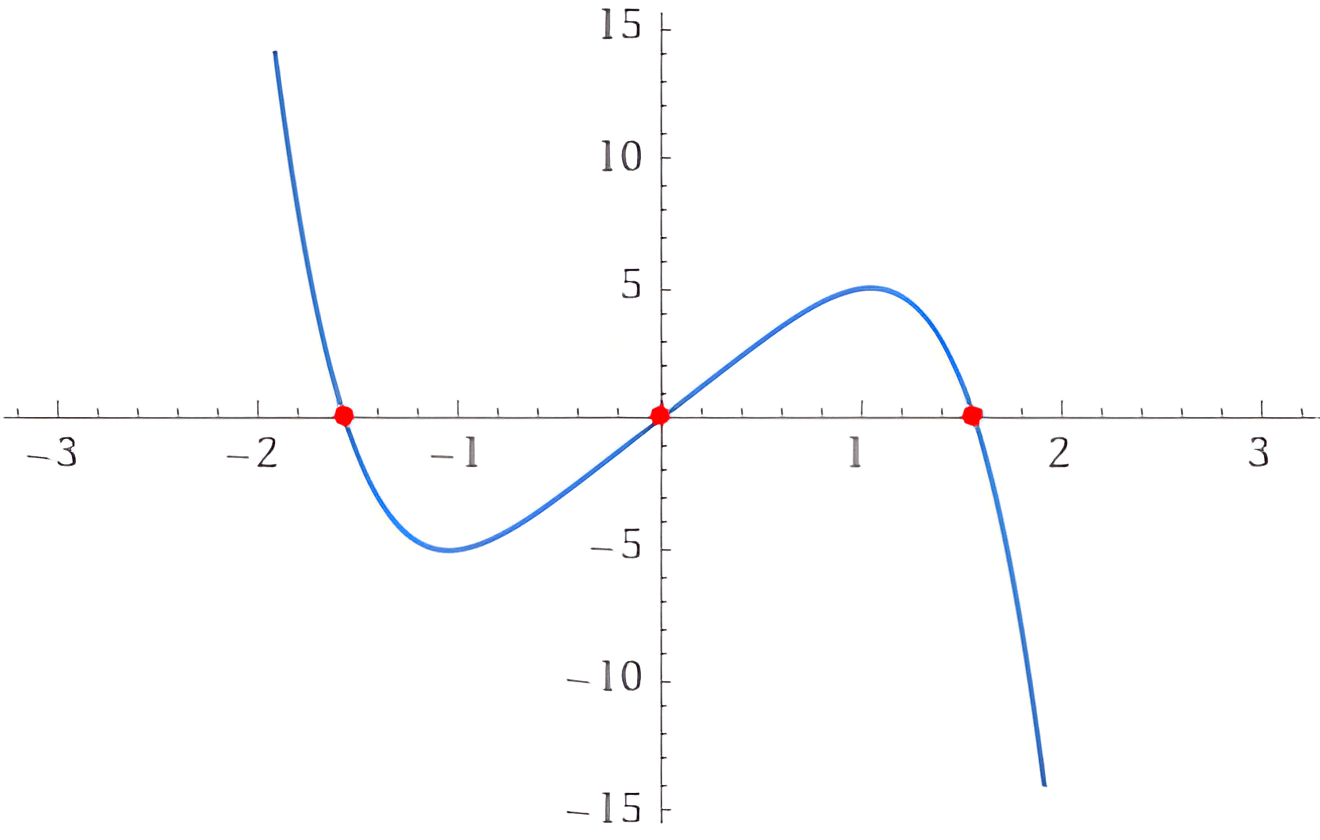
Generated Graph
Solution by Steps
step 1
To determine if T is invertible, we need to check if the determinant of the matrix [T] is non-zero
step 2
The matrix [T] is given by:
[T]=(1−2amp;2amp;−4)
We calculate the determinant using the formula for a 2x2 matrix:
det(A)=ad−bc
where A=(acamp;bamp;d)
step 3
Substituting the values from [T]:
det([T])=(1)(−4)−(2)(−2)=−4+4=0
Since the determinant is zero, the matrix [T] is not invertible
step 1
The characteristic polynomial of the matrix representation [T]C,B is given as −λ5+6λ
step 2
To determine if T is invertible, we need to check if λ=0 is a root of the characteristic polynomial
step 3
Solving the characteristic polynomial:
−λ5+6λ=0
Factoring out λ:
λ(−λ4+6)=0
This gives us the roots:
λ=0orλ4=6
Since λ=0 is a root, the matrix is not invertible
step 1
Given that Nullity(T)≥rank(T) and V={0}, we need to determine if T is invertible
step 2
For T to be invertible, the nullity of T must be zero (i.e., Null(T)={0})
step 3
Since Nullity(T)≥rank(T), it implies that there are non-zero vectors in the null space of T. Therefore, T is not invertible
Answer
(a) T is not invertible because the determinant of [T] is zero.
(c) T is not invertible because λ=0 is a root of the characteristic polynomial.
(d) T is not invertible because Nullity(T)≥rank(T).
Key Concept
Invertibility of a Linear Transformation
Explanation
A linear transformation T is invertible if and only if its matrix representation has a non-zero determinant, its characteristic polynomial does not have zero as a root, and its nullity is zero.

Solution by Steps
step 1
The set S contains 4 elements: {◯,◯,□,□}
step 2
The power set P(S) contains all subsets of S
step 3
The number of subsets of a set with n elements is 2n
step 4
Since S has 4 elements, P(S) has 24=16 elements
step 5
The dimension of P(S) as a vector space over F2 is 16
Answer
The dimension of P(S) is 16.
step 1
To show that T is surjective, we need to show that for every element in F22, there is a subset X∈P(S) such that T(X) maps to that element
step 2
Consider the elements of F22: {[0,0],[0,1],[1,0],[1,1]}
step 3
For [0,0]: Choose X={} (empty set). It has an even number of black elements and an even number of circles
step 4
For [0,1]: Choose X={◯}. It has an even number of black elements and an odd number of circles
step 5
For [1,0]: Choose X={□}. It has an odd number of black elements and an even number of circles
step 6
For [1,1]: Choose X={◯,□}. It has an odd number of black elements and an odd number of circles
step 7
Since we can find a subset X for each element in F22, T is surjective
Answer
T is surjective.
step 1
The null-space of T consists of all subsets X∈P(S) such that T(X)=[0,0]
step 2
This means X must have an even number of black elements and an even number of circles
step 3
The subsets of S that satisfy this condition are: {}, {◯,◯}, {□,□}, {◯,◯,□,□}
Answer
The elements in the null-space of T are {}, {◯,◯}, {□,□}, {◯,◯,□,□}.
step 1
The ordered basis B is {{◯},{◯},{□},{□}}
step 2
Apply T to each basis element:
step 3
T({◯})=[0,1]
step 4
T({◯})=[0,1]
step 5
T({□})=[1,0]
step 6
T({□})=[1,0]
step 7
The matrix representation of T with respect to B and S is:
step 8
[01amp;0amp;1amp;1amp;0amp;1amp;0]
Answer
The matrix representation of T is [01amp;0amp;1amp;1amp;0amp;1amp;0].
Key Concept
Linear Transformation and Vector Space
Explanation
The problem involves understanding the dimension of a power set, proving surjectivity of a linear transformation, identifying elements in the null space, and finding the matrix representation of the transformation.

Solution by Steps
step 1
Given the matrix A=2−11amp;1amp;1amp;2, we need to find the orthogonal projection matrix P onto the column space of A
step 2
The orthogonal projection matrix P is given by P=A(ATA)−1AT
step 3
First, compute ATA:
AT=[21amp;−1amp;1amp;1amp;2]
ATA=2−11amp;1amp;1amp;2T2−11amp;1amp;1amp;2=[63amp;3amp;6]
step 4
Next, compute (ATA)−1:
(ATA)−1=[63amp;3amp;6]−1=271[6−3amp;−3amp;6]=[92−91amp;−91amp;92]
step 5
Now, compute P=A(ATA)−1AT:
P=2−11amp;1amp;1amp;2[92−91amp;−91amp;92][21amp;−1amp;1amp;1amp;2]
P=959194amp;91amp;95amp;−94amp;94amp;−94amp;95
step 6
(a) The null-space of P is the set of all vectors that are mapped to the zero vector by P. Since P is a projection matrix, its null-space is the orthogonal complement of the column space of A. The image of P is the column space of A
step 7
(b) The rank of P is the dimension of the column space of A, which is 2. The nullity of P is the dimension of the null-space of P, which is 1
step 8
(c) To find the singular value decomposition (SVD) of A, we need to find matrices U, Σ, and V such that A=UΣVT. This involves finding the eigenvalues and eigenvectors of ATA and AAT
Answer
(a) The null-space of P is the orthogonal complement of the column space of A. The image of P is the column space of A.
(b) The rank of P is 2, and the nullity of P is 1.
(c) The singular value decomposition of A involves finding matrices U, Σ, and V such that A=UΣVT.
Key Concept
Orthogonal Projection Matrix
Explanation
The orthogonal projection matrix P projects vectors onto the column space of A. The rank of P is the dimension of the column space, and the nullity is the dimension of the orthogonal complement. The SVD of A provides a factorization into orthogonal matrices and a diagonal matrix of singular values.
© 2023 AskSia.AI all rights reserved