
AskSia
Plus

use
Apr 9, 2024

use

Generated Graph
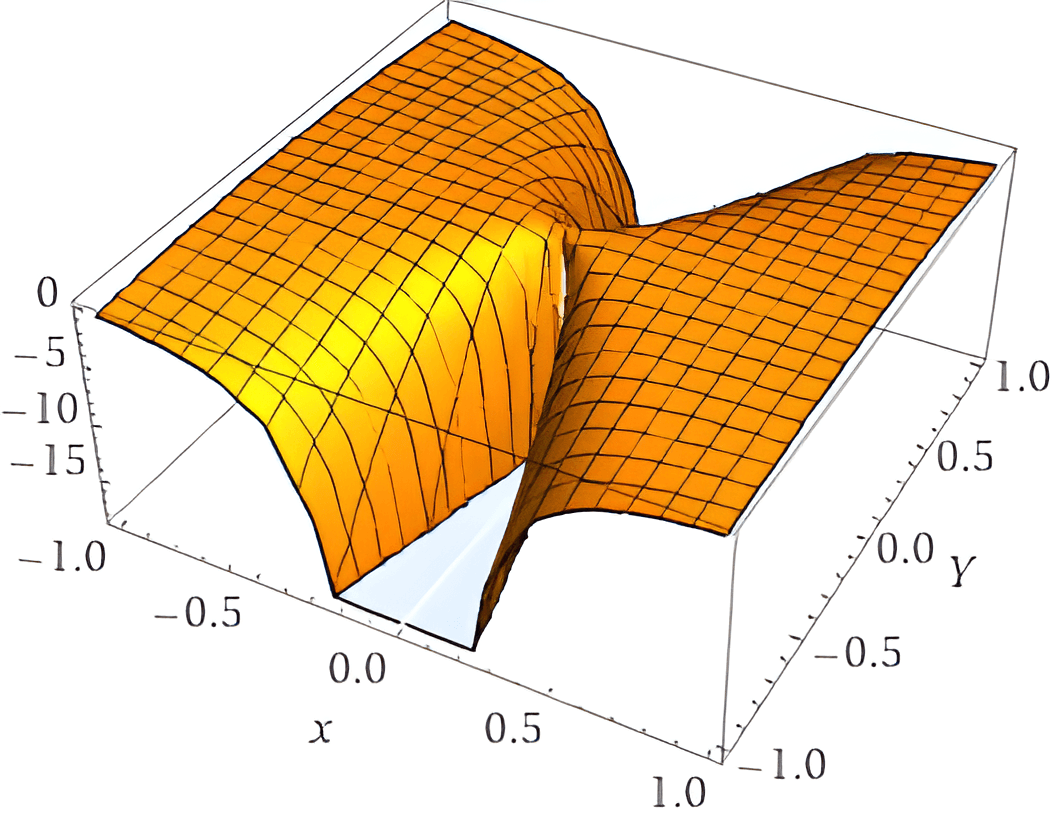
Solution by Steps
step 1
To differentiate the function xY2 with respect to x, we apply the quotient rule
step 2
The quotient rule states that (gf)′=g2f′g−fg′, where f=Y2 and g=x. Since Y is treated as a constant with respect to x, f′=0
step 3
Applying the quotient rule, we get dxd(xY2)=x20⋅x−Y2⋅1
step 4
Simplifying the expression, we find x2−Y2
Answer
dxd(xY2)=−x2Y2
Key Concept
Differentiation using the quotient rule
Explanation
The quotient rule is used to differentiate a function that is the quotient of two other functions, particularly when the numerator is a function of a constant with respect to the variable of differentiation.
use an augmented matrix to solve the system x+2y-3z=12 5x-3y+z=-11 2x+y+4z=-5
Solution by Steps
step 1
Convert the system of equations into an augmented matrix:
$$ \begin{bmatrix} 1 & 2 & -3 & | & 12 \\ 5 & -3 & 1 & | & -11 \\ 2 & 1 & 4 & | & -5 \end{bmatrix} $$
step 2
Perform row reduction on the augmented matrix to reach row-echelon form:
$$ \begin{bmatrix} 1 & 0 & 0 & | & 0 \\ 0 & 1 & 0 & | & 3 \\ 0 & 0 & 1 & | & -2 \end{bmatrix} $$
step 3
Interpret the row-reduced matrix as a system of equations to find the solution:
$$ \begin{cases} x = 0 \\ y = 3 \\ z = -2 \end{cases} $$
Answer
The solution to the system of equations is x=0, y=3, and z=−2.
Key Concept
Row Reduction of Augmented Matrices
Explanation
The row reduction process transforms the augmented matrix of a system of linear equations into a form where the solution can be easily read off as the entries in the last column.
© 2023 AskSia.AI all rights reserved