
AskSia
Plus

these questions is about the limits and continuity,solve these questions one by ...
Jun 23, 2024

these questions is about the limits and continuity,solve these questions one by one and give most correctly answer,showing full steps about how to slove each questions

Generated Graph
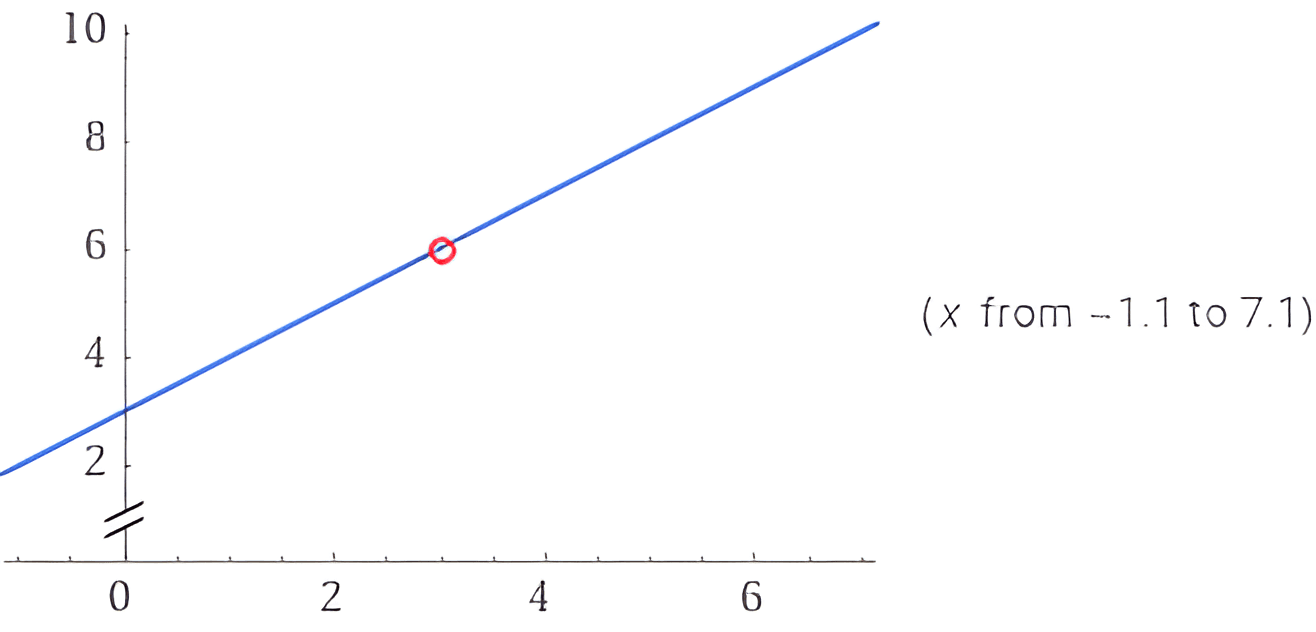
Solution by Steps
step 1
Factor the numerator: x2−9=(x−3)(x+3)
step 2
Simplify the expression: x−3(x−3)(x+3)=x+3
step 3
Evaluate the limit: limx→3(x+3)=6
A
Key Concept
Limit of a Rational Function
Explanation
When the numerator and denominator have a common factor, cancel it out and then evaluate the limit.
step 1
Identify the points where each piece of the function might be discontinuous. For x−2−3, it is discontinuous at x=2
step 2
Check the continuity at x=0. The left-hand limit limx→0−(4−x)=4 and the right-hand limit limx→0+x−2−3=−2−3=23. Since these limits are not equal, the function is discontinuous at x=0
E
Key Concept
Discontinuity in Piecewise Functions
Explanation
Check the points where the function changes definition and where the denominator of any fraction is zero.
step 1
Factor the denominator: x2+5x+6=(x+2)(x+3)
step 2
Identify the points where the denominator is zero: x=−2 and x=−3. These are the points of discontinuity
B
Key Concept
Discontinuity in Rational Functions
Explanation
A rational function is discontinuous where its denominator is zero.
step 1
Simplify the expression: xx2+4x+10=x+x4x+x10=x+4+x10
step 2
Evaluate the limit: As x→∞, x10→0. So, limx→∞(x+4+x10)=∞
B
Key Concept
Limit at Infinity
Explanation
When the highest degree term in the numerator and denominator are the same, the limit is determined by the coefficients of these terms.
step 1
Substitute x=1 into the expression: 1(1+12+10)=1(1+1+10)=1⋅12=12
E
Key Concept
Direct Substitution
Explanation
For polynomial functions, if the function is continuous at the point, simply substitute the value of x.
step 1
Evaluate the limit as x→0 for x2−4: limx→0(x2−4)=−4
step 2
Evaluate the function at x=0: f(0)=02=0
step 3
Since the limit as x→0 does not equal the function value at x=0, the limit does not exist
B
Key Concept
Limit and Function Value
Explanation
For the limit to exist at a point, the limit as x→a must equal the function value at x=a.
step 1
Factor the numerator: 25−x2=(5−x)(5+x)
step 2
Simplify the expression: −5+x(5−x)(5+x)=−(x−5)(5−x)(5+x)=−(5+x)
step 3
Evaluate the limit: limx→5−(5+x)=−10
C
Key Concept
Simplifying Rational Functions
Explanation
Factor and simplify the expression before evaluating the limit.
step 1
As x→∞, 2x→∞. So, 2+2x→∞
step 2
Evaluate the limit: limx→∞2+2x1=0
D
Key Concept
Limit of a Function as x→∞
Explanation
If the denominator grows without bound, the fraction approaches zero.
step 1
Evaluate the left-hand limit as x→1−: limx→1−7x=7
step 2
Evaluate the right-hand limit as x→1+: limx→1+x−13x2−1 is undefined because the denominator is zero
step 3
Since the left-hand limit and right-hand limit are not equal, the limit does not exist
B
Key Concept
One-Sided Limits
Explanation
For the limit to exist at a point, the left-hand limit and right-hand limit must be equal.
these questions is about the limits and continuity,solve these questions one by one and give most correctly answer,showing full steps about how to slove each questions

Generated Graph
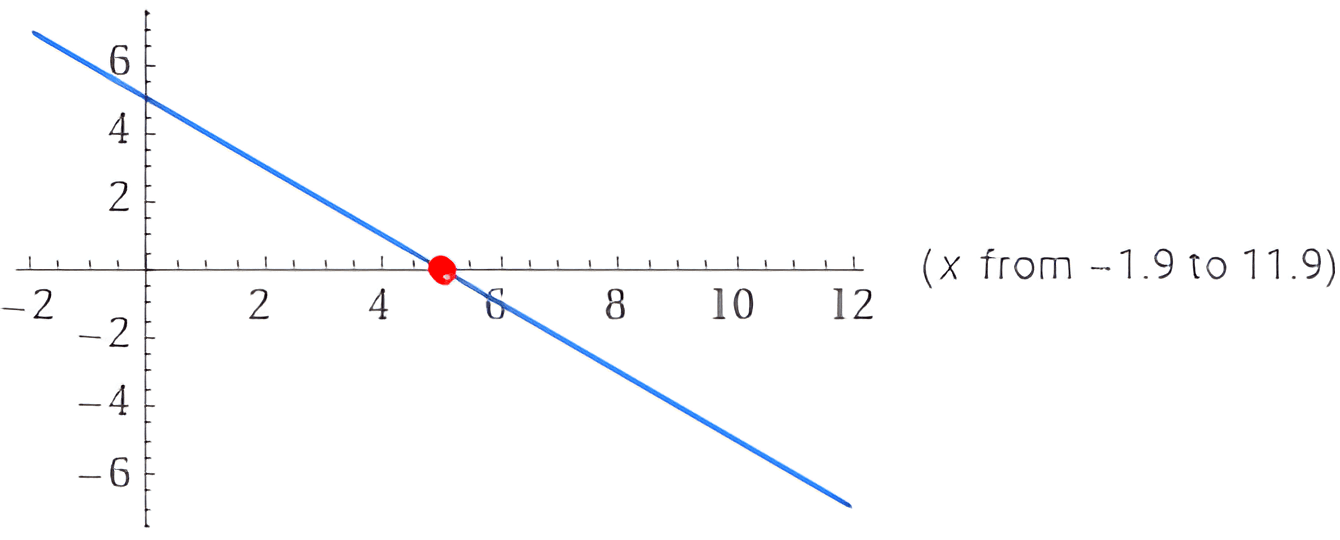
Solution by Steps
step 1
Substitute x=5 into the expression: 5+525−52=1025−25=100=0
C
Key Concept
Limit Evaluation
Explanation
When evaluating limits, substituting the value of x directly into the function can sometimes simplify the expression and provide the limit.
step 1
The function f(x)=x2−5x+3 is a polynomial, and polynomials are continuous everywhere. Therefore, the limit exists at all points
C
Key Concept
Continuity of Polynomials
Explanation
Polynomials are continuous for all real numbers, meaning their limits exist at all points.
step 1
Evaluate the left-hand limit: limx→0−g(x)=limx→0−(−x2−1)=−1
step 2
Evaluate the right-hand limit: limx→0+g(x)=limx→0+(x2−4x+12)=12
step 3
Since the left-hand limit and right-hand limit are not equal, the limit does not exist
False
Key Concept
Limit Existence
Explanation
For a limit to exist at a point, the left-hand limit and right-hand limit must be equal.
step 1
Divide the numerator and the denominator by x3: 4+x3−x25x33−x22−2
step 2
As x→∞, the terms with xn1 approach 0: 4+0−00−0−2=4−2=−21
E
Key Concept
Limits at Infinity
Explanation
When finding limits at infinity, dividing by the highest power of x in the denominator can simplify the expression.
step 1
Evaluate the limit as x→0 from both sides: limx→0(3x2−4x+5)=5
step 2
Evaluate the function at x=0: f(0)=4(0)2+5=5
step 3
Since the limit as x→0 equals the function value at x=0, the function is continuous at x=0
C
Key Concept
Continuity at a Point
Explanation
A function is continuous at a point if the limit as x approaches that point equals the function value at that point.
step 1
Substitute x=−2 into the expression: −2+14(−2)−1=−1−8−1=9=3
A
Key Concept
Limit Evaluation with Square Roots
Explanation
When evaluating limits involving square roots, substituting the value of x directly can simplify the expression.
step 1
Substitute x=0 into the expression: 2e0+e−0=21+1=1
C
Key Concept
Exponential Limits
Explanation
Exponential functions are continuous, and their limits can often be found by direct substitution.
step 1
Evaluate the function at x=4: f(4)=444+3(4)+2=4256+12+2=67.5
step 2
Since the function is a polynomial divided by a constant, it is continuous everywhere
True
Key Concept
Continuity of Rational Functions
Explanation
Rational functions are continuous at all points where the denominator is not zero.
step 1
Evaluate the left-hand limit as x→2: limx→2−(−x2)=−4
step 2
Evaluate the right-hand limit as x→2: limx→2+(x2)=4
step 3
Since the left-hand limit and right-hand limit are not equal, the function is discontinuous at x=2
E
Key Concept
Discontinuity in Piecewise Functions
Explanation
A piecewise function is discontinuous at a point if the left-hand limit and right-hand limit at that point are not equal.
© 2023 AskSia.AI all rights reserved