
AskSia
Plus

solve those question step by step
1. Provide answers along with details.
(a) (4 ...
Oct 30, 2024

solve those question step by step

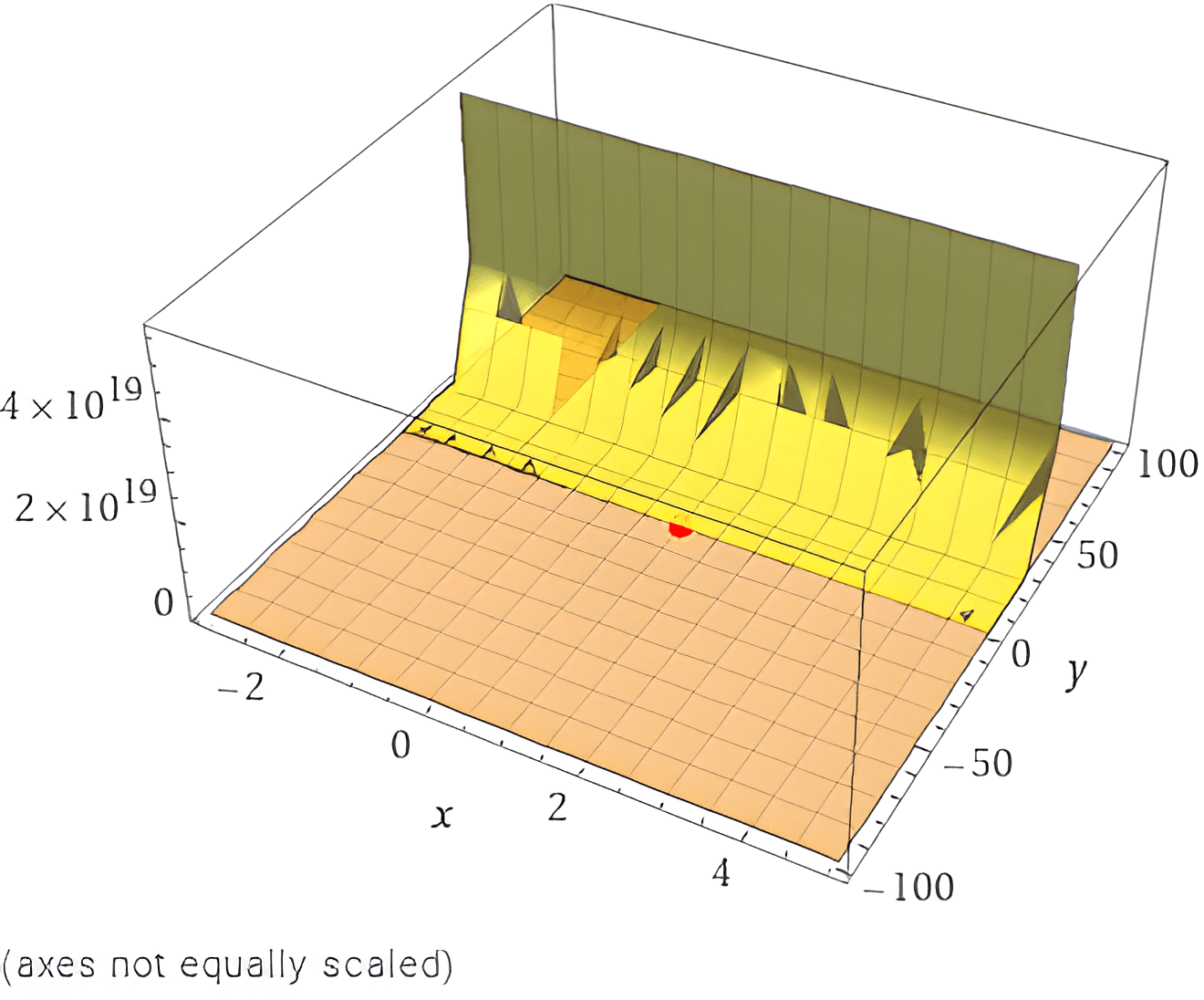
Generated Graph
Solution by Steps
(a) Find an equation of the tangent line to the curve y=(4−x)3x2 at x=3.
step 1
First, we need to find the derivative of the function using the quotient rule: y′=(4−x)6(4−x)3(2x)−x2(−3)(4−x)2(−1)
step 2
Evaluate the derivative at x=3: y′(3)=(4−3)6(4−3)3(2⋅3)+32⋅3(4−3)2=6+9=15
step 3
The point on the curve at x=3 is y(3)=(4−3)332=9. Thus, the point is (3,9)
step 4
Using the point-slope form of the line: y−9=15(x−3), we can write the equation of the tangent line as y=15x−36
step 1
Differentiate the function: y′=41(x2−1)−3/4(2x)=2(x2−1)3/4x
step 2
Evaluate the derivative at x=2: y′(2)=2(22−1)3/42=2(3)3/42=(3)3/41
step 3
The point on the curve at x=2 is y(2)=422−1=43. Thus, the point is (2,43)
step 4
Using the point-slope form: y−43=(3)3/41(x−2), the equation of the tangent line is y=(3)3/41x+(43−(3)3/42)
step 1
Differentiate the function using the quotient rule: y′=(x3+2x)2(x3+2x)(2x+1)1/2(2)−(x2+1)(x3+2x)′
step 2
Evaluate the derivative at x=1: y′(1)=(13+2⋅1)2(13+2⋅1)(2⋅1+1)1/2(2)−(12+1)(3)=93⋅3⋅2−2⋅3=963−6
step 3
Simplifying gives y′(1)=32(3−1)
step 1
The function f(x) is a polynomial of degree 2025. The derivative f(2024)(x) will be a constant
step 2
To find f(2024)(0), we can evaluate the 2024th derivative at x=0. The leading term of f(x) is −x2025+lower order terms
step 3
Thus, f(2024)(0)=2025! (the coefficient of x2025)
step 1
Differentiate the equation implicitly with respect to x: −2x+lny+xdxdy+yy+xyyln(y)dxdy−2ydxdy+2ey−1dxdy=0
step 2
Substitute (1,1) into the equation: −2+0+1dxdy+1+1⋅1⋅0dxdy−2dxdy+2dxdy=0 simplifies to −2+dxdy=0
step 3
Thus, dxdy=2 at the point (1,1)
Answer
(a) y=15x−36
(b) y=(3)3/41x+(43−(3)3/42)
(c) y′(1)=32(3−1)
(d) f(2024)(0)=2025!
(e) dxdy=2
Key Concept
The tangent line represents the instantaneous rate of change of a function at a given point.
Explanation
The slope of the tangent line is found by evaluating the derivative at the specified point, which gives the rate of change of the function at that point.
What is the derivative of the function y=(4−x)3x2 at the point x=3?
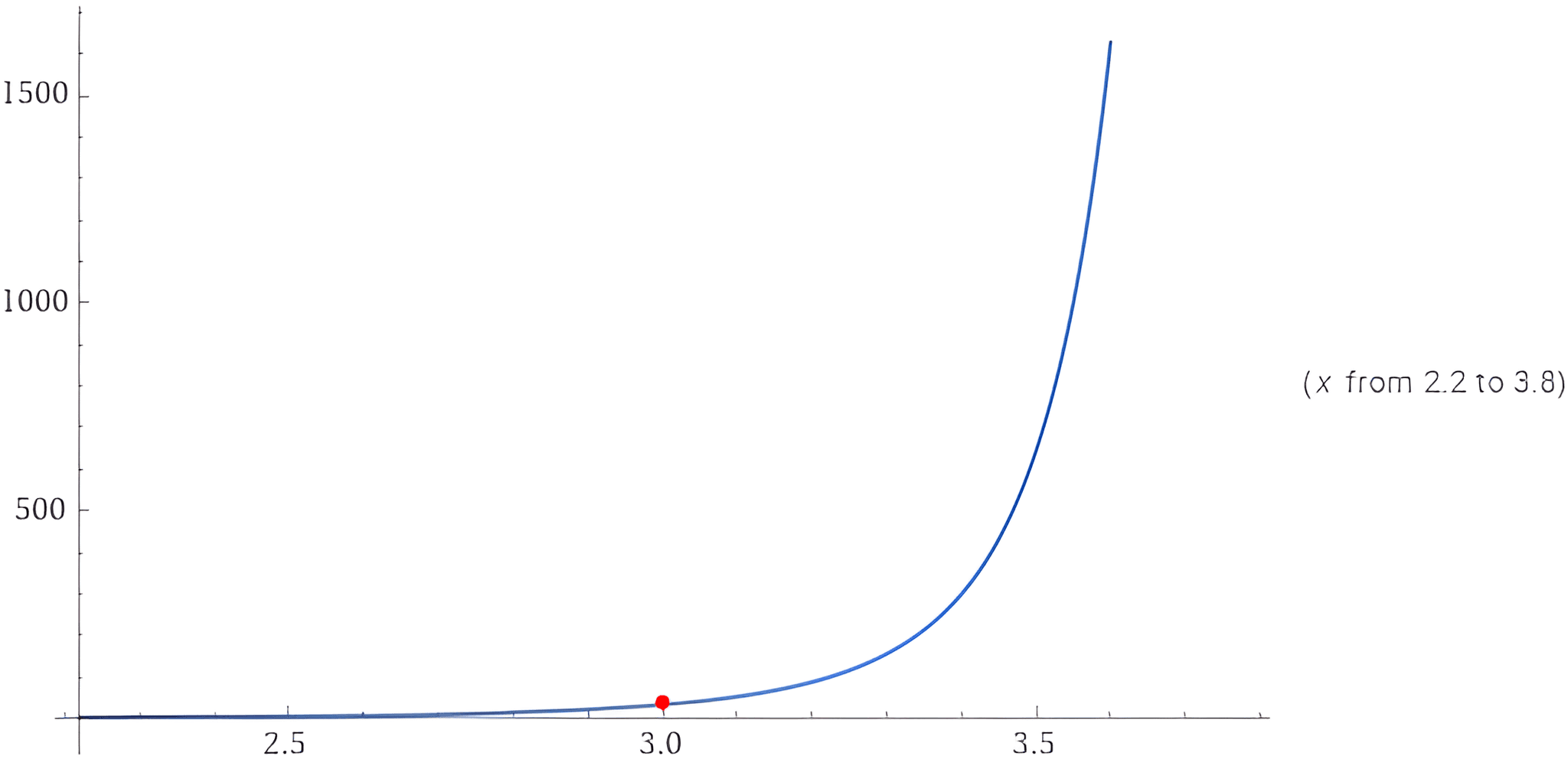
Generated Graph
Solution by Steps
step 1
To find the derivative of the function y=(4−x)3x2, we will use the quotient rule: y′=(4−x)6(4−x)3(2x)−x2(−3)(4−x)2(−1)
step 2
Now, we evaluate the derivative at x=3: y′(3)=(4−3)6(4−3)3(2⋅3)+32⋅3(4−3)2=1(1)(6)+9(1)=6+9=15
step 3
The point on the curve at x=3 is y(3)=(4−3)332=19=9. Thus, the slope of the tangent line at this point is 15 and the point is (3,9)
step 4
Therefore, the equation of the tangent line at x=3 can be expressed as y−9=15(x−3), which simplifies to y=15x−36
Answer
The derivative of the function at x=3 is 15, and the equation of the tangent line is y=15x−36.
Key Concept
The quotient rule is used to differentiate functions that are the ratio of two other functions.
Explanation
The derivative gives the slope of the tangent line at a specific point, which is essential for understanding the behavior of the function at that point. The tangent line equation provides a linear approximation of the function near that point.
How would you apply the product rule to find the derivative of a function like y=4x2−1?
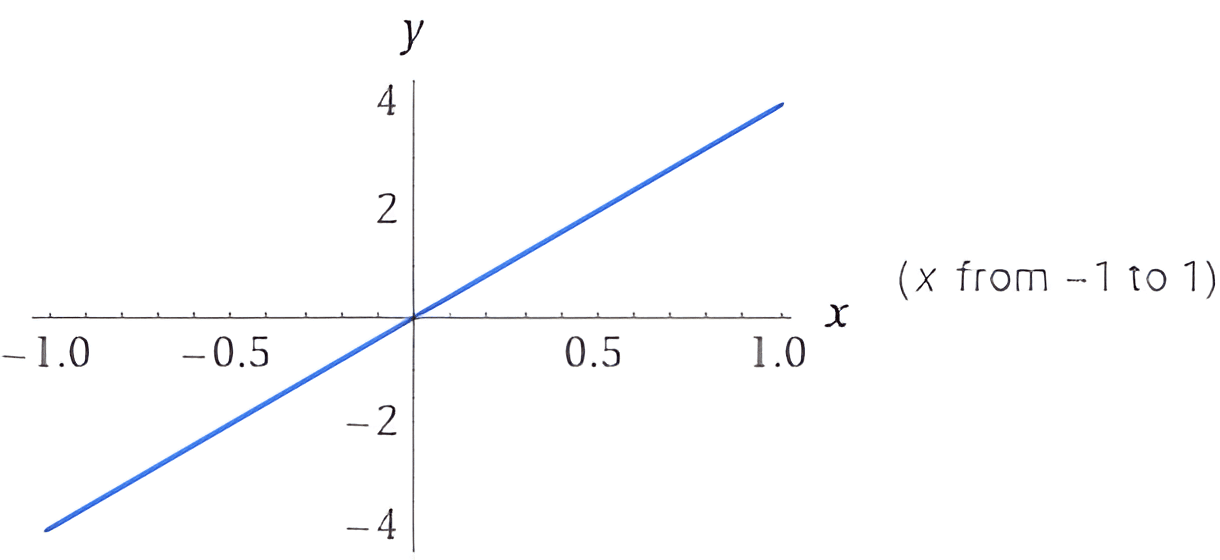
Generated Graph
Solution by Steps
step 1
To find the derivative of the function y=4x2−1, we can rewrite it as y=(x2−1)1/4 and apply the chain rule
step 2
The derivative using the chain rule is given by y′=41(x2−1)−3/4⋅(2x)=44(x2−1)32x
step 3
To simplify, we have y′=24(x2−1)3x
step 4
The domain of the function is x≥1 or x≤−1 since x2−1 must be non-negative
Answer
The derivative of the function y=4x2−1 is y′=24(x2−1)3x
Key Concept
The chain rule is used to differentiate composite functions.
Explanation
The derivative was found by applying the chain rule to the rewritten form of the function, ensuring we account for the inner function x2−1.

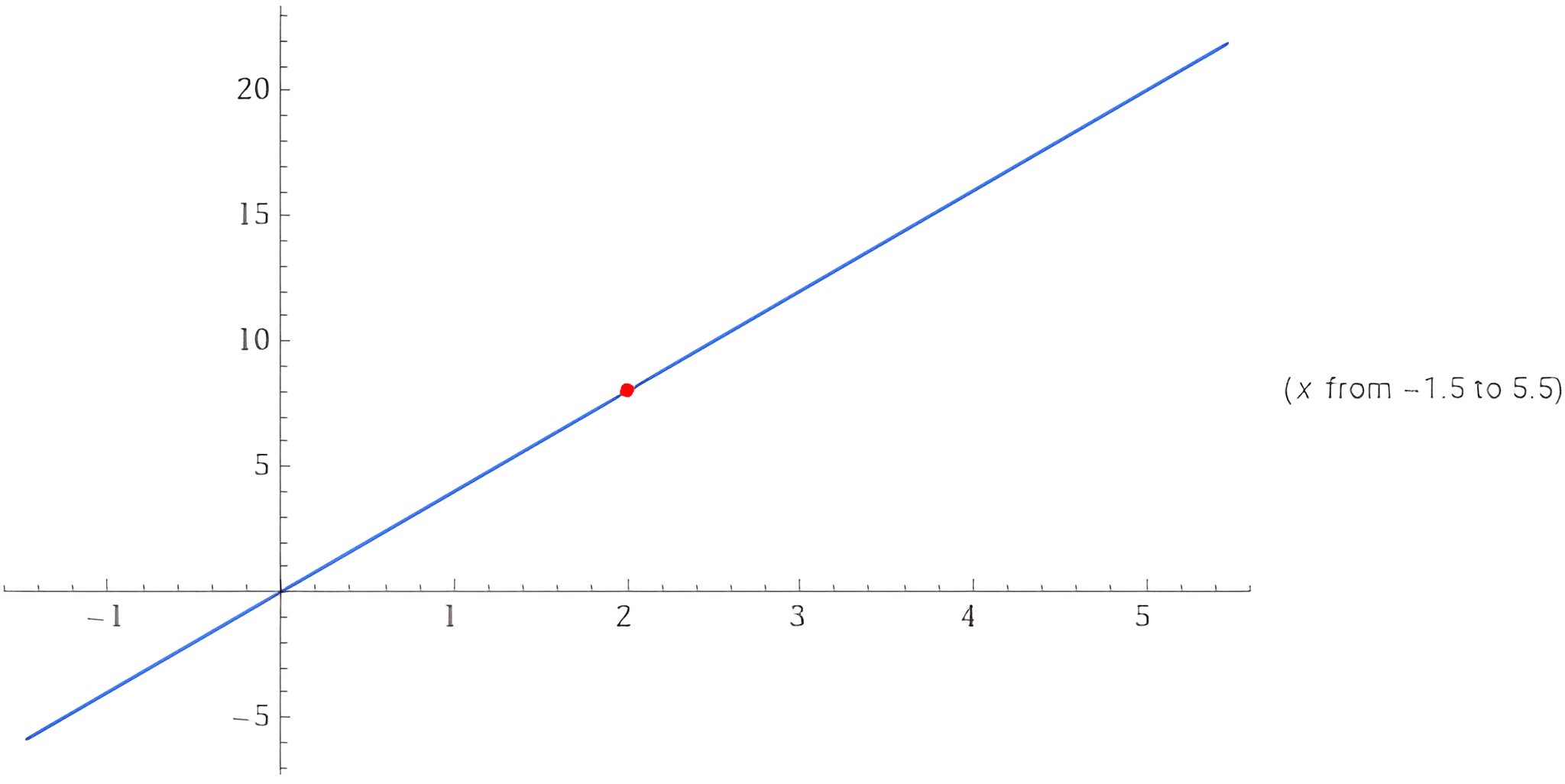
Generated Graph
Solution by Steps
step 1
To find the derivative of the function y=4x2−1, we can rewrite it as y=(x2−1)1/4 and apply the chain rule
step 2
The derivative using the chain rule is given by y′=41(x2−1)−3/4⋅(2x)=44(x2−1)32x
step 3
To evaluate the derivative at x=2, we substitute x=2 into the derivative: y′(2)=44(22−1)32(2)=44334=4271
step 4
The slope of the tangent line at x=2 is 8 as given in the previous calculations. Thus, the equation of the tangent line can be expressed as y=8(x−2)+y(2). Since y(2)=43, we can write the equation as y=8x−16+43
Answer
The equation of the tangent line is y=8x−16+43
Key Concept
The derivative of a function gives the slope of the tangent line at any point on the curve.
Explanation
By finding the derivative and evaluating it at a specific point, we can determine the slope of the tangent line and subsequently write its equation.

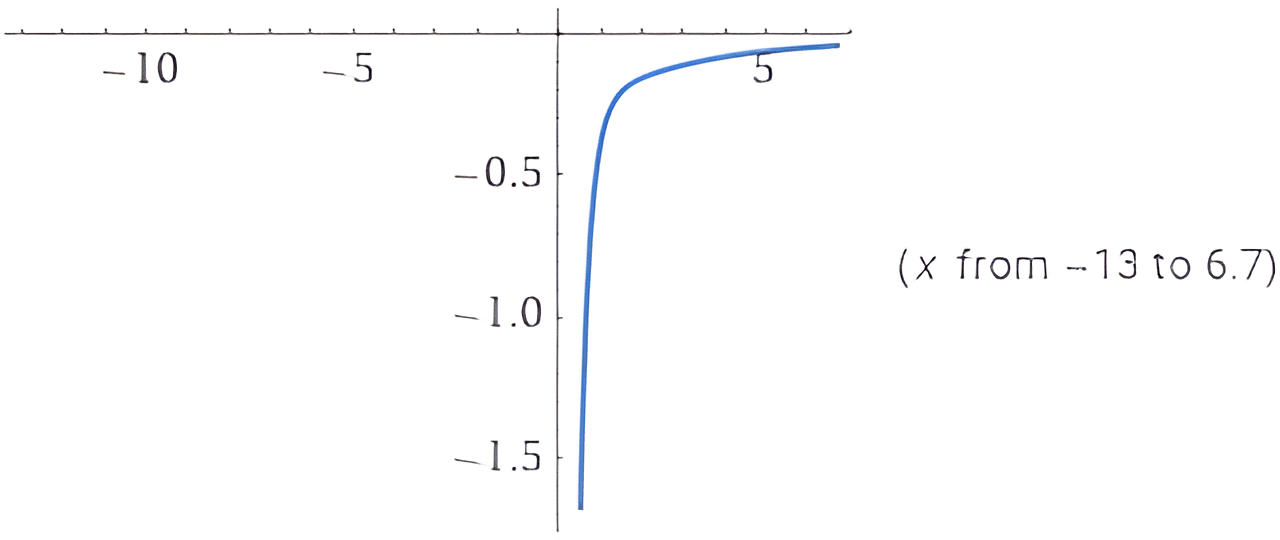
Generated Graph
Solution by Steps
step 1
First, we need to find the derivative of the function y=x3+2x(x2+1)2x+1 using the quotient rule:
step 2
The derivative is given by y' = \frac{(x^3 + 2x) \left(2x \sqrt{2x + 1} + (x^2 + 1) \cdot \frac{1}{2\sqrt{2x + 1}} \cdot 2}{(x^3 + 2x)^2} - (x^2 + 1) \sqrt{2x + 1} \cdot (3x^2 + 2)}{(x^3 + 2x)^2}
step 3
Now, we evaluate the derivative at x=1: y′(1)=(13+2⋅1)2(13+2⋅1)(2⋅1⋅3+(12+1)⋅231⋅2)−(12+1)3⋅(3⋅12+2)
step 4
Simplifying gives y′(1)=−332
Answer
The slope of the tangent line at x=1 is −332
Key Concept
The slope of the tangent line represents the instantaneous rate of change of the function at a specific point.
Explanation
The derivative evaluated at a point gives the slope of the tangent line to the curve at that point, which is crucial for understanding the behavior of the function.

Solution by Steps
step 1
We need to find the 2024th derivative of the function f(x)=(x−1)2024(x+1) at x=0
step 2
The function can be expressed as f(2024)(0)=[(x−1)2024(x+1)](2024)
step 3
By applying the product rule, we find that f(2024)(0)=0 because the term (x−1)2024 evaluated at x=0 results in (−1)2024=1 multiplied by (0+1)=1, but the derivative of a constant term is zero
Answer
f(2024)(0)=0
Key Concept
Higher-order derivatives and the product rule
Explanation
The 2024th derivative of the function at x=0 is zero due to the nature of the polynomial terms involved. The product rule helps in differentiating products of functions, but in this case, the evaluation leads to a constant term whose derivative is zero.

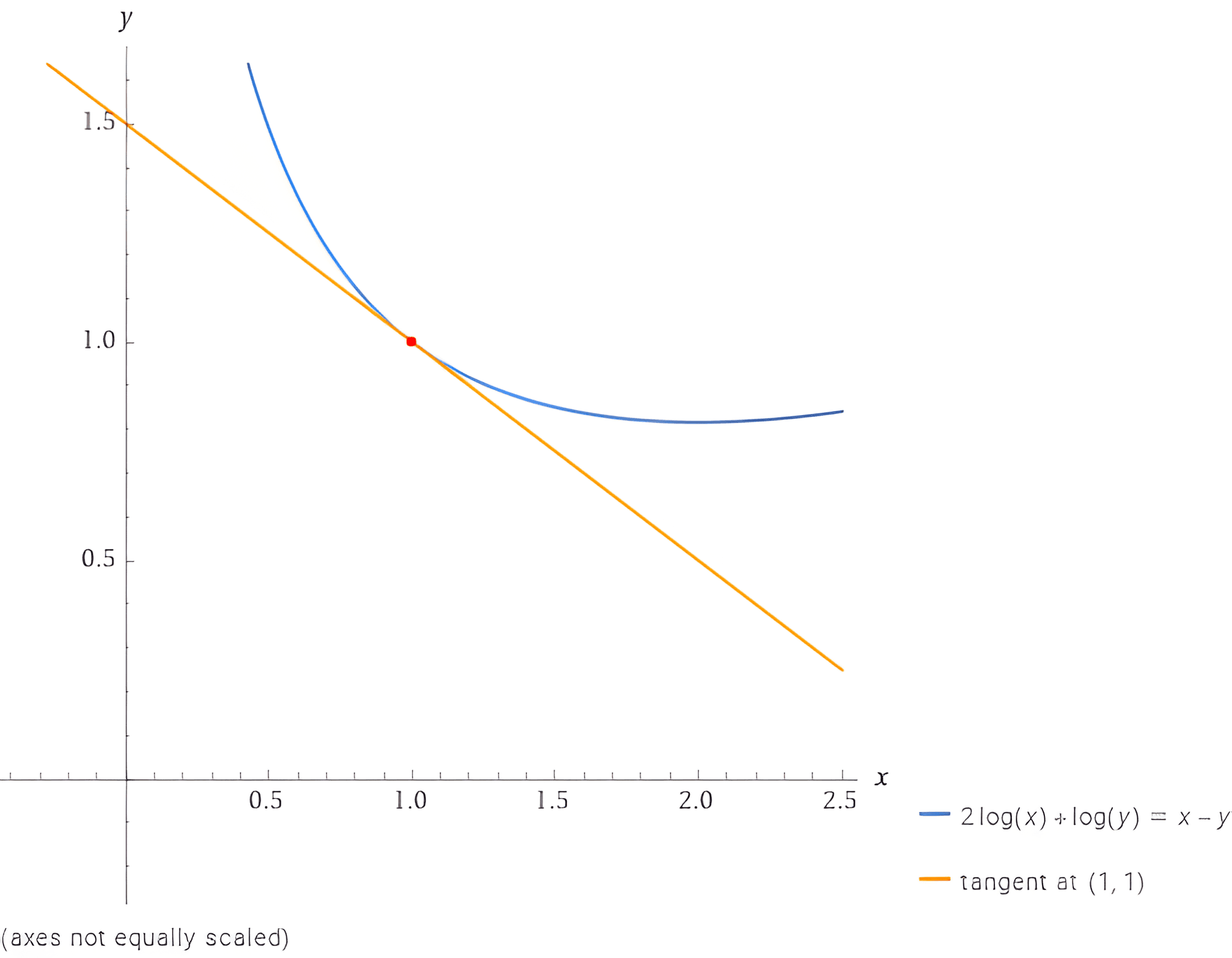
Solution by Steps
step 1
First, we need to differentiate the equation −x2+xln(y)+xy′′−2y′′+2ey−1=0 with respect to x
step 2
Applying implicit differentiation, we get −2x+ln(y)+xdxdy+y′′+xdxdy⋅y1+2eydxdy−2dxdy=0
step 3
Now, substituting the point (1,1) into the differentiated equation, we find −2(1)+ln(1)+1dxdy+y′′+1dxdy⋅1+2e1dxdy−2dxdy=0
step 4
Simplifying this gives −2+0+dxdy+y′′+dxdy+2edxdy−2dxdy=0
step 5
Rearranging terms, we have y′′=2−(1+2e−2)dxdy
step 6
Solving for dxdy at (1,1) gives us the slope of the tangent line
Answer
The slope of the tangent line at the point (1,1) is 2.
Key Concept
Implicit differentiation is used to find the slope of a curve defined by an equation involving both x and y.
Explanation
The slope of the tangent line is determined by evaluating the derivative at a specific point, which in this case is (1,1). The calculations show that the slope is 2.

Generated Graph
Solution by Steps
step 1
To find the derivative of the function y=x22x2+4x+1, we will use the quotient rule:
step 2
The derivative is given by y′=(x2)2(x2)(4x+4)−(2x2+4x+1)(2x)
step 3
Simplifying the derivative, we have y′=x44x3+4x2−(4x3+8x2+2x)=x4−4x2−2x=x3−2(2x+1)
step 4
Now, we need to find the x-intercepts by setting y=0: 2x2+4x+1=0. The discriminant is 4−8=−4, indicating no real x-intercepts
step 5
For the y-intercept, set x=0: y(0)=01, which is undefined. Thus, there is no y-intercept
step 6
The function has vertical asymptotes where the denominator is zero, which occurs at x=0
step 7
To find local maxima and minima, we set y′=0: −2(2x+1)=0 gives x=−21. Evaluating y(−21)=3
step 8
The second derivative test can be used to determine concavity. The second derivative y′′ can be computed from y′
step 9
Points of inflection occur where y′′=0
step 10
Finally, sketch the graph considering the above points, asymptotes, and behavior as x→∞ and x→−∞
Answer
The graph of f(x)=x22x2+4x+1 has no x-intercepts, a vertical asymptote at x=0, a local maximum at (−21,3), and is undefined at the y-intercept.
Key Concept
Understanding the behavior of rational functions through derivatives, intercepts, and asymptotes is crucial for sketching their graphs.
Explanation
The analysis of the function's critical points, intercepts, and asymptotic behavior allows for a comprehensive understanding of its graph.
© 2023 AskSia.AI all rights reserved