
AskSia
Plus

solve these question and give step-by-step
If $\mathrm{A}=\left[\begin{array}{cc...
Jun 14, 2024

solve these question and give step-by-step

Generated Graph
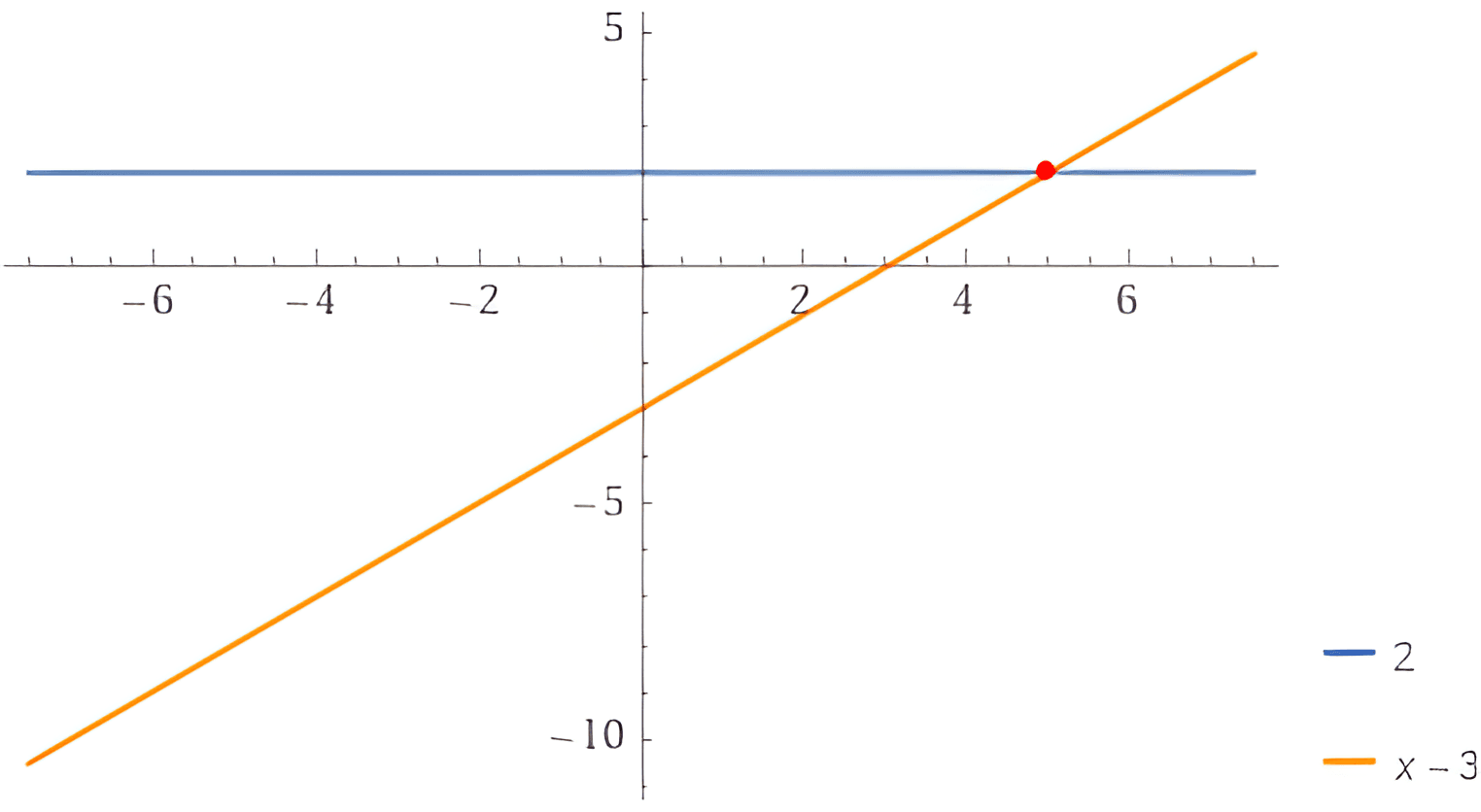
Solution by Steps
step 1
For matrix A to be symmetric, A=AT. This means aij=aji
step 2
Compare the elements: a12=a21 and a13=a31
step 3
From a12=a21: x−3=3. Solve for x: x=6
step 4
From a13=a31: x−2=4. Solve for x: x=6
Answer
x=6
Key Concept
Symmetric Matrix
Explanation
A symmetric matrix is equal to its transpose, meaning aij=aji.
step 1
The determinant of a 2x2 matrix [acamp;bamp;d] is given by ad−bc
step 2
Substitute the values: 17⋅(−3)−(−11)⋅6
step 3
Calculate: −51+66=15
Answer
15
Key Concept
Determinant of a 2x2 Matrix
Explanation
The determinant of a 2x2 matrix is calculated as ad−bc.
step 1
The order of A⊤ is 3×4
step 2
The order of A⊤B is 3×5
step 3
The order of (A⊤B)⊤ is 5×3
step 4
The order of (A⊤B)⊤C⊤ is 5×7
Answer
5×7
Key Concept
Order of Matrix Product
Explanation
The order of the product of matrices depends on the dimensions of the matrices involved.
step 1
Calculate AB: [−86amp;2amp;−3][21amp;1amp;7]=[−149amp;6amp;−21]
step 2
Find the determinant of AB: (−14)(−21)−(6)(9)=294−54=240
step 3
The inverse of a 2x2 matrix [acamp;bamp;d] is ad−bc1[d−camp;−bamp;a]
step 4
Apply the formula: (AB)−1=2401[−21−9amp;−6amp;−14]=[−24021−2409amp;−2406amp;−24014]
Answer
[−24021−2409amp;−2406amp;−24014]
Key Concept
Inverse of a Matrix Product
Explanation
The inverse of a product of matrices can be found by first calculating the product and then finding the inverse of the resulting matrix.
step 1
Multiply matrix B by 3: 3B=−33−9amp;−12amp;−6amp;9amp;9amp;−6amp;−15
step 2
Add matrix A and 3B: X=A+3B=1−10amp;5amp;2amp;−3amp;−1amp;2amp;3+−33−9amp;−12amp;−6amp;9amp;9amp;−6amp;−15
step 3
Perform the addition: X=−22−9amp;−7amp;−4amp;6amp;8amp;−4amp;−12
Answer
−22−9amp;−7amp;−4amp;6amp;8amp;−4amp;−12
Key Concept
Matrix Addition
Explanation
To solve a matrix equation involving addition, multiply the matrices as required and then add the corresponding elements.
solve these question and give step-by-step
Solution by Steps
step 1
Write the system of equations in matrix form:
121amp;2amp;3amp;3amp;−1amp;1amp;−2xyz=121
step 2
Use Gaussian elimination to solve the system. First, subtract the first row from the second row:
101amp;2amp;−1amp;3amp;−1amp;3amp;−2amp;∣amp;∣amp;∣amp;1amp;1amp;1
step 3
Subtract the first row from the third row:
100amp;2amp;−1amp;1amp;−1amp;3amp;−1amp;∣amp;∣amp;∣amp;1amp;1amp;0
step 4
Add the second row to the third row:
100amp;2amp;−1amp;0amp;−1amp;3amp;2amp;∣amp;∣amp;∣amp;1amp;1amp;1
step 5
Solve for z:
2z=1⟹z=21
step 6
Substitute z back into the second row to solve for y:
−y+3(21)=1⟹−y+23=1⟹y=21
step 7
Substitute y and z back into the first row to solve for x:
x+2(21)−(21)=1⟹x+1−21=1⟹x=21
Answer
x=21,y=21,z=21
Key Concept
Solving a system of linear equations using Gaussian elimination
Explanation
Gaussian elimination is a method for solving a system of linear equations. It involves performing row operations to transform the system's augmented matrix into row-echelon form, from which the solutions can be easily obtained.
step 1
Compute AT:
AT=(3−1amp;0amp;2)
step 2
Compute ATA:
ATA=(3−1amp;0amp;2)(30amp;−1amp;2)=(9−3amp;−3amp;5)
step 3
Compute 2A:
2A=2(30amp;−1amp;2)=(60amp;−2amp;4)
step 4
Compute X:
X=ATA−2A=(9−3amp;−3amp;5)−(60amp;−2amp;4)=(3−3amp;−1amp;1)
Answer
X=(3−3amp;−1amp;1)
Key Concept
Matrix multiplication and subtraction
Explanation
To solve for X, we need to compute the transpose of A, multiply it by A, and then subtract twice the original matrix A.
step 1
Compute the order of AT:
AT is 3×4
step 2
Compute the order of ATB:
ATB is 3×4 and 4×5⟹3×5
step 3
Compute the order of (ATB)T:
(ATB)T is 5×3
step 4
Compute the order of (ATB)TCT:
(ATB)TCT is 5×3 and 3×7⟹5×7
Answer
The order of (ATB)TCT is 5×7
Key Concept
Matrix multiplication and transposition
Explanation
The order of the resulting matrix from the product of two matrices depends on the dimensions of the matrices being multiplied. The transpose operation swaps the dimensions.
step 1
Compute the determinant of A:
det(A)=8⋅1−5⋅4=8−20=−12
step 2
Compute the adjugate of A:
adj(A)=(1−4amp;−5amp;8)
step 3
Compute the inverse of A:
A−1=det(A)1adj(A)=−121(1−4amp;−5amp;8)=(−12131amp;125amp;−32)
Answer
A−1=(−12131amp;125amp;−32)
Key Concept
Matrix inverse calculation
Explanation
To find the inverse of a matrix, we need to compute its determinant and adjugate, and then divide the adjugate by the determinant.
step 1
Use the cofactor expansion along the first row:
det(A)=15−7−5amp;5amp;15−4−120amp;5amp;15+8−120amp;−7amp;−5
step 2
Compute the 2x2 determinants:
−7−5amp;5amp;15=(−7)(15)−(5)(−5)=−105+25=−80
−120amp;5amp;15=(−12)(15)−(5)(0)=−180
−120amp;−7amp;−5=(−12)(−5)−(−7)(0)=60
step 3
Substitute back into the cofactor expansion:
det(A)=15(−80)−4(−180)+8(60)=−1200+720+480=0
Answer
The determinant of A is 0
Key Concept
Determinant calculation using cofactor expansion
Explanation
The determinant of a matrix can be calculated using cofactor expansion along any row or column. The result is the sum of the products of the elements and their corresponding cofactors.
step 1
Compute AB:
AB=(30amp;0amp;2amp;−1amp;1)110amp;2amp;0amp;6=(32amp;6amp;6)
step 2
Compute AB+C:
AB+C=(32amp;6amp;6)+(−2−2amp;0amp;−5)=(10amp;6amp;1)
step 3
Compute 2(AB+C):
X=2(10amp;6amp;1)=(20amp;12amp;2)
Answer
X=(20amp;12amp;2)
Key Concept
Matrix addition and scalar multiplication
Explanation
To solve for X, we first compute the product AB, then add matrix C to the result, and finally multiply the resulting matrix by 2.
solve all questions and give step-by-step
Solution by Steps
step 1
To find the rank of the matrix, we need to reduce it to its row echelon form
step 2
Perform row operations to simplify the matrix:
347amp;2amp;2amp;4amp;−1amp;6amp;5
Subtract 34 times the first row from the second row:
307amp;2amp;−32amp;4amp;−1amp;314amp;5
Subtract 37 times the first row from the third row:
300amp;2amp;−32amp;−32amp;−1amp;314amp;316
Subtract the second row from the third row:
300amp;2amp;−32amp;0amp;−1amp;314amp;32
step 3
The matrix is now in row echelon form. The number of non-zero rows is 3, so the rank of the matrix is 3
Answer
The rank of the matrix is 3.
Key Concept
Rank of a matrix
Explanation
The rank of a matrix is the maximum number of linearly independent row vectors in the matrix.
step 1
Use the property that A⋅A−1=I, where I is the identity matrix
step 2
Multiply A and A−1:
[x4amp;2amp;3]⋅[816−1amp;12−1amp;94]=[10amp;0amp;1]
step 3
Perform the matrix multiplication:
[8x−6284−63amp;12−x+98amp;12−4+912]=[10amp;0amp;1]
step 4
Simplify the equations:
8x−31=1⇒x=8(1+31)=8⋅34=332
Answer
The value of x is 332.
Key Concept
Matrix inverse property
Explanation
The product of a matrix and its inverse is the identity matrix.
step 1
To find the rank of the matrix, we need to reduce it to its row echelon form
step 2
Perform row operations to simplify the matrix:
[2−6amp;−3amp;−9]
Divide the first row by 2:
[1−6amp;−23amp;−9]
Add 6 times the first row to the second row:
[10amp;−23amp;0]
step 3
The matrix is now in row echelon form. The number of non-zero rows is 1, so the rank of the matrix is 1
Answer
The rank of the matrix is 1.
Key Concept
Rank of a matrix
Explanation
The rank of a matrix is the maximum number of linearly independent row vectors in the matrix.
step 1
Calculate A2:
A2=[01amp;1amp;0]⋅[01amp;1amp;0]=[10amp;0amp;1]
step 2
Calculate A4:
A4=(A2)2=[10amp;0amp;1]⋅[10amp;0amp;1]=[10amp;0amp;1]
Answer
The value of A4 is [10amp;0amp;1].
Key Concept
Matrix exponentiation
Explanation
When a matrix is raised to a power, it is multiplied by itself that many times.
step 1
Calculate the determinant:
(x−1)(x+2)−(4⋅1)=0
step 2
Simplify the equation:
x2+2x−x−2−4=0⇒x2+x−6=0
step 3
Solve the quadratic equation:
x2+x−6=0⇒(x+3)(x−2)=0
step 4
Find the values of x:
x=−3orx=2
Answer
The values of x are −3 and 2.
Key Concept
Determinant of a matrix
Explanation
The determinant of a 2x2 matrix is calculated as ad−bc.
solve these questions and giving steps
Solution by Steps
step 1
Calculate the product AB:
\[ AB = \begin{pmatrix} 3 & 0 & -1 \\ 0 & 2 & 1 \end{pmatrix} \begin{pmatrix} 1 & 2 \\ 1 & 0 \\ 0 & 6 \end{pmatrix} = \begin{pmatrix} 3 \cdot 1 + 0 \cdot 1 + (-1) \cdot 0 & 3 \cdot 2 + 0 \cdot 0 + (-1) \cdot 6 \\ 0 \cdot 1 + 2 \cdot 1 + 1 \cdot 0 & 0 \cdot 2 + 2 \cdot 0 + 1 \cdot 6 \end{pmatrix} = \begin{pmatrix} 3 & 0 \\ 2 & 6 \end{pmatrix}
step 2
Add matrices AB and C:
\[ AB + C = \begin{pmatrix} 3 & 0 \\ 2 & 6 \end{pmatrix} + \begin{pmatrix} -2 & 0 \\ -2 & -5 \end{pmatrix} = \begin{pmatrix} 1 & 0 \\ 0 & 1 \end{pmatrix}
step 3
Multiply the result by 2:
\[ X = 2 \begin{pmatrix} 1 & 0 \\ 0 & 1 \end{pmatrix} = \begin{pmatrix} 2 & 0 \\ 0 & 2 \end{pmatrix}
Answer
X=(20amp;0amp;2)
Key Concept
Matrix Multiplication and Addition
Explanation
To solve for X, we first multiply matrices A and B, then add matrix C, and finally multiply the result by 2.
step 1
Use the property of inverse matrices:
A⋅A−1=I
\[ \begin{pmatrix} x & 2 \\ 4 & 3 \end{pmatrix} \begin{pmatrix} \frac{1}{8} & \frac{-1}{12} \\ \frac{-1}{6} & \frac{4}{9} \end{pmatrix} = \begin{pmatrix} 1 & 0 \\ 0 & 1 \end{pmatrix}
step 2
Set up the equation for the (1,1) element:
x⋅81+2⋅6−1=1
8x−31=1
8x=1+31=34
\[ x = \frac{4}{3} \cdot 8 = \frac{32}{3}
Answer
x=332
Key Concept
Inverse Matrix Property
Explanation
To find x, we use the property that the product of a matrix and its inverse is the identity matrix. We solve for x by equating the (1,1) element of the product to 1.
step 1
Calculate A2:
\[ A^2 = \begin{pmatrix} 0 & 1 \\ 1 & 0 \end{pmatrix} \begin{pmatrix} 0 & 1 \\ 1 & 0 \end{pmatrix} = \begin{pmatrix} 1 & 0 \\ 0 & 1 \end{pmatrix} = I
step 2
Calculate A4:
A4=(A2)2=I2=I
\[ A^4 = \begin{pmatrix} 1 & 0 \\ 0 & 1 \end{pmatrix}
Answer
A4=(10amp;0amp;1)
Key Concept
Matrix Exponentiation
Explanation
To find A4, we first calculate A2 and then square the result. Since A2 is the identity matrix, A4 is also the identity matrix.
solve these questions and giving steps
Solution by Steps
step 1
Given that A is a symmetric matrix, we know that AT=A
[question 1] Answer
C
Key Concept
Symmetric Matrix
Explanation
A symmetric matrix is equal to its transpose.
step 1
Calculate the product AB:
A=(−86amp;2amp;−3),B=(21amp;1amp;7)
step 2
Perform matrix multiplication:
AB=(−8⋅2+2⋅16⋅2+(−3)⋅1amp;−8⋅1+2⋅7amp;6⋅1+(−3)⋅7)=(−16+212−3amp;−8+14amp;6−21)=(−149amp;6amp;−15)
step 3
Find the transpose of the product:
(AB)T=(−146amp;9amp;−15)
[question 2] Answer
D
Key Concept
Matrix Multiplication and Transpose
Explanation
The transpose of a product of matrices is the product of their transposes in reverse order.
step 1
Identify the incorrect condition for matrix multiplication:
A(BC)=(AB)C(True)
AB=BA(False, in general)
AB=0if either A or B is 0 (True)
A(B+C)=AB+AC(True)
[question 3] Answer
B
Key Concept
Matrix Multiplication Properties
Explanation
Matrix multiplication is not commutative, meaning AB=BA in general.
step 1
The formula for the cofactor of an element aij is:
Aij=(−1)i+jMij
[question 4] Answer
A
Key Concept
Cofactor Formula
Explanation
The cofactor of an element in a matrix is given by (−1)i+j times the minor of that element.
step 1
Set up the system of equations based on the given information:
8x+3y=70
10x+6y=90
step 2
Solve the system of equations:
Multiply the first equation by 2:
16x+6y=140
Subtract the second equation from this result:
(16x+6y)−(10x+6y)=140−90
6x=50
x=650=325
step 3
Substitute x back into the first equation:
8(325)+3y=70
3200+3y=70
3y=70−3200
3y=3210−200
3y=310
y=910
[question 5] Answer
None of the given options are correct based on the calculations.
Key Concept
System of Linear Equations
Explanation
Solving a system of linear equations involves finding the values of variables that satisfy all equations simultaneously.
© 2023 AskSia.AI all rights reserved