
AskSia
Plus

solve 14,15
14 A confidence interval is used to estimate the population mean $\m...
May 30, 2024

solve 14,15

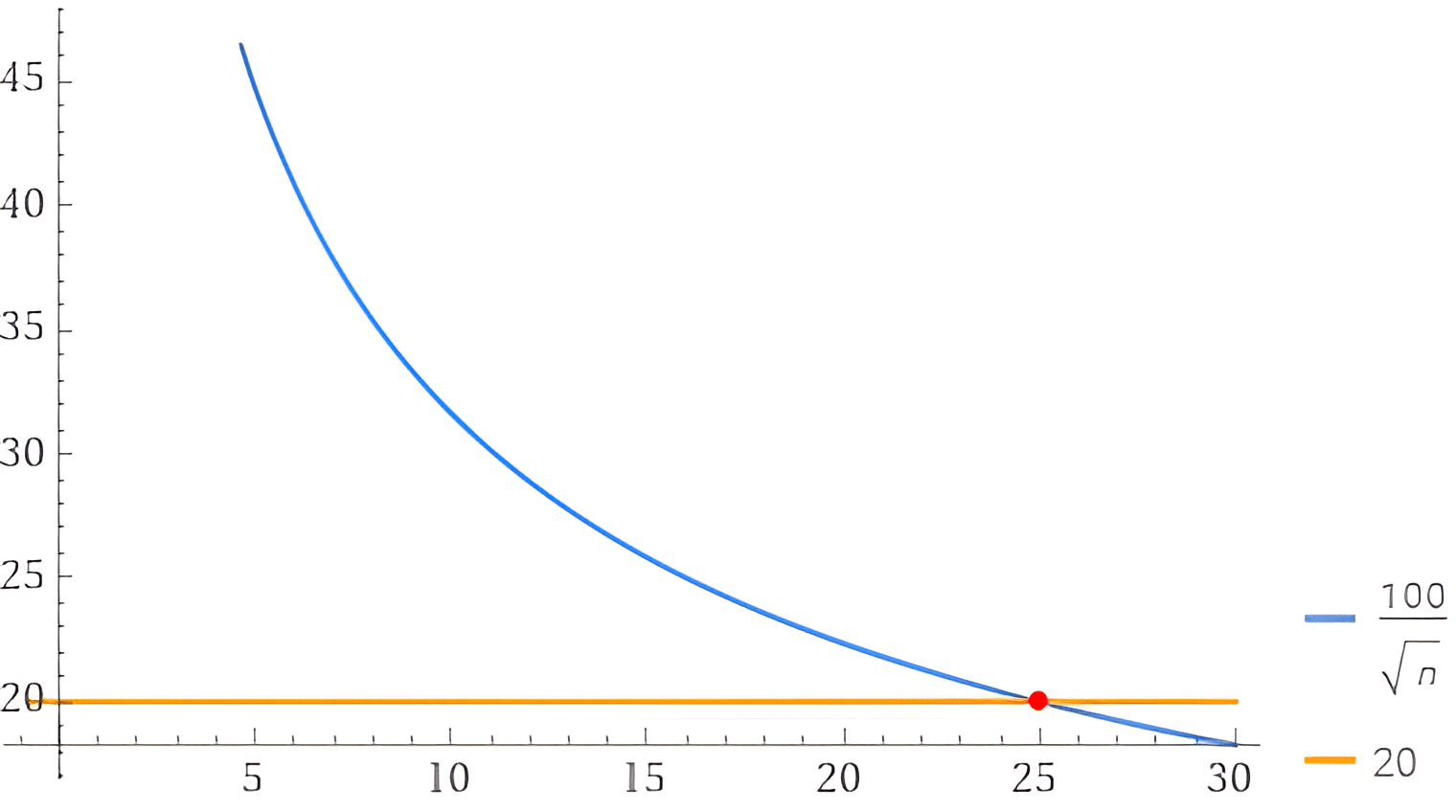
Generated Graph
Solution by Steps
step 1
The width of the confidence interval is inversely proportional to the square root of the sample size, n
step 2
To decrease the width by 50%, we need to increase the sample size by a factor of 4. This is because (41=21)
step 1
To decrease the width of the confidence interval by 20%, we need to find the factor by which the sample size should be increased
step 2
Let the factor be k. Then, k1=0.8
step 3
Solving for k, we get k=(0.81)2=1.5625
step 4
The percentage increase in the sample size is (1.5625−1)×100%=56.25%
step 1
If the sample size is increased by a factor of 9, the width of the confidence interval will decrease by a factor of 9=3
step 1
If the sample size is decreased by a factor of 16, the width of the confidence interval will increase by a factor of 16=4
Answer
(a) Factor of 4, (b) 56.25% increase, (c) Decrease by a factor of 3, (d) Increase by a factor of 4
Key Concept
Sample size and confidence interval width relationship
Explanation
The width of the confidence interval is inversely proportional to the square root of the sample size.
step 1
The formula for the margin of error (E) in a confidence interval is E=z⋅nσ, where z is the z-score, σ is the population standard deviation, and n is the sample size
step 2
For a 95% confidence level, the z-score is approximately 1.96
step 3
We need the margin of error to be 20, so 20=1.96⋅n100
step 4
Solving for n, we get n=(201.96⋅100)2=96.04
step 5
Since the sample size must be an integer, we round up to the nearest whole number, so n=97
Answer
97
Key Concept
Margin of error in confidence intervals
Explanation
The margin of error depends on the z-score, population standard deviation, and sample size.

Solution by Steps
step 1
We need to determine the sample size n required to estimate the mean weight μ with a 95% confidence level and a margin of error of 0.5 grams. The formula for the sample size is given by n=(EZ⋅σ)2, where Z is the z-score corresponding to the confidence level, σ is the standard deviation, and E is the margin of error
step 2
For a 95% confidence level, the z-score Z is 1.96. Given σ=2.0 grams and E=0.5 grams, we substitute these values into the formula: n=(0.51.96⋅2.0)2
step 3
Simplifying the expression: n=(0.53.92)2=(7.84)2=61.47
step 4
Since the sample size must be a whole number, we round up to the nearest whole number: n=62
Answer
62
Key Concept
Sample size determination for confidence intervals
Explanation
The sample size is calculated using the formula n=(EZ⋅σ)2, where Z is the z-score for the desired confidence level, σ is the standard deviation, and E is the margin of error.
step 1
We need to determine the sample size n required to estimate the mean number of customers per day with a 99% confidence level and a margin of error of 10. The formula for the sample size is n=(EZ⋅σ)2
step 2
For a 99% confidence level, the z-score Z is 2.576. Given σ=50 and E=10, we substitute these values into the formula: n=(102.576⋅50)2
step 3
Simplifying the expression: n=(10128.8)2=(12.88)2=165.89
step 4
Since the sample size must be a whole number, we round up to the nearest whole number: n=166
Answer
166
Key Concept
Sample size determination for confidence intervals
Explanation
The sample size is calculated using the formula n=(EZ⋅σ)2, where Z is the z-score for the desired confidence level, σ is the standard deviation, and E is the margin of error.
step 1
We need to determine the sample size n required to estimate the mean lifetime of light bulbs with a 90% confidence level and a margin of error of 20 hours. The formula for the sample size is n=(EZ⋅σ)2
step 2
For a 90% confidence level, the z-score Z is 1.645. Given σ=150 hours and E=20 hours, we substitute these values into the formula: n=(201.645⋅150)2
step 3
Simplifying the expression: n=(20246.75)2=(12.3375)2=152.19
step 4
Since the sample size must be a whole number, we round up to the nearest whole number: n=153
Answer
153
Key Concept
Sample size determination for confidence intervals
Explanation
The sample size is calculated using the formula n=(EZ⋅σ)2, where Z is the z-score for the desired confidence level, σ is the standard deviation, and E is the margin of error.
step 1
We need to determine the sample size n required to estimate the mean IQ score with a 95% confidence level and a margin of error of 2 points. The formula for the sample size is n=(EZ⋅σ)2
step 2
For a 95% confidence level, the z-score Z is 1.96. Given σ=15 and E=2, we substitute these values into the formula: n=(21.96⋅15)2
step 3
Simplifying the expression: n=(229.4)2=(14.7)2=216.09
step 4
Since the sample size must be a whole number, we round up to the nearest whole number: n=217
Answer
217
Key Concept
Sample size determination for confidence intervals
Explanation
The sample size is calculated using the formula n=(EZ⋅σ)2, where Z is the z-score for the desired confidence level, σ is the standard deviation, and E is the margin of error.
step 1
We need to determine the sample size n required to estimate the mean IQ score with a 99% confidence level and a margin of error of 2 points. The formula for the sample size is n=(EZ⋅σ)2
step 2
For a 99% confidence level, the z-score Z is 2.576. Given σ=15 and E=2, we substitute these values into the formula: n=(22.576⋅15)2
step 3
Simplifying the expression: n=(238.64)2=(19.32)2=373.22
step 4
Since the sample size must be a whole number, we round up to the nearest whole number: n=374
Answer
374
Key Concept
Sample size determination for confidence intervals
Explanation
The sample size is calculated using the formula n=(EZ⋅σ)2, where Z is the z-score for the desired confidence level, σ is the standard deviation, and E is the margin of error.
solve 16,17,18,19
Solution by Steps
step 1
Identify the given values: σ=2.0 grams, confidence level = 95%, margin of error E=0.5 grams
step 2
For a 95% confidence level, the critical value z is approximately 1.96
step 3
Use the formula for sample size: n=(Ez⋅σ)2
step 4
Substitute the values into the formula: n=(0.51.96⋅2.0)2
step 5
Calculate the sample size: n=(0.53.92)2=(7.84)2=61.47
step 6
Round up to the nearest whole number: n=62
Answer
62
Key Concept
Sample size calculation for estimating a population mean
Explanation
The sample size is determined using the formula n=(Ez⋅σ)2, where z is the critical value, σ is the standard deviation, and E is the margin of error.
step 1
Identify the given values: σ=50, confidence level = 99%, margin of error E=10
step 2
For a 99% confidence level, the critical value z is approximately 2.576
step 3
Use the formula for sample size: n=(Ez⋅σ)2
step 4
Substitute the values into the formula: n=(102.576⋅50)2
step 5
Calculate the sample size: n=(10128.8)2=(12.88)2=165.89
step 6
Round up to the nearest whole number: n=166
Answer
166
Key Concept
Sample size calculation for estimating a population mean
Explanation
The sample size is determined using the formula n=(Ez⋅σ)2, where z is the critical value, σ is the standard deviation, and E is the margin of error.
step 1
Identify the given values: σ=150 hours, confidence level = 90%, margin of error E=20 hours
step 2
For a 90% confidence level, the critical value z is approximately 1.645
step 3
Use the formula for sample size: n=(Ez⋅σ)2
step 4
Substitute the values into the formula: n=(201.645⋅150)2
step 5
Calculate the sample size: n=(20246.75)2=(12.3375)2=152.19
step 6
Round up to the nearest whole number: n=153
Answer
153
Key Concept
Sample size calculation for estimating a population mean
Explanation
The sample size is determined using the formula n=(Ez⋅σ)2, where z is the critical value, σ is the standard deviation, and E is the margin of error.
step 1
Identify the given values: σ=15, confidence level = 95%, margin of error E=2
step 2
For a 95% confidence level, the critical value z is approximately 1.96
step 3
Use the formula for sample size: n=(Ez⋅σ)2
step 4
Substitute the values into the formula: n=(21.96⋅15)2
step 5
Calculate the sample size: n=(229.4)2=(14.7)2=216.09
step 6
Round up to the nearest whole number: n=217
Answer
217
Key Concept
Sample size calculation for estimating a population mean
Explanation
The sample size is determined using the formula n=(Ez⋅σ)2, where z is the critical value, σ is the standard deviation, and E is the margin of error.
step 1
Identify the given values: σ=15, confidence level = 99%, margin of error E=2
step 2
For a 99% confidence level, the critical value z is approximately 2.576
step 3
Use the formula for sample size: n=(Ez⋅σ)2
step 4
Substitute the values into the formula: n=(22.576⋅15)2
step 5
Calculate the sample size: n=(238.64)2=(19.32)2=373.22
step 6
Round up to the nearest whole number: n=374
Answer
374
Key Concept
Sample size calculation for estimating a population mean
Explanation
The sample size is determined using the formula n=(Ez⋅σ)2, where z is the critical value, σ is the standard deviation, and E is the margin of error.
solve 19ab
Solution by Steps
step 1
To determine the sample size required for a 95% confidence level with a margin of error of 2 points, we use the formula for sample size in estimating a population mean: n=(EZ⋅σ)2
step 2
For a 95% confidence level, the Z-score (Z) is 1.96. The standard deviation (σ) is 15, and the margin of error (E) is 2
step 3
Plugging in the values: n=(21.96⋅15)2
step 4
Simplifying inside the parentheses: n=(229.4)2=(14.7)2
step 5
Calculating the square: n=216.09
step 6
Since the sample size must be a whole number, we round up to the nearest whole number: n=217
step 1
To determine the sample size required for a 99% confidence level with a margin of error of 2 points, we use the same formula: n=(EZ⋅σ)2
step 2
For a 99% confidence level, the Z-score (Z) is 2.576. The standard deviation (σ) is 15, and the margin of error (E) is 2
step 3
Plugging in the values: n=(22.576⋅15)2
step 4
Simplifying inside the parentheses: n=(238.64)2=(19.32)2
step 5
Calculating the square: n=373.22
step 6
Since the sample size must be a whole number, we round up to the nearest whole number: n=374
Answer
Part (a): 217
Part (b): 374
Key Concept
Sample Size Calculation for Confidence Intervals
Explanation
The sample size required to estimate a population mean with a given confidence level and margin of error can be calculated using the formula n=(EZ⋅σ)2. The Z-score corresponds to the desired confidence level, σ is the population standard deviation, and E is the margin of error.
© 2023 AskSia.AI all rights reserved