
AskSia
Plus

solve 1,2,3,4
SPECIALIST
MATHEMATICS CAMBRIDGE SENIOR MATHEN
SECON
Chapter 15 Li...
Jun 16, 2024

solve 1,2,3,4

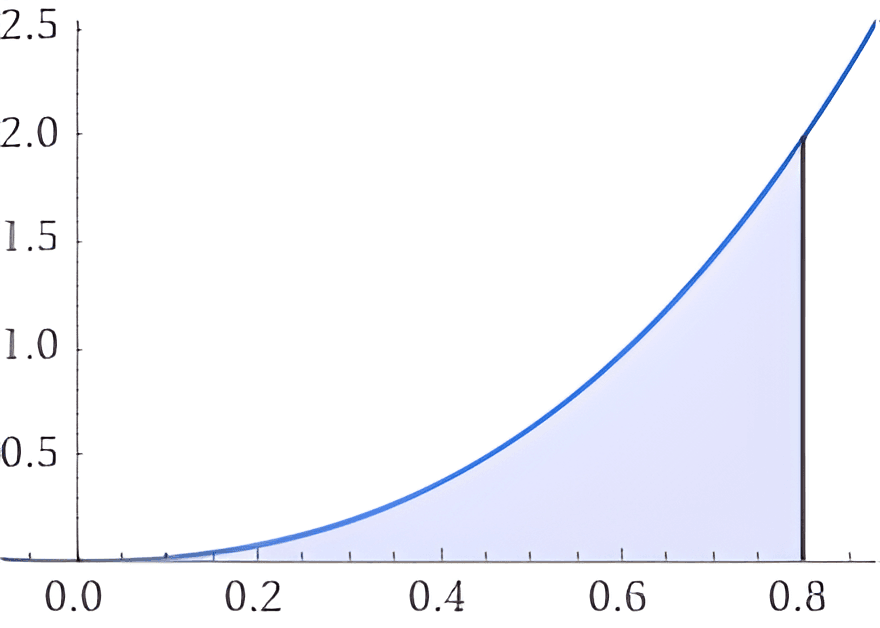
Generated Graph
Solution by Steps
step 1
We need to integrate the probability density function f(x)=x2(2x+23) from 0 to 0.8
step 2
The integral is ∫00.8x2(2x+23)dx
step 3
Using the Asksia-LL calculator result: ∫00.8x2(2x+23)dx=0.4608
Answer
Pr(X⩽0.8)=0.4608
Key Concept
Integration of the probability density function
Explanation
To find the probability that X is less than or equal to 0.8, we integrate the given probability density function from 0 to 0.8.
step 1
We need to find the value of X such that Y⩽2. Given Y=2X+1, we solve 2X+1⩽2
step 2
Solving the inequality: 2X+1⩽2⟹2X⩽1⟹X⩽21
step 3
We now need to find Pr(X⩽21)
step 4
Using the Asksia-LL calculator result: ∫01/2x2(2x+23)dx=0.09375
Answer
Pr(Y⩽2)=0.09375
Key Concept
Transformation of random variables
Explanation
To find the probability that Y is less than or equal to 2, we first transform the inequality in terms of X and then integrate the probability density function up to the corresponding value of X.
step 1
To find E(X), we use the formula E(X)=∫01xf(x)dx
step 2
Using the Asksia-LL calculator result: ∫01xx2(2x+23)dx=0.775
step 3
Therefore, E(X)=0.775
step 4
To find Var(X), we use the formula Var(X)=∫01x2f(x)dx−(E(X))2
step 5
Using the Asksia-LL calculator result: ∫01x2x2(2x+23)dx=0.63333
step 6
Therefore, Var(X)=0.63333−(0.775)2=0.63333−0.600625=0.032705
Answer
E(X)=0.775, Var(X)=0.032705
Key Concept
Expectation and variance of a random variable
Explanation
The expectation (mean) of a random variable is found by integrating x times the probability density function. The variance is found by integrating x2 times the probability density function and subtracting the square of the mean.
step 1
Given Y=2X+1, we use the linearity of expectation: E(Y)=2E(X)+1
step 2
Using the result from 1c: E(Y)=2(0.775)+1=1.55+1=2.55
step 3
For variance, Var(Y)=22Var(X)=4Var(X)
step 4
Using the result from 1c: Var(Y)=4(0.032705)=0.13082
Answer
E(Y)=2.55, Var(Y)=0.13082
Key Concept
Linearity of expectation and scaling property of variance
Explanation
The expectation of a linear transformation of a random variable is the linear transformation of the expectation. The variance of a linear transformation is the square of the coefficient times the variance of the original variable.
step 1
We know E(Y)=mμ+n and Var(Y)=m2σ2
step 2
Given μ=30, σ2=64, E(Y)=20, and Var(Y)=16
step 3
From Var(Y)=16: m2⋅64=16⟹m2=6416=41⟹m=21
step 4
From E(Y)=20: m⋅30+n=20⟹21⋅30+n=20⟹15+n=20⟹n=5
Answer
m=21, n=5
Key Concept
Solving linear equations for expectation and variance
Explanation
By using the given mean and variance of X and the linear transformation properties, we can solve for the coefficients m and n.
step 1
Given Y=mX+n, with m=21 and n=5
step 2
Substitute X=5: Y=21⋅5+5=2.5+5=7.5
Answer
Y=7.5 when X=5
Key Concept
Linear transformation of a random variable
Explanation
By substituting the given value of X into the linear transformation equation, we can find the corresponding value of Y.
step 1
The mean of X is E(X)=∑x⋅Pr(X=x)
step 2
Using the given probabilities: E(X)=(−1)⋅83+0⋅41+4⋅41+10⋅81=−83+0+1+810=−83+818=815=1.875
step 3
The variance of X is Var(X)=∑(x−E(X))2⋅Pr(X=x)
step 4
Using the given probabilities and E(X)=1.875: Var(X)=(−1−1.875)2⋅83+(0−1.875)2⋅41+(4−1.875)2⋅41+(10−1.875)2⋅81
step 5
Calculating each term: (−2.875)2⋅83+(−1.875)2⋅41+(2.125)2⋅41+(8.125)2⋅81=8.265625⋅83+3.515625⋅41+4.515625⋅41+66.015625⋅81
step 6
Summing these: Var(X)=3.099609375+0.87890625+1.12890625+8.251953125=13.359375
step 7
For the sum of three independent observations, E(3X)=3E(X) and Var(3X)=3Var(X)
step 8
Therefore, E(3X)=3⋅1.875=5.625 and Var(3X)=3⋅13.359375=40.078125
Answer
E(3X)=5.625, Var(3X)=40.078125
Key Concept
Mean and variance of the sum of independent random variables
Explanation
The mean of the sum of independent random variables is the sum of their means, and the variance of the sum is the sum of their variances.
step 1
Given E(aX+bY)=aE(X)+bE(Y) and Var(aX+bY)=a2Var(X)+b2Var(Y)
step 2
Given E(X)=7, Var(X)=12, E(Y)=−4, Var(Y)=6, E(aX+bY)=37, and Var(aX+bY)=204
step 3
From E(aX+bY)=37: a⋅7+b⋅(−4)=37⟹7a−4b=37
step 4
From Var(aX+bY)=204: a2⋅12+b2⋅6=204⟹12a2+6b2=204⟹2a2+b2=34
step 5
Solving the system of equations: 7a−4b=37 and 2a2+b2=34
step 6
By trial and error or algebraic methods, we find a=7 and b=−4
Answer
a=7, b=−4
Key Concept
Solving systems of linear and quadratic equations
Explanation
By setting up and solving the system of equations derived from the given mean and variance conditions, we can find the integer values of a and b.
solve 5,6,7,8
Solution by Steps
step 1
List all possible samples of size 2 from the set {1,3,5} with replacement
step 2
The possible samples are: (1,1),(1,3),(1,5),(3,1),(3,3),(3,5),(5,1),(5,3),(5,5)
step 3
Calculate xˉ for each sample:
step 4
xˉ(1,1)=21+1=1
step 5
xˉ(1,3)=21+3=2
step 6
xˉ(1,5)=21+5=3
step 7
xˉ(3,1)=23+1=2
step 8
xˉ(3,3)=23+3=3
step 9
xˉ(3,5)=23+5=4
step 10
xˉ(5,1)=25+1=3
step 11
xˉ(5,3)=25+3=4
step 12
xˉ(5,5)=25+5=5
step 1
Determine the sampling distribution for Xˉ
step 2
The possible values of Xˉ are 1,2,3,4,5
step 3
Calculate the probabilities for each value:
step 4
P(Xˉ=1)=91
step 5
P(Xˉ=2)=92
step 6
P(Xˉ=3)=93=31
step 7
P(Xˉ=4)=92
step 8
P(Xˉ=5)=91
Answer
The possible samples are (1,1),(1,3),(1,5),(3,1),(3,3),(3,5),(5,1),(5,3),(5,5). The sampling distribution for Xˉ is: P(Xˉ=1)=91, P(Xˉ=2)=92, P(Xˉ=3)=31, P(Xˉ=4)=92, P(Xˉ=5)=91.
Key Concept
Sampling distribution
Explanation
The sampling distribution of a statistic is the distribution of that statistic, considered as a random variable, when derived from a random sample of size n.
step 1
Find the mean of the data in the table
step 2
Xˉ=510+6+0+4+0=4
step 3
Find the variance of the data
step 4
σ2=5(10−4)2+(6−4)2+(0−4)2+(4−4)2+(0−4)2=536+4+16+0+16=14.4
step 1
List all possible samples of size 3 from the 5 employees without replacement
step 2
The possible samples are: (A,B,C),(A,B,D),(A,B,E),(A,C,D),(A,C,E),(A,D,E),(B,C,D),(B,C,E),(B,D,E),(C,D,E)
step 3
Calculate Xˉ for each sample:
step 4
Xˉ(A,B,C)=310+6+0=5.33
step 5
Xˉ(A,B,D)=310+6+4=6.67
step 6
Xˉ(A,B,E)=310+6+0=5.33
step 7
Xˉ(A,C,D)=310+0+4=4.67
step 8
Xˉ(A,C,E)=310+0+0=3.33
step 9
Xˉ(A,D,E)=310+4+0=4.67
step 10
Xˉ(B,C,D)=36+0+4=3.33
step 11
Xˉ(B,C,E)=36+0+0=2
step 12
Xˉ(B,D,E)=36+4+0=3.33
step 13
Xˉ(C,D,E)=30+4+0=1.33
step 1
Use the table to find the variance of Xˉ
step 2
Calculate the mean of Xˉ: Xˉˉ=105.33+6.67+5.33+4.67+3.33+4.67+3.33+2+3.33+1.33=4.4
step 3
Calculate the variance of Xˉ:
step 4
σXˉ2=10(5.33−4.4)2+(6.67−4.4)2+(5.33−4.4)2+(4.67−4.4)2+(3.33−4.4)2+(4.67−4.4)2+(3.33−4.4)2+(2−4.4)2+(3.33−4.4)2+(1.33−4.4)2=2.84
Answer
The mean of the data is 4, and the variance is 14.4. The sampling distribution of Xˉ is: 5.33,6.67,5.33,4.67,3.33,4.67,3.33,2,3.33,1.33. The variance of Xˉ is 2.84.
Key Concept
Sampling distribution and variance
Explanation
The sampling distribution of a sample mean is the distribution of the mean of all possible samples of a given size from a population. The variance of the sample mean is calculated using the means of these samples.
step 1
Given a population with mean μ=82 and standard deviation σ=12, and a sample size n=64
step 2
The standard error of the mean is σXˉ=nσ=6412=1.5
step 3
Calculate the z-scores for 80.8 and 83.2:
step 4
z80.8=1.580.8−82=−0.8
step 5
z83.2=1.583.2−82=0.8
step 6
Find the probability that the sample mean lies between 80.8 and 83.2 using the standard normal distribution:
step 7
P(80.8 < \bar{X} < 83.2) = P(-0.8 < Z < 0.8) = 0.576
step 1
Given a population with mean μ=82 and standard deviation σ=12, and a sample size n=100
step 2
The standard error of the mean is σXˉ=nσ=10012=1.2
step 3
Calculate the z-scores for 80.8 and 83.2:
step 4
z80.8=1.280.8−82=−1
step 5
z83.2=1.283.2−82=1
step 6
Find the probability that the sample mean lies between 80.8 and 83.2 using the standard normal distribution:
step 7
P(80.8 < \bar{X} < 83.2) = P(-1 < Z < 1) = 0.6826
Answer
For a sample size of 64, the probability that the sample mean lies between 80.8 and 83.2 is 0.576. For a sample size of 100, the probability is 0.6826.
Key Concept
Standard error and z-scores
Explanation
The standard error of the mean measures the dispersion of sample means around the population mean. Z-scores are used to find probabilities for sample means within a normal distribution.
step 1
Given X with mean μX=30 and variance σX2=9, and Y with mean μY=40 and variance σY2=16
step 2
The mean of X+Y is μX+Y=μX+μY=30+40=70
step 3
The variance of X+Y is σX+Y2=σX2+σY2=9+16=25
step 1
The mean of X−Y is μX−Y=μX−μY=30−40=−10
step 2
The variance of X−Y is σX−Y2=σX2+σY2=9+16=25
Answer
The mean and variance of X+Y are 70 and 25, respectively. The mean and variance of X−Y are -10 and 25, respectively.
Key Concept
Mean and variance of sum and difference of independent random variables
Explanation
For independent random variables, the mean of their sum or difference is the sum or difference of their means, and the variance of their sum or difference is the sum of their variances.
solve 9,10,11
Solution by Steps
step 1
The mean weight of the contents of the cans is the difference between the mean weight of full cans and the mean weight of empty cans
step 2
Mean weight of contents = 260 grams - 30 grams = 230 grams
step 3
The standard deviation of the contents is found using the formula for the difference of two independent normal distributions: σcontents=σfull2+σempty2
step 4
σcontents=102+22=100+4=104≈10.2 grams
step 1
The combined weight of two full cans is normally distributed with mean 2×260=520 grams and standard deviation 2×10=102≈14.14 grams
step 2
We need to find P(X > 540) where X∼N(520,14.14)
step 3
Convert to the standard normal distribution: Z=14.14540−520≈1.41
step 4
Using standard normal distribution tables, P(Z > 1.41) \approx 0.0793
9 Answer
Mean weight of contents: 230 grams, Standard deviation: 10.2 grams, Probability: 0.0793
step 1
Each assignment time is normally distributed with mean 35 minutes and standard deviation 8 minutes
step 2
We need to find P(X > 40) for each assignment where X∼N(35,8)
step 3
Convert to the standard normal distribution: Z=840−35=0.625
step 4
Using standard normal distribution tables, P(Z > 0.625) \approx 0.2660
step 5
The probability that all three assignments take more than 40 minutes is (0.2660)3≈0.0188
step 1
The average time for three assignments is normally distributed with mean 35 minutes and standard deviation 38≈4.62 minutes
step 2
We need to find P(\bar{X} > 40) where Xˉ∼N(35,4.62)
step 3
Convert to the standard normal distribution: Z=4.6240−35≈1.08
step 4
Using standard normal distribution tables, P(Z > 1.08) \approx 0.1401
step 1
The total time for three assignments is normally distributed with mean 3×35=105 minutes and standard deviation 3×8≈13.86 minutes
step 2
We need to find P(X > 115) where X∼N(105,13.86)
step 3
Convert to the standard normal distribution: Z=13.86115−105≈0.72
step 4
Using standard normal distribution tables, P(Z > 0.72) \approx 0.2358
10 Answer
Part (a): 0.0188, Part (b): 0.1401, Part (c): 0.2358
step 1
The mean weight of a sample of 5 pumpkins is normally distributed with mean 5 kg and standard deviation 50.8≈0.358 kg
step 2
We need to find P(\bar{X} > 6) where Xˉ∼N(5,0.358)
step 3
Convert to the standard normal distribution: Z=0.3586−5≈2.79
step 4
Using standard normal distribution tables, P(Z > 2.79) \approx 0.0026
step 1
We need to find P(4.5 < \bar{X} < 5.5) where Xˉ∼N(5,0.358)
step 2
Convert to the standard normal distribution: Z1=0.3584.5−5≈−1.40 and Z2=0.3585.5−5≈1.40
step 3
Using standard normal distribution tables, P(-1.40 < Z < 1.40) \approx 0.9192
step 1
We need to find the sample size n such that the probability of the sample mean differing from the population mean by more than 0.2 kg is at most 2%
step 2
The standard error of the mean is n0.8
step 3
We need P(|\bar{X} - 5| > 0.2) \leq 0.02
step 4
Convert to the standard normal distribution: P\left( \left| Z \right| > \frac{0.2 \sqrt{n}}{0.8} \right) \leq 0.02
step 5
Using standard normal distribution tables, P(|Z| > 2.33) \leq 0.02
step 6
Solve for n: 0.80.2n=2.33⇒n=9.32⇒n≈87
11 Answer
Part (a)(i): 0.0026, Part (a)(ii): 0.9192, Part (b): 87
Key Concept
Normal Distribution and Probability Calculations
Explanation
These problems involve using properties of the normal distribution to calculate means, standard deviations, and probabilities for various scenarios.
© 2023 AskSia.AI all rights reserved