
AskSia
Plus

lim𝑥→−1− 𝑥^2−4 / 𝑥+1 =
Mar 24, 2024

lim𝑥→−1− 𝑥^2−4 / 𝑥+1 =

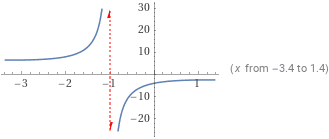
Generated Graph
Solution by Steps
step 1
Evaluate the limit of the function as x approaches -1 from the left side (negative side)
step 2
The limit from the left side is limx→(−1)−x+1−x2−4
step 3
As x approaches -1 from the left, the numerator approaches 3 and the denominator approaches 0 from the positive side, causing the expression to approach ∞
step 4
Evaluate the limit of the function as x approaches -1 from the right side (positive side)
step 5
The limit from the right side is limx→(−1)+x+1−x2−4
step 6
As x approaches -1 from the right, the numerator approaches 3 and the denominator approaches 0 from the negative side, causing the expression to approach −∞
step 7
Since the limits from the left and right do not match, the two-sided limit does not exist
Answer
The limit does not exist.
Key Concept
Limits involving division by zero
Explanation
When the denominator of a fraction approaches zero, the limit can approach infinity or negative infinity, depending on the direction from which x approaches the value. If the limits from both sides do not match, the two-sided limit does not exist.
Create a real-life example that will result in an instantaneous positive rate of
change and second real-life example that will result in a negative average rate of
change. Explain. [3 marks]
Solution by Steps
step 1
Identify a real-life situation where an instantaneous positive rate of change occurs: A car accelerating from a stoplight
step 2
The rate of change of the car's speed with respect to time is positive as the speed increases from 0 to a certain value over a short time interval
step 3
Use the derivative of the car's position function with respect to time to represent this positive rate of change. If s(t) is the position function, then \frac{ds}{dt} > 0 indicates a positive rate of change
Answer
A car accelerating from a stoplight represents an instantaneous positive rate of change.
Key Concept
Instantaneous Rate of Change
Explanation
The instantaneous rate of change is the derivative of a quantity with respect to time at a specific moment, indicating how quickly the quantity is changing at that instant.
Solution by Steps
step 1
Identify a real-life situation where a negative average rate of change occurs: A bank account losing value over a year due to withdrawals
step 2
The average rate of change of the account balance with respect to time is negative as the balance decreases from the beginning to the end of the year
step 3
Calculate the average rate of change by taking the difference in the account balance over the time period and dividing by the length of the time period. If B(t) is the balance function, then \frac{\Delta B}{\Delta t} < 0 indicates a negative average rate of change
Answer
A bank account losing value over a year due to withdrawals represents a negative average rate of change.
Key Concept
Average Rate of Change
Explanation
The average rate of change is the change in the value of a quantity over a period of time divided by the length of the time period, indicating the overall rate at which the quantity is changing during that interval.
Consider the function 𝑓(𝑥) = 9 + 𝑏𝑥 − 𝑎𝑥^2 [5 marks]
a) Find a simplified expression for the AROC from 𝑥 = 3 𝑡𝑜 𝑥 = 5
b) Determine the instantaneous velocity at 𝑥 = 2. Use the correct formula from #3.
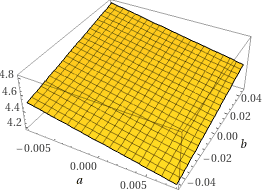
Generated Graph
Solution by Steps
step 1
Calculate the Average Rate of Change (AROC) from x=3 to x=5 using the formula x2−x1f(x2)−f(x1)
step 2
Substitute x1=3 and x2=5 into the function f(x)=9+bx−ax2 to find f(3) and f(5)
step 3
Compute f(5)=9+b⋅5−a⋅52 and f(3)=9+b⋅3−a⋅32
step 4
Subtract f(3) from f(5) and divide by 5−3 to get the AROC
step 5
Simplify the expression to get the final AROC: 21(−41a+7b+9)
Answer
AROC=−241a+27b+29
Key Concept
Average Rate of Change (AROC)
Explanation
The AROC is found by evaluating the function at two points and dividing the difference by the change in x.
Solution by Steps
step 1
To find the instantaneous velocity at x=2, we need to compute the derivative of f(x)=9+bx−ax2 at x=2
step 2
Differentiate f(x) with respect to x to get f′(x)=b−2ax
step 3
Substitute x=2 into f′(x) to find the instantaneous velocity
step 4
Compute f′(2)=b−2a⋅2 to get the derivative at x=2
step 5
Simplify the expression to get the final instantaneous velocity: −4a+b
Answer
Instantaneous velocity at x=2 is −4a+b
Key Concept
Instantaneous Velocity
Explanation
The instantaneous velocity is the derivative of the position function at a specific point, representing the rate of change at that instant.
Part C – Thinking Inquiry [10 marks]
7. a) It is said that the temperature T of Tim Hortons Coffee cools at a rate of 15% every minute. If R is the room temperature and if a cup of coffee is originally served at 𝑇 = 90OC, determine the following limits, with justification, where 𝑡 is the time in minutes: lim 𝑡→∞ 𝑇 𝑎𝑛𝑑 lim 𝑡→5 𝑇 [4 marks]
© 2023 AskSia.AI all rights reserved