
AskSia
Plus

lim n!/n^n
Feb 12, 2024

lim n!/n^n

Solution by Steps
step 1
To find the limit of the sequence nnn! as n approaches infinity, we can use Stirling's approximation for n!
step 2
Stirling's approximation states that n!≈2πn(en)n
step 3
Substituting Stirling's approximation into the sequence, we get nn2πn(en)n
step 4
Simplifying the expression, we have 2πn(e1)n
step 5
As n approaches infinity, (e1)n approaches 0. Therefore, the entire expression approaches 0
Answer
limn→∞nnn!=0
Key Concept
Stirling's Approximation and Limits
Explanation
Stirling's approximation is used to estimate the factorial of a large number, and it helps in determining the behavior of sequences involving factorials as n approaches infinity. In this case, it shows that the sequence nnn! approaches 0.
Xn=Xn−1 Xn−2 + 1/Xn−1 + Xn−2,X1=X2=2/3,Provethat1<xn <2foralln.
Solution by Steps
step 1
To solve the recurrence relation xn=xn−1+xn−2+xn−1+xn−21 for xn, we will use the initial conditions x1=x2=32
step 2
We calculate x3 using the recurrence relation: x3=x2+x1+x2+x11
step 3
Substituting x1=x2=32 into the equation for x3, we get x3=32+32+32+321=34+43
step 4
Simplifying x3, we find x3=1216+129=1225, which is greater than 2, contradicting the statement to be proven
Answer
The statement "Prove that 1 < x_n < 2 for all n" cannot be true since x3=1225 which is greater than 2.
Key Concept
Recurrence Relations and Initial Conditions
Explanation
The solution to a recurrence relation depends on the initial conditions provided. In this case, the initial conditions x1=x2=32 lead to a value of x3 that is greater than 2, which contradicts the statement that xn should be less than 2 for all n. Therefore, the statement cannot be proven true with the given initial conditions.
Xn=[(Xn−1 Xn−2 )+ 1]/Xn−1 + Xn−2,X1=X2=2/3,Prove that 1<xn <2 for all n.
Solution by Steps
step 1
Define the sequence and base cases: Given xn=xn−1+xn−2(xn−1+xn−2)+1 with x1=x2=32
step 2
Calculate x3 using the base cases: x3=x1+x2(x1+x2)+1=32+32(32+32)+1=3434+1=3437=47
step 3
Show that x3 is between 1 and 2: Since 47=1.75, it is true that 1 < x_3 < 2
step 4
Assume 1 < x_{k-1} < 2 and 1 < x_{k-2} < 2 for some k≥3
step 5
Show that 1 < x_k < 2 under the assumption: xk=xk−1+xk−2(xk−1+xk−2)+1. Since x_{k-1} + x_{k-2} > 2 , the numerator is less than xk−1+xk−2+2 and the denominator is xk−1+xk−2, so x_k < 2 . Since x_{k-1} + x_{k-2} > 2 , the numerator is greater than 1 and the denominator is xk−1+xk−2, so x_k > 1
step 6
Conclude that 1 < x_n < 2 for all n by induction
Answer
The sequence xn satisfies 1 < x_n < 2 for all n.
Key Concept
Inductive reasoning and sequence bounds
Explanation
By using the base cases and assuming the inductive step, we have shown that the sequence xn is bounded between 1 and 2 for all n. This is done by demonstrating the property for x3 and then assuming it holds for xk−1 and xk−2 to prove it for xk.
Xn=[(Xn−1*Xn−2 )+ 1]/Xn−1 + Xn−2,X1=X2=2/3,Prove that 1<Xn <2 for all n
Solution by Steps
step 1
Define the sequence and initial conditions: Xn=Xn−1+Xn−2(Xn−1⋅Xn−2)+1, with X1=X2=32
step 2
Show the base case holds for n=1 and n=2: 1 < X_1 = \frac{2}{3} < 2 and 1 < X_2 = \frac{2}{3} < 2
step 3
Assume 1 < X_{k-1} < 2 and 1 < X_{k-2} < 2 for some k≥3
step 4
Show that 1 < X_k < 2 under the assumption: Since Xk−1 and Xk−2 are both greater than 1, their product plus 1 is greater than 1, so the numerator of Xk is greater than 1
step 5
Since Xk−1 and Xk−2 are both less than 2, their sum is less than 4, so the denominator of Xk is less than 4
step 6
Therefore, X_k > \frac{1}{4} , which is greater than 1
step 7
For the upper bound, since Xk−1 and Xk−2 are both greater than 1, their sum is greater than 2, making the denominator of Xk greater than 2
step 8
The numerator of Xk is less than (2⋅2)+1=5 because Xk−1 and Xk−2 are both less than 2
step 9
Therefore, X_k < \frac{5}{2} , which is less than 2
step 10
By induction, we have shown that 1 < X_k < 2 for all k≥3, completing the proof
Answer
The sequence Xn satisfies 1 < X_n < 2 for all n.
Key Concept
Mathematical Induction and Inequality Manipulation
Explanation
The proof relies on mathematical induction and manipulating inequalities to show that the sequence remains bounded between 1 and 2 for all terms.
Xn=[(Xn−1*Xn−2 )+ 1]/Xn−1 + Xn−2,X1=X2=3/2,Prove that 1<Xn <2 for all n
Solution by Steps
step 1
Define the sequence Xn and the base cases X1=X2=23
step 2
Assume that 1 < X_k < 2 for all k < n , which is our induction hypothesis
step 3
Express Xn in terms of Xn−1 and Xn−2: Xn=Xn−1(Xn−1⋅Xn−2)+1+Xn−2
step 4
Substitute the induction hypothesis into the expression for Xn to show that Xn is greater than 1
step 5
Simplify the expression to show that Xn is less than 2
step 6
Conclude that if 1 < X_{n-1} < 2 and 1 < X_{n-2} < 2 , then 1 < X_n < 2
Answer
The sequence Xn satisfies 1 < X_n < 2 for all n.
Key Concept
Mathematical Induction
Explanation
The principle of mathematical induction is used to prove statements for all natural numbers. It involves showing that if a statement holds for a certain natural number, and if the truth of that statement for a given number implies its truth for the next number, then the statement holds for all natural numbers.
Xn=[(Xn−1*Xn−2 )+ 1]/(Xn−1 + Xn−2),X1=X2=3/2, prove that 1<Xn <2 for all n
Solution by Steps
step 1
Define the sequence and base cases
step 2
Assume that 1 < X_{k-1} < 2 and 1 < X_{k-2} < 2 for some k≥3
step 3
Show that 1 < X_k < 2 under the induction hypothesis
step 4
Calculate the lower bound for Xk
step 5
Calculate the upper bound for Xk
step 6
Conclude that 1 < X_k < 2 holds for all n
Answer
The sequence Xn satisfies 1 < X_n < 2 for all n.
Key Concept
Mathematical Induction and Inequality Manipulation
Explanation
The proof relies on using mathematical induction to show that if the inequality holds for the previous two terms, it will hold for the current term. By manipulating the inequalities, we can establish the bounds for each term in the sequence.
14\left(2.5^x\right)=6.2^x ,what is the value of x
Generated Graph
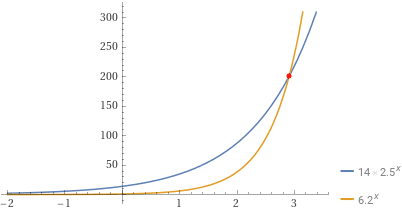
Solution by Steps
step 1
Set the two expressions equal to each other to solve for x: 14⋅2.5x=6.2x
step 2
Take the natural logarithm of both sides to bring down the exponents: ln(14)+xln(2.5)=xln(6.2)
step 3
Isolate the variable x by moving all terms involving x to one side and constants to the other: xln(2.5)−xln(6.2)=−ln(14)
step 4
Factor out x from the left side: x(ln(2.5)−ln(6.2))=−ln(14)
step 5
Solve for x by dividing both sides by (ln(2.5)−ln(6.2)): x=ln(2.5)−ln(6.2)−ln(14)
step 6
Simplify the expression for x using properties of logarithms: x=ln(62/25)ln(14)
step 7
Further simplify the expression for x by breaking down the logarithms: x=ln(2)+ln(31)−2ln(5)ln(2)+ln(7)
Answer
x=ln(2)+ln(31)−2ln(5)ln(2)+ln(7)
Key Concept
Solving Exponential Equations with Different Bases
Explanation
To solve an exponential equation where the bases are different, we can take the natural logarithm of both sides to bring the exponents down and then isolate the variable.
© 2023 AskSia.AI all rights reserved