
AskSia
Plus

draw the graph:\sin \left(\sin ^{-1}x\right)
Feb 12, 2024

draw the graph:\sin \left(\sin ^{-1}x\right)

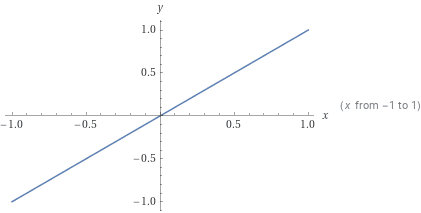
Generated Graph
Solution by Steps
step 1
To draw the graph of the function y=sin(sin−1(x)), we recognize that sin−1(x) is the inverse function of sin(x)
step 2
The function sin(sin−1(x)) simplifies to y=x for all x in the domain of sin−1(x), which is [−1,1]
step 3
The graph of y=x is a straight line passing through the origin with a slope of 1
step 4
Plot the straight line for x values between -1 and 1 to represent the graph of y=sin(sin−1(x))
Answer
The graph is a straight line passing through the origin with a slope of 1, within the interval [−1,1].
Key Concept
Inverse Functions and Their Composition
Explanation
The composition of a function and its inverse results in the identity function over the domain of the inverse function. In this case, sin(sin−1(x))=x for x in [−1,1], which is graphed as a straight line.
draw the graph:\sin ^{-1}\left(\sin x\right)
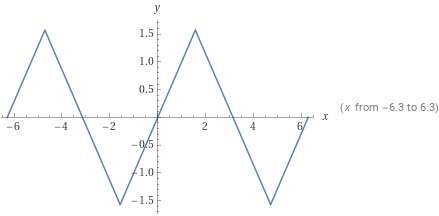
Generated Graph
Solution by Steps
step 1
To draw the graph of y=sin−1(sinx), we need to understand the behavior of the sine function and its inverse
step 2
The sine function, sinx, oscillates between -1 and 1 for all x
step 3
The inverse sine function, sin−1x, is defined for the domain [−1,1] and has a range of [−2π,2π]
step 4
When we compose sin−1 with sinx, the output is x whenever x is in the range [−2π,2π]. Outside this interval, the graph will repeat periodically due to the periodic nature of the sine function
step 5
The graph of y=sin−1(sinx) will be a series of line segments with a slope of 1, where each segment spans an interval of length π and is centered at multiples of π
Answer
The graph of y=sin−1(sinx) consists of line segments with a slope of 1, repeating every π units along the x-axis.
Key Concept
Composition of a function and its inverse
Explanation
The graph of y=sin−1(sinx) shows the output of x whenever x is within the principal range of [−2π,2π] for the inverse sine function. Outside this range, the graph will exhibit a sawtooth pattern due to the periodic nature of the sine function and the restricted domain of its inverse.
© 2023 AskSia.AI all rights reserved