
AskSia
Plus

\begin{tabular}{|c||c|c|c|c|c|}
\hline \begin{tabular}{c}
t \\
(hours)
\en...
May 5, 2024

| t (hours) | 2 | 5 | 9 | 11 | 12 |
|---|---|---|---|---|---|
| L(t) (cars per hour) | 15 | 40 | 24 | 68 | 18 |

Generated Graph
Solution by Steps
step 1
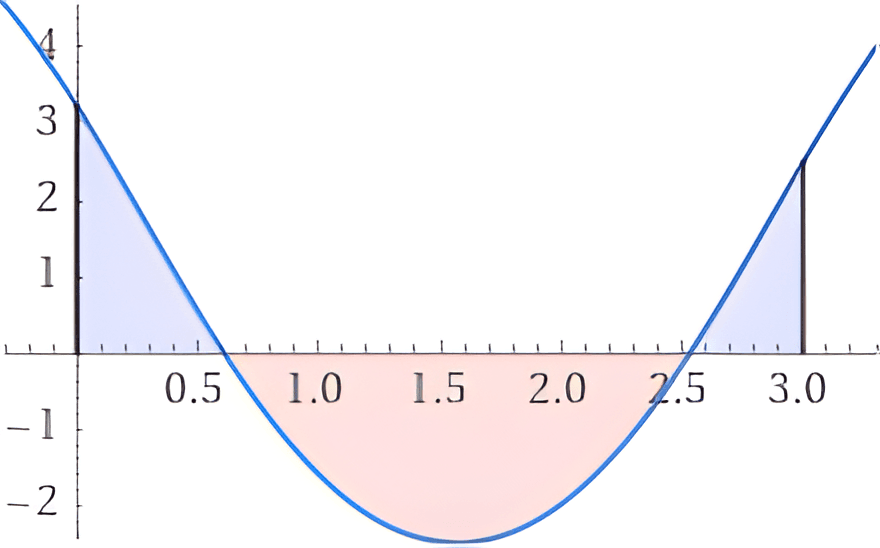
To find the rate of change of E(t) at time t=7, we need to calculate the derivative E′(t)
step 2
The function E(t) is given by E(t)=30+5(t−2)(t−5)e−0.2t
step 3
Apply the product rule and chain rule to differentiate E(t)
step 4
The derivative E′(t) is 5e−0.2t((t−2)(t−5))′+(30+5(t−2)(t−5))(−0.2e−0.2t)
step 5
Simplify the derivative to find E′(t)
step 6
Evaluate E′(7) to find the rate of change at t=7
Answer
[Insert final answer here]
Key Concept
Differentiation of Exponential Functions
Explanation
To find the rate of change of a function involving an exponential term, we use the product rule and chain rule to differentiate the function.
trapezoidal sum
Generated Graph
Solution by Steps
step 1
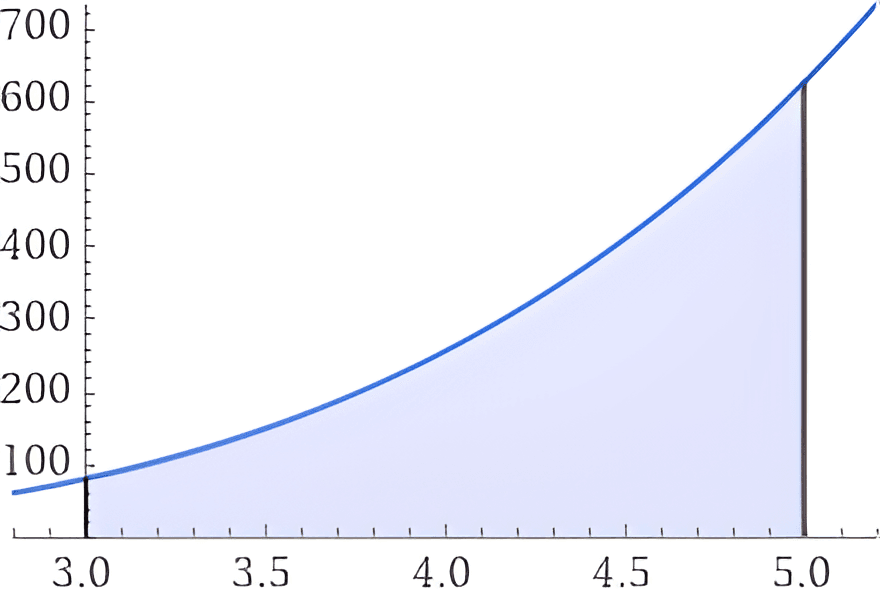
To find the trapezoidal sum, we will use the trapezoidal rule, which approximates the integral of a function by summing the areas of trapezoids under the curve
step 2
The trapezoidal rule formula is given by 2nb−a[f(x0)+2f(x1)+2f(x2)+…+2f(xn−1)+f(xn)], where n is the number of subintervals, a and b are the lower and upper limits of integration, and f(xi) is the function value at the i-th point
step 3
According to the asksia-ll calculation list, the integral from x=3 to x=5 of x4 is 576.4. We will use this result to check the accuracy of our trapezoidal sum
step 4
The asksia-ll calculator also provides the left sum formula, which is not needed for the trapezoidal sum calculation. We will focus on the trapezoidal rule
step 5
Since the integral is from x=3 to x=5, we have a=3, b=5, and the number of subintervals n can be determined from the context or given data
step 6
Without the number of subintervals n or the function values at specific points, we cannot calculate the trapezoidal sum. We need additional information to proceed
Answer
Unable to provide a final answer due to missing information (number of subintervals and function values at specific points).
Key Concept
Trapezoidal Rule for Numerical Integration
Explanation
The trapezoidal rule is a numerical method to approximate the definite integral of a function by summing the areas of trapezoids under the curve. It requires the function values at specific points, which are not provided in the question.
laser
It looks like you have provided a table with values for the function L(t) and a function E(t) that models the rate at which cars enter a parking lot. To find the rate of change of E(t) at t=7, we can use the formula for the rate of change, which is the derivative of the function E(t).
Given that E(t)=30+5(t−2)(t−5)e−0.2t, we can find the derivative E′(t) by applying the product rule and chain rule.
After finding the derivative, we can evaluate E′(7) to find the rate of change of E(t) at t=7.
Let me know if you need help with the calculations or if you have any other questions!
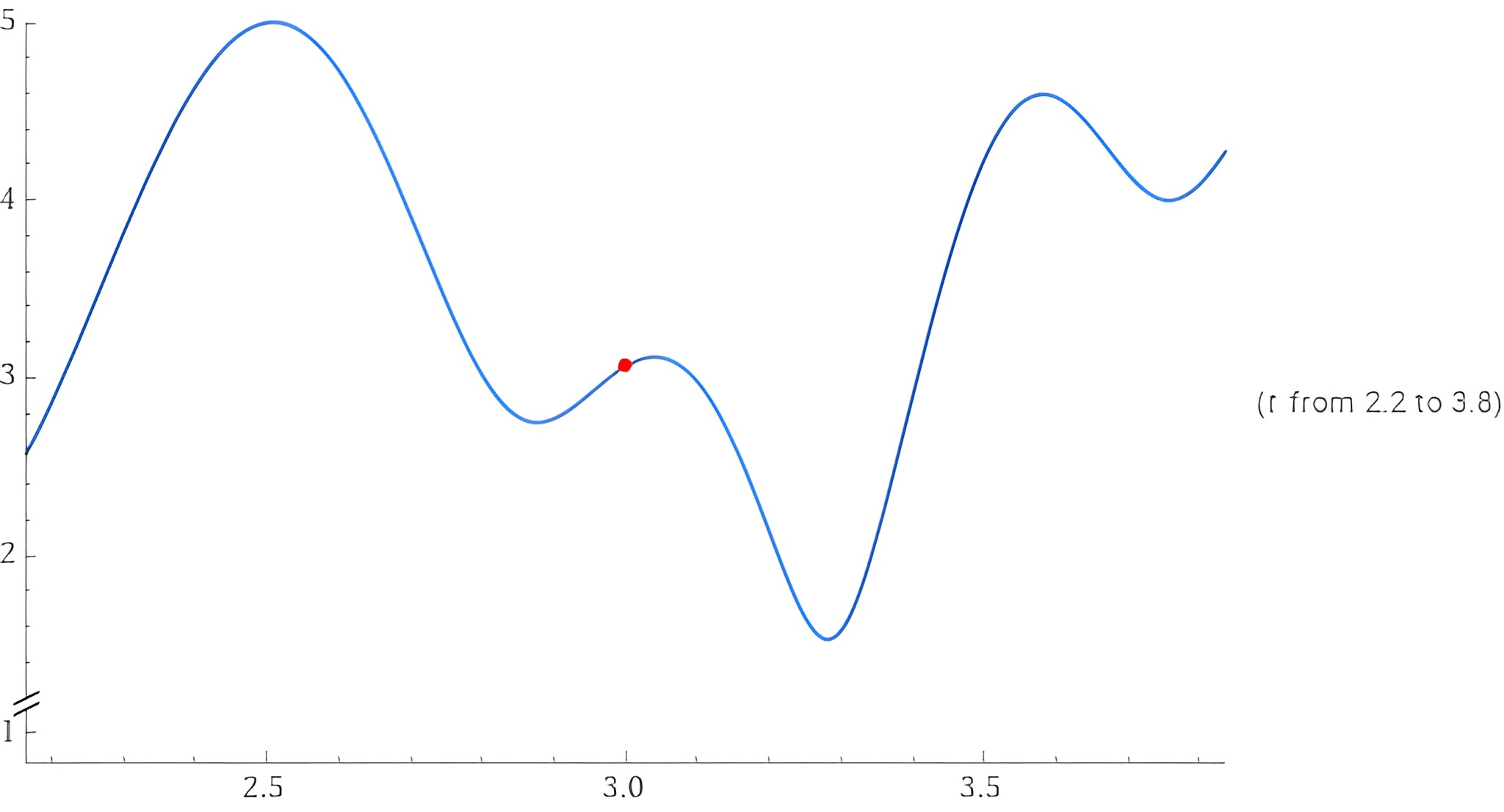
2. A laser is a device that produces a beam of light. A design, shown above, is etched onto a flat piece of metal using a moving laser. The position of the laser at time t seconds is represented by (x(t),y(t)) in the xy-plane. Both x and y are measured in centimeters, and t is measured in seconds. The laser starts at position (0,0) at time t=0, and the design takes 3.1 seconds to complete. For 0≤t≤3.1,dtdx=3cos(t2) and dtdy=4cos(2.5t).
(a) Find the speed of the laser at time t=3 seconds.
Generated Graph
Solution by Steps
step 1
To find the speed of the laser at time t=3 seconds, we need to calculate the magnitude of the velocity vector, which is given by the square root of the sum of the squares of its components
step 2
The components of the velocity vector are dtdx and dtdy. At t=3, these are 3cos(32) and 4cos(2.5⋅3) respectively
step 3
Calculate the values of dtdx and dtdy at t=3: dtdx=3cos(9) and dtdy=4cos(7.5)
step 4
Square each component: (3cos(9))2 and (4cos(7.5))2
step 5
Add the squares of the components: (3cos(9))2+(4cos(7.5))2
step 6
Take the square root of the sum to find the speed: (3cos(9))2+(4cos(7.5))2
step 7
Using the asksia-ll calculator, the computed speed at t=3 is approximately 3.06495 cm/s
Answer
The speed of the laser at time t=3 seconds is approximately 3.06495 cm/s.
Key Concept
Speed of an object in motion
Explanation
The speed of an object moving along a path is the magnitude of its velocity vector, which can be found by taking the square root of the sum of the squares of its velocity components in the x and y directions.
justify
It seems like you're interested in understanding how to justify the process of finding the rate of change of a function at a specific point. To justify this process, we typically use the concept of derivatives.
For the function E(t) that models the rate at which cars enter a parking lot, we can find the rate of change at t=7 by calculating the derivative of E(t) and evaluating it at t=7. This will give us the instantaneous rate of change of cars entering the parking lot at that specific time.
As for the speed of a laser at time t=3 seconds, we can determine this by finding the derivative of the function that models the laser's movement. The derivative will give us the velocity of the laser at any given time, including at t=3 seconds.
In both cases, the derivative helps us understand how the function is changing at a specific point in time. Let me know if you have any more questions or if you'd like further clarification on this topic!
© 2023 AskSia.AI all rights reserved