
AskSia
Plus

You need to refer to the sections on Congruence and Arithmetic modulo n in Chapt...
May 23, 2024

You need to refer to the sections on Congruence and Arithmetic modulo n in Chapter 3
for this question. Consider numbers such as 19326 or 96123. One way to check whether
they are divisible by 3 is to simply try to divide them directly. However, there is a test for
divisibility by 3. Add up the digits, e.g. 1 + 9 + 3 + 2 + 6 = 21. Since the sum of the digits
21 is divisibly by 3, then both numbers are divisible by 3, since the sums of their digits
are divisible by 3. A number such as 112 is not divisible by 3 since 1 + 1 + 2 = 4 is not
divisible by 3. The goal of this question is to prove formally that this test for divisibility
by 3 works for the general case.
(a) Show that 10 ≡3 1 and 10k ≡3 1 for any positive integer k.
(b) Show that A × 10k ≡3 A for any positive integers k and A.
(c) Now consider a number where the digits are [ak, ak−1, · · · , a1, a0]. This number N is
equivalent to
N = ak × 10k + ak−1 × 10k−1 + · · · + a2 × 102 + a1 × 10 + a0,
where ak is an integer from 1 to 9, and the rest of the ai are integers from 0 to 9.
Show that N ≡3 ak + ak−1 + · · · + a2 + a1 + a0, and then show that N is divisible by
3 if and only if ak + ak−1 + · · · + a2 + a1 + a0 is divisible by 3.
(d) Suggest a test for divisibility by 6.

Solution by Steps
step 1
To show that 10≡31 and 10k≡31 for any positive integer k, we start by noting that 10≡1(mod3)
step 2
Since 10≡1(mod3), raising both sides to the power of k gives 10k≡1k(mod3)
step 3
Simplifying, we get 10k≡1(mod3) for any positive integer k
step 4
To show that A×10k≡3A for any positive integers k and A, we use the result from step 3
step 5
Since 10k≡1(mod3), multiplying both sides by A gives A×10k≡A×1(mod3)
step 6
Simplifying, we get A×10k≡A(mod3)
step 7
Consider a number N where the digits are [ak,ak−1,⋯,a1,a0]. This number N is equivalent to N=ak×10k+ak−1×10k−1+⋯+a2×102+a1×10+a0
step 8
Using the result from step 3, we know that 10i≡1(mod3) for any i
step 9
Therefore, N≡ak×1+ak−1×1+⋯+a2×1+a1×1+a0(mod3)
step 10
Simplifying, we get N≡ak+ak−1+⋯+a2+a1+a0(mod3)
step 11
Thus, N is divisible by 3 if and only if ak+ak−1+⋯+a2+a1+a0 is divisible by 3
step 12
To suggest a test for divisibility by 6, note that a number is divisible by 6 if and only if it is divisible by both 2 and 3
step 13
Therefore, a number is divisible by 6 if it is even (last digit is 0,2,4,6, or 8) and the sum of its digits is divisible by 3
Answer
A number is divisible by 3 if the sum of its digits is divisible by 3. A number is divisible by 6 if it is even and the sum of its digits is divisible by 3.
Key Concept
Divisibility rules for 3 and 6
Explanation
The sum of the digits of a number determines its divisibility by 3. For divisibility by 6, the number must be even and the sum of its digits must be divisible by 3.
How can we prove that a number is divisible by 3 using the sum of its digits?
Solution by Steps
step 1
To prove that a number is divisible by 3 using the sum of its digits, we start by expressing the number in its decimal form. Let the number be n and its digits be ak,ak−1,…,a1,a0. Then, we can write n as:
n=ak⋅10k+ak−1⋅10k−1+⋯+a1⋅10+a0
step 2
Notice that 10≡1(mod3). This means that any power of 10 is congruent to 1 modulo 3:
10k≡1k≡1(mod3)
step 3
Using this property, we can simplify the expression for n modulo 3:
n≡ak⋅1+ak−1⋅1+⋯+a1⋅1+a0⋅1(mod3)
n≡ak+ak−1+⋯+a1+a0(mod3)
step 4
Therefore, n is divisible by 3 if and only if the sum of its digits ak+ak−1+⋯+a1+a0 is divisible by 3
Answer
A number is divisible by 3 if the sum of its digits is divisible by 3.
Key Concept
Divisibility by 3 using the sum of digits
Explanation
A number is divisible by 3 if the sum of its digits is divisible by 3 because each power of 10 is congruent to 1 modulo 3.

Solution by Steps
step 1
Identify the highest order term in the function f(n)
step 2
The highest order term in f(n) is 3n2
step 3
According to Proposition 15, the theta notation is determined by the highest order term
step 4
Therefore, f(n)=Θ(n2)
step 1
Expand the function g(n)
step 2
g(n)=2n⋅4+2n⋅5lnn+3⋅4+3⋅5lnn=8n+10nlnn+12+15lnn
step 3
Identify the highest order term in the expanded function
step 4
The highest order term is 10nlnn
step 5
According to Proposition 15, the theta notation is determined by the highest order term
step 6
Therefore, g(n)=Θ(nlnn)
step 1
Identify the highest order terms in the numerator and the denominator
step 2
The highest order term in the numerator is n3 and in the denominator is 5n2
step 3
Simplify the function by dividing the highest order terms
step 4
h(n)≈5n2n3=5n
step 5
According to Proposition 16, the theta notation is determined by the simplified form
step 6
Therefore, h(n)=Θ(n)
Answer
(a) Θ(n2), (b) Θ(nlnn), (c) Θ(n)
Key Concept
Theta notation
Explanation
Theta notation describes the asymptotic behavior of functions, focusing on the highest order term to determine the growth rate.

Solution by Steps
step 1
Each roll of a die has 6 possible outcomes. Since the die is rolled 7 times, the total number of outcomes is 67
step 2
Calculate 67: 67=279936
step 1
If 3 is not present, each roll has 5 possible outcomes (1, 2, 4, 5, 6). Since the die is rolled 7 times, the total number of outcomes is 57
step 2
Calculate 57: 57=78125
step 1
Choose 1 out of 7 rolls to be 3. This can be done in (17) ways
step 2
For the remaining 6 rolls, each has 5 possible outcomes. So, the number of outcomes is 56
step 3
Calculate (17)×56: (17)=7 and 56=15625
step 4
Multiply: 7×15625=109375
step 1
Total outcomes minus outcomes where 3 is not present and outcomes where 3 is present exactly once
step 2
Calculate: 279936−78125−109375=92436
step 1
The total number of rolls is 7. We need to arrange 1, 2, 2, 4, 4, 4, 4
step 2
The number of ways to arrange these is given by the multinomial coefficient: 1!2!4!7!
step 3
Calculate: 1!2!4!7!=1×2×245040=105
Answer
(a) 279936
(b) 78125
(c) 109375
(d) 92436
(e) 105
step 1
Use the stars and bars method to find the number of non-negative integer solutions to x1+x2+x3=15
step 2
The formula is (k−1n+k−1) where n=15 and k=3
step 3
Calculate: (3−115+3−1)=(217)=136
step 1
Substitute x1=y1+1, x2=y2+1, x3=y3+1 where y1,y2,y3≥0
step 2
The equation becomes y1+y2+y3=12
step 3
Use the stars and bars method: (3−112+3−1)=(214)=91
step 1
Consider the cases for x1: x1=1, x1=2, and x1=3
step 2
For x1=1: x2+x3=14, solutions are (2−114+2−1)=(115)=15
step 3
For x1=2: x2+x3=13, solutions are (2−113+2−1)=(114)=14
step 4
For x1=3: x2+x3=12, solutions are (2−112+2−1)=(113)=13
step 5
Sum the solutions: 15+14+13=42
Answer
(a) 136
(b) 91
(c) 42
step 1
Substitute xk=mk into the recurrence relation xk=pxk+1+qxk−1
step 2
This gives mk=pmk+1+qmk−1
step 3
Divide by mk−1: m2=pm+q
step 4
Rearrange to form the quadratic equation: m2−pm−q=0
step 1
Solve the quadratic equation m2−pm−q=0 using the quadratic formula: m=2p±p2+4q
step 2
Let the roots be m1 and m2
step 3
The general solution is xk=Am1k+Bm2k
step 4
Use the boundary conditions x0=0 and xN=1 to find A and B
step 5
x0=0⇒A+B=0⇒B=−A
step 6
xN=1⇒Am1N−Am2N=1⇒A(m1N−m2N)=1⇒A=m1N−m2N1
step 7
Substitute A and B back into the general solution: xk=m1N−m2Nm1k−m2k
step 1
Substitute p=q=21 into the quadratic equation: m2−21m−21=0
step 2
Solve the quadratic equation: m=221±(21)2+2⋅21=221±41+1=221±45=221±25=41±5
step 3
The roots are m1=41+5 and m2=41−5
step 4
The general solution is xk=Am1k+Bm2k
step 5
Use the boundary conditions x0=0 and xN=1 to find A and B
step 6
x0=0⇒A+B=0⇒B=−A
step 7
xN=1⇒Am1N−Am2N=1⇒A(m1N−m2N)=1⇒A=m1N−m2N1
step 8
Substitute A and B back into the general solution: xk=m1N−m2Nm1k−m2k
Answer
(a) m2−pm−q=0
(b) xk=m1N−m2Nm1k−m2k
(c) xk=m1N−m2Nm1k−m2k
Key Concept
Probability and combinatorics in rolling dice and solving integer equations
Explanation
The solutions involve calculating the total number of outcomes using combinatorial methods and solving recurrence relations using boundary conditions.

Generated Graph
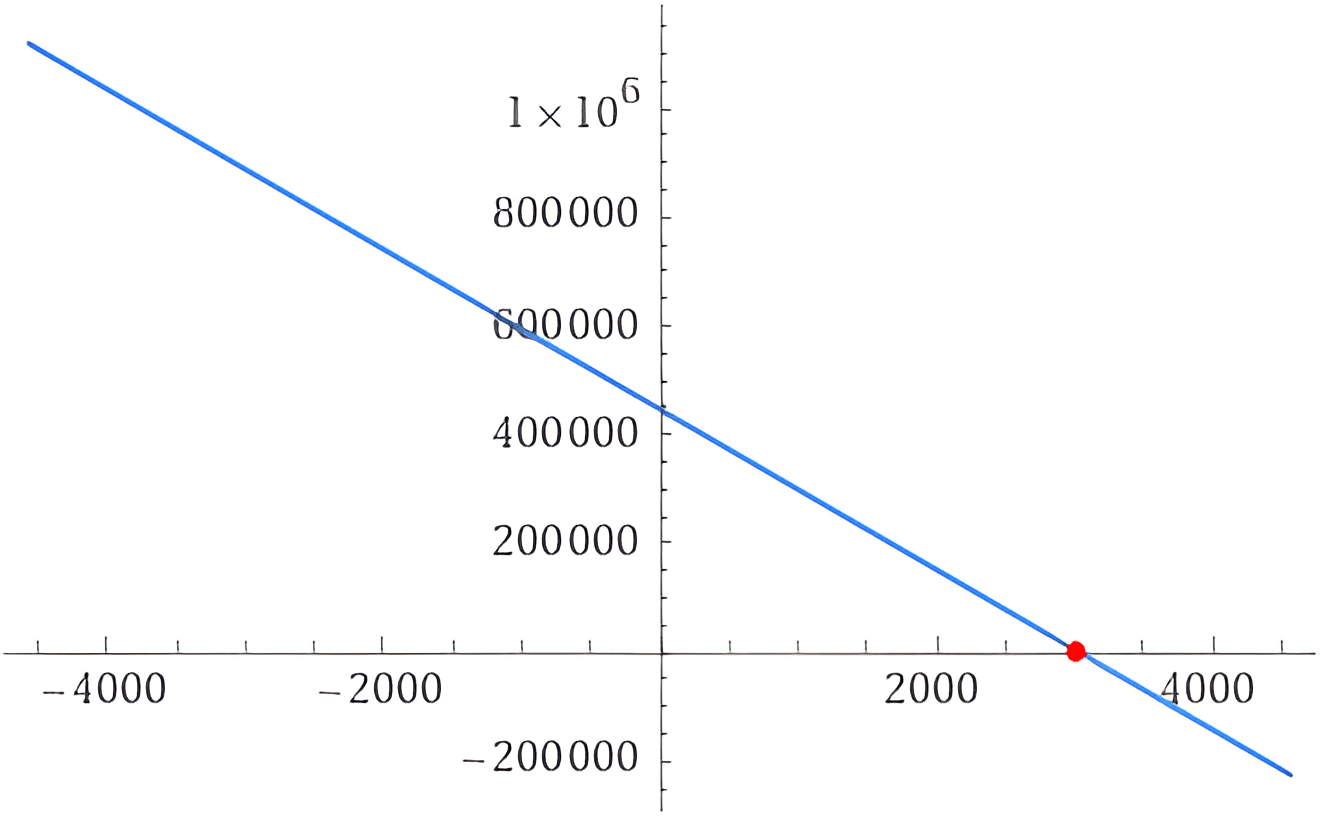
Solution by Steps
step 1
We start with the given equation: 300000⋅(1+120.04)120−b⋅120.04(1+120.04)120−1=0
step 2
Simplify the monthly interest rate: 120.04=0.0033333
step 3
Substitute the monthly interest rate into the equation: 300000⋅(1+0.0033333)120−b⋅0.0033333(1+0.0033333)120−1=0
step 4
Calculate (1+0.0033333)120: (1+0.0033333)120≈1.488863
step 5
Substitute the calculated value into the equation: 300000⋅1.488863−b⋅0.00333331.488863−1=0
step 6
Simplify the equation: 300000⋅1.488863−b⋅146.6589=0
step 7
Solve for b: b=146.6589300000⋅1.488863≈3037.35
Answer
b≈3037.35
Key Concept
Loan repayment calculation
Explanation
The monthly payment b is determined by solving the equation that balances the loan amount with the interest and payments over the loan period.

Solution by Steps
step 1
To find the number of ways to arrange 6 stones in a circular pattern with a discernable front and back, we use the formula for circular permutations: (n−1)!
step 2
Here, n=6, so the number of arrangements is (6−1)!=5!
step 3
Calculate 5!: 5!=5×4×3×2×1=120
Answer
120
step 1
To find the number of ways to arrange 6 stones in a circular pattern without a discernable front and back, we use the formula for circular permutations with reflection: 2(n−1)!
step 2
Here, n=6, so the number of arrangements is 2(6−1)!=25!
step 3
Calculate 25!: 25!=2120=60
Answer
60
Key Concept
Circular Permutations
Explanation
The number of ways to arrange objects in a circle differs based on whether the arrangement has a discernable front and back. For a circle with a discernable front and back, the formula is (n−1)!. For a circle without a discernable front and back, the formula is 2(n−1)!.
© 2023 AskSia.AI all rights reserved