
AskSia
Plus

Which of the following is the correct form of the partial fraction decompositio...
Sep 23, 2024



Generated Graph
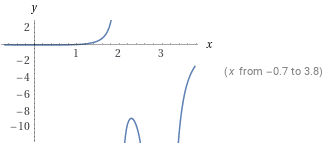
Solution by Steps
step 2
To find the coefficients A, B, and C, we multiply both sides by the denominator (x−3)2(x−2) to eliminate the fractions: 1−x=A(x−3)2+B(x−2)(x−3)+C(x−2)
step 3
Expanding the right-hand side gives us a polynomial in x. We can then equate coefficients from both sides to solve for A, B, and C
step 4
After solving the equations, we find that the correct decomposition is (x−2)−1+(x−3)1−(x−3)22
step 5
Thus, the correct form of the partial fraction decomposition matches option (a): (x−2)A+(x−3)B+(x−3)2C
A
Key Concept
Partial Fraction Decomposition
Explanation
This technique allows us to express a rational function as a sum of simpler fractions, making it easier to integrate or analyze.

Solution by Steps
step 1
We start with the quadratic function 4x2−20x−2 and aim to rewrite it in the form a(x−p)2+q
step 2
First, we factor out the coefficient of x2 from the first two terms: 4(x2−5x)−2
step 3
Next, we complete the square for the expression inside the parentheses. The term to complete the square is (2−5)2=425. Thus, we rewrite it as: 4(x2−5x+425−425)−2
step 4
This simplifies to 4((x−25)2−425)−2
step 5
Distributing the 4 gives us 4(x−25)2−25−2, which simplifies to 4(x−25)2−27
step 6
Therefore, the quadratic function in the desired form is 4(x−25)2−27
Answer
4(x−25)2−27
Key Concept
Completing the square is a method used to rewrite quadratic functions in vertex form.
Explanation
The vertex form a(x−p)2+q allows us to easily identify the vertex of the parabola represented by the quadratic function. In this case, the vertex is at (25,−27).

Solution by Steps
step 1
To find the number of different ways to form a group of 4 students from 73 students, we use the combination formula C(n,r)=r!(n−r)!n!. Here, n=73 and r=4
step 2
Plugging in the values, we calculate C(73,4)=4!(73−4)!73!=4!⋅69!73!
step 3
This simplifies to C(73,4)=4×3×2×173×72×71×70
step 4
Calculating the numerator: 73×72×71×70=19448160 and the denominator: 4×3×2×1=24
step 5
Finally, we divide the numerator by the denominator: 2419448160=810840. Thus, the number of different ways to form a group of 4 students is 1088430
Answer
1088430
Key Concept
Combination formula for selecting groups
Explanation
The answer represents the total number of ways to choose 4 students from a group of 73, calculated using the combination formula.

Generated Graph
Solution by Steps
step 1
Since (x−1) is a factor of p(x), we can use the Factor Theorem. This means that p(1)=0. Thus, we substitute x=1 into the polynomial: p(1)=2(1)3−(1)2+a(1)+b=0
step 2
Simplifying this gives us: 2−1+a+b=0, which simplifies to a+b+1=0. Therefore, we have the equation: a+b=−1
step 3
Next, we use the information about the remainder when p(x) is divided by (x+3). According to the Remainder Theorem, p(−3)=−36. Substituting x=−3 into the polynomial gives us: p(−3)=2(−3)3−(−3)2+a(−3)+b=−36
step 4
Simplifying this gives us: p(−3)=2(−27)−9−3a+b=−36, which simplifies to −54−9−3a+b=−36. Thus, we have the equation: −3a+b−63=0, or −3a+b=63
step 5
Now we have a system of equations: a+b=−1 and −3a+b=63. We can solve this system to find the values of a and b. Subtracting the first equation from the second gives us: −3a+b−(a+b)=63−(−1), which simplifies to −4a=64
step 6
Solving for a gives us: a=−16. Substituting a=−16 back into the first equation a+b=−1 gives us: −16+b=−1, thus b=15
Answer
a=−16, b=15
Key Concept
Factor Theorem and Remainder Theorem
Explanation
We used the Factor Theorem to find that p(1)=0 and the Remainder Theorem to find p(−3)=−36, leading to a system of equations to solve for a and b.

Solution by Steps
step 1
Since (x−1) is a factor of p(x), we can use the Factor Theorem. This means that p(1)=0. Thus, we substitute x=1 into the polynomial: p(1)=2(1)3−(1)2+a(1)+b=0
step 2
Simplifying this gives us: 2−1+a+b=0, which simplifies to a+b+1=0. Therefore, we have the equation: a+b=−1
step 3
Next, since the remainder when p(x) is divided by x+3 is -36, we can use the Remainder Theorem. This means that p(−3)=−36. Substituting x=−3 into the polynomial gives us: p(−3)=2(−3)3−(−3)2+a(−3)+b=−36
step 4
Simplifying this gives us: 2(−27)−9−3a+b=−36, which simplifies to −54−9−3a+b=−36. Thus, we have the equation: −3a+b=27
step 5
Now we have a system of equations: a+b=−1 and −3a+b=27. We can solve this system. From the first equation, we can express b as b=−1−a. Substituting this into the second equation gives us: −3a+(−1−a)=27
step 6
Simplifying this gives us: −4a−1=27, which leads to −4a=28, thus a=−7. Substituting a=−7 back into b=−1−a gives us: b=−1−(−7)=6
Answer
a=−7, b=6
Key Concept
Factor and Remainder Theorems are used to find coefficients in polynomials.
Explanation
By applying the Factor Theorem and Remainder Theorem, we set up equations to solve for the unknown coefficients a and b.


Solution by Steps
step 1
To find the partial fractions decomposition of (x+1)(x+5)x−15, we set it up as (x+1)A+(x+5)B
step 2
Multiplying both sides by the denominator (x+1)(x+5) gives us x−15=A(x+5)+B(x+1)
step 3
Expanding the right side results in x−15=Ax+5A+Bx+B=(A+B)x+(5A+B)
step 4
Equating coefficients, we have A+B=1 and 5A+B=−15
step 5
Solving the system of equations, from A+B=1, we can express B=1−A. Substituting into the second equation gives 5A+(1−A)=−15
step 6
Simplifying this results in 4A+1=−15, leading to 4A=−16 and thus A=−4
step 7
Substituting A=−4 back into B=1−A gives B=1−(−4)=5
Answer
The partial fractions decomposition is (x+1)−4+(x+5)5
Key Concept
Partial fractions decomposition is a method used to express a rational function as a sum of simpler fractions.
Explanation
The answer shows how to break down a complex fraction into simpler components, making it easier to integrate or analyze.
© 2023 AskSia.AI all rights reserved