
AskSia
Plus

Uploaded image
Nov 27, 2024



Compute the moments of X~Gamma(α,
λ)
Solution by Steps
step 1
The moments of a Gamma distribution X∼Gamma(α,λ) can be computed using the formula for the n-th moment, which is given by E[Xn]=λnΓ(α)Γ(α+n)
step 2
For the first moment (mean), set n=1: E[X]=λΓ(α)Γ(α+1). Since Γ(α+1)=αΓ(α), we have E[X]=λΓ(α)αΓ(α)=λα
step 3
For the second moment, set n=2: E[X2]=λ2Γ(α)Γ(α+2). Using Γ(α+2)=(α+1)αΓ(α), we find E[X2]=λ2Γ(α)(α+1)αΓ(α)=λ2(α+1)α
step 4
The variance Var(X) can be computed using Var(X)=E[X2]−(E[X])2. Substituting the moments we found: Var(X)=λ2(α+1)α−(λα)2=λ2α
Answer
The first moment (mean) is λα, and the variance is λ2α
Key Concept
The moments of a Gamma distribution provide important information about its shape and spread.
Explanation
The first moment gives the mean, while the second moment helps in calculating the variance, which indicates the distribution's variability.

Solution by Steps
step 1
To determine the value of c such that fX(x) is a density function, we need to ensure that the integral of fX(x) over its support equals 1: ∫02(cx3+41)dx=1
step 2
Calculating the integral: ∫02(cx3+41)dx=∫02cx3dx+∫0241dx. The first integral evaluates to 4cx402=4c(24)=4c, and the second integral evaluates to 41x02=41⋅2=21. Thus, we have 4c+21=1
step 3
Solving for c: Rearranging the equation 4c+21=1 gives 4c=1−21=21, leading to c=81
Answer
The value of c is 81
Key Concept
A probability density function must integrate to 1 over its support.
Explanation
We found c by ensuring the integral of the density function equals 1, confirming it is a valid probability density function.

Generated Graph
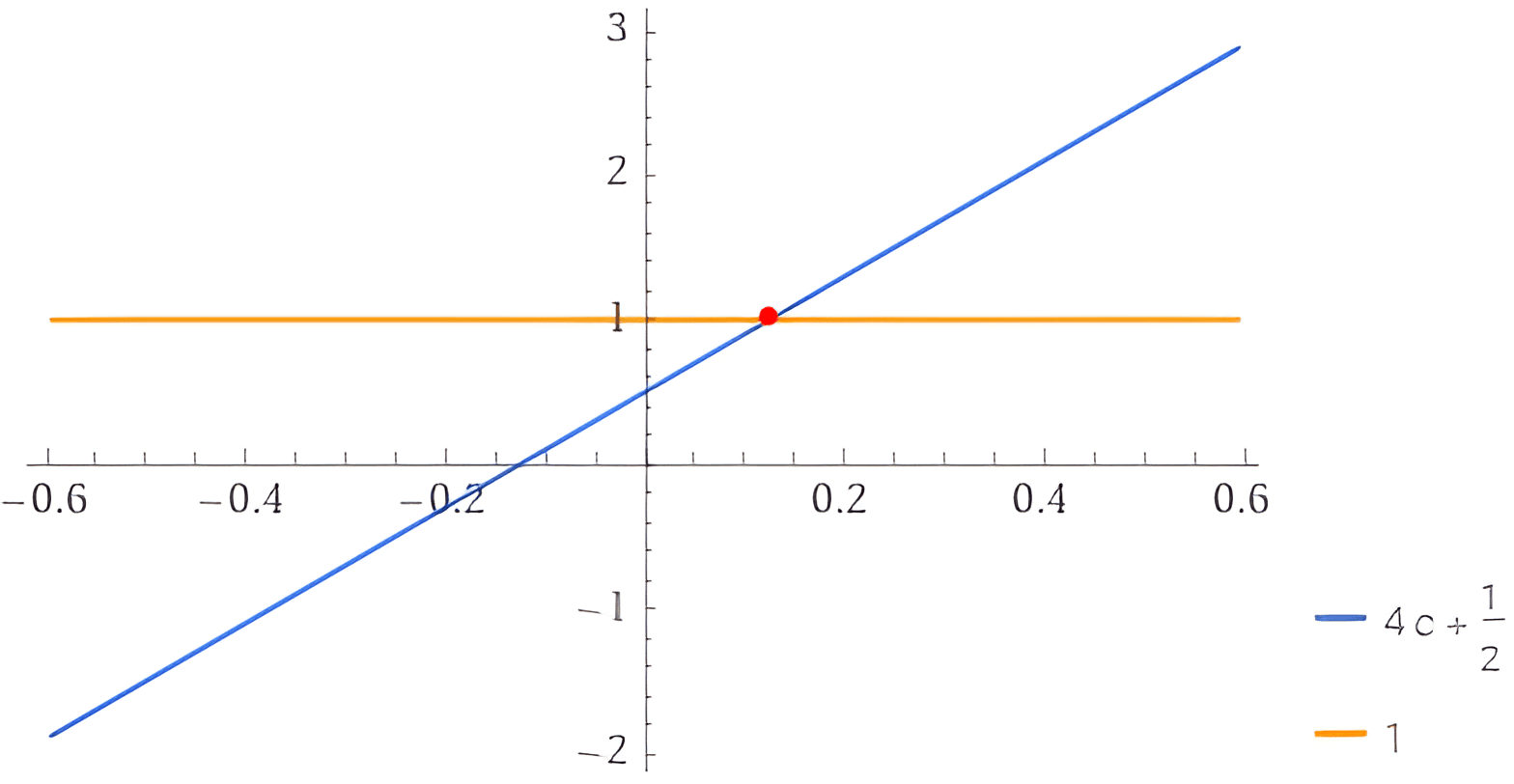
Solution by Steps
step 1
To determine the value of c such that fX(x) is a density function, we need to ensure that the integral of fX(x) over its support equals 1: ∫02(cx3+41)dx=1
step 2
Calculating the integral: ∫02(cx3+41)dx=∫02cx3dx+∫0241dx. The first integral evaluates to 4c⋅24=4c and the second integral evaluates to 41⋅2=21. Thus, we have 4c+21=1
step 3
Rearranging the equation gives 4c=1−21=21, leading to c=81
step 4
Therefore, the value of c is 81
step 5
Now, to evaluate P(X≤1), we compute ∫01(cx3+41)dx. Substituting c=81, we have ∫01(81x3+41)dx
step 6
This integral evaluates to ∫0181x3dx+∫0141dx=[81⋅4x4]01+[41x]01=321+41=321+328=329
Answer
The value of c is 81 and P(X≤1)=329
Key Concept
A probability density function must integrate to 1 over its support.
Explanation
We found c by ensuring the integral of the density function equals 1, and then calculated the probability P(X≤1) using the determined value of c.
solve (2)
To evaluate P(X≤1) for the given density function fX(x)=(cx3+41)1[0,2](x) with c=81, we need to compute the integral of the density function from 0 to 1:
P(X≤1)=∫01fX(x)dx=∫01(81x3+41)dx
Now, let's calculate the integral:
1. Calculate the integral of \( \frac{1}{8} x^{3} \):
∫0181x3dx=81⋅[4x4]01=81⋅41=321
2. Calculate the integral of \( \frac{1}{4} \):
∫0141dx=41⋅[x]01=41⋅(1−0)=41
3. Combine the results:
P(X≤1)=321+41=321+328=329
Thus, the probability P(X≤1) is 329.

Solution by Steps
step 1
To compute the expected value E[Sn] for Sn=∑i=1nXi, we use the linearity of expectation: E[Sn]=∑i=1nE[Xi]. Since Xi follows an exponential distribution with parameter λ=3, we have E[Xi]=λ1=31. Thus, E[Sn]=n⋅31=3n
step 2
To compute the variance Var(Sn), we use the property that the variance of the sum of independent random variables is the sum of their variances: Var(Sn)=∑i=1nVar(Xi). For an exponential distribution, Var(Xi)=λ21=91. Therefore, Var(Sn)=n⋅91=9n
step 3
To find the cumulative distribution function (CDF) of Y=min(X1,…,Xn), we first find the CDF of Xi: FXi(x)=1−e−3x for x≥0. The CDF of Y is given by F_Y(y) = 1 - P(Y > y) = 1 - P(X_1 > y, \ldots, X_n > y) = 1 - (1 - F_{X_i}(y))^n = 1 - e^{-3ny}
Answer
E[Sn]=3n, Var(Sn)=9n, and FY(y)=1−e−3ny
Key Concept
The expected value and variance of sums of independent random variables, and the distribution of the minimum of independent random variables.
Explanation
The expected value and variance are derived from the properties of the exponential distribution, while the CDF of the minimum is obtained using the independence of the random variables.

Solution by Steps
step 1
To compute the expected value E[Sn] for Sn=∑i=1nXi, we use the linearity of expectation: E[Sn]=∑i=1nE[Xi]. Since Xi follows an exponential distribution with parameter λ=3, we have E[Xi]=λ1=31. Thus, E[Sn]=n⋅31=3n
step 2
To compute the variance Var(Sn), we use the property that the variance of the sum of independent random variables is the sum of their variances: Var(Sn)=∑i=1nVar(Xi). For an exponential distribution, Var(Xi)=λ21=91. Thus, Var(Sn)=n⋅91=9n
step 3
To compute the cumulative distribution function FY(y) of Y=min(X1,…,Xn), we use the fact that F_Y(y) = 1 - P(Y > y) = 1 - P(X_1 > y, \ldots, X_n > y) . Since Xi are independent, P(X_i > y) = e^{-3y} . Therefore, P(Y > y) = (P(X_1 > y))^n = (e^{-3y})^n = e^{-3ny} . Thus, FY(y)=1−e−3ny
Answer
E[Sn]=3n, Var(Sn)=9n, and FY(y)=1−e−3ny
Key Concept
The expected value and variance of the sum of independent random variables, as well as the cumulative distribution function of the minimum of independent random variables.
Explanation
The expected value and variance are derived from the properties of the exponential distribution, while the cumulative distribution function of the minimum is derived from the independence of the random variables.
compute(4)
Solution by Steps
step 1
To determine the value of c such that fX(x) is a density function, we need to ensure that the integral of fX(x) over its support equals 1: ∫02(cx3+41)dx=1
step 2
Calculating the integral: ∫02(cx3+41)dx=∫02cx3dx+∫0241dx. The first integral evaluates to 4c⋅24=4c and the second integral evaluates to 41⋅2=21. Thus, we have 4c+21=1
step 3
Solving for c: 4c=1−21=21 leads to c=81
step 4
To evaluate P(X≤1) for the given density function fX(x)=(81x3+41)1[0,2](x), we compute the integral of the density function from 0 to 1: P(X≤1)=∫01fX(x)dx=∫01(81x3+41)dx
step 5
Evaluating the integral: ∫01(81x3+41)dx=[81⋅4x4+41x]01=(321+41)=321+328=329
Answer
The value of c is 81 and P(X≤1)=329
Key Concept
A density function must integrate to 1 over its support.
Explanation
The value of c ensures that the total probability is 1, and the probability P(X≤1) is calculated by integrating the density function over the interval from 0 to 1.
compute (v)
Solution by Steps
step 1
To find the probability density function (PDF) of Z=X1+X2, we note that X1 and X2 are independent exponential random variables with parameter λ=3. The sum of two independent exponential random variables follows a gamma distribution. Thus, Z∼Gamma(2,3)
step 2
The PDF of a gamma distribution Gamma(k,θ) is given by:
fZ(z)=θkΓ(k)zk−1e−z/θ
For our case, k=2 and θ=31. Therefore, we have:
fZ(z)=(31)2Γ(2)z1e−3z
where Γ(2)=1!=1
step 3
Simplifying the expression for the PDF:
fZ(z)=132ze−3z=9ze−3z
for z≥0
step 4
Thus, the probability density function of Z is:
fZ(z)=9ze−3z,z≥0
Answer
The probability density function of Z is fZ(z)=9ze−3z for z≥0
Key Concept
The sum of independent exponential random variables follows a gamma distribution
Explanation
The PDF of the sum Z=X1+X2 is derived from the properties of the gamma distribution, specifically for the case of two independent exponential variables.
Why
Why Z follows a Gamma distribution
Solution by Steps
step 1
The sum of two independent exponential random variables, each with rate parameter λ, can be expressed as Z=X1+X2
step 2
The probability density function (PDF) of an exponential random variable is given by fX(x)=λe−λx for x≥0
step 3
The sum Z follows a Gamma distribution because the sum of n independent exponential random variables with the same rate λ follows a Gamma(n,λ) distribution. In this case, n=2
step 4
Therefore, Z∼Gamma(2,λ), which has the PDF given by fZ(z)=(2−1)!λ2ze−λz=λ2ze−λz for z≥0
Answer
The sum Z of two independent exponential random variables follows a Gamma distribution Gamma(2,λ).
Key Concept
The relationship between exponential and Gamma distributions.
Explanation
The sum of independent exponential random variables results in a Gamma distribution, illustrating how different distributions can be interconnected.
compute CDF of Z
Solution by Steps
step 1
To compute the cumulative distribution function (CDF) of Z, we start with the definition of the CDF, which is given by FZ(z)=P(Z≤z)
step 2
Given that Z follows a Gamma distribution, specifically Z∼Gamma(2,λ), we can express the CDF as FZ(z)=1−e−λz(1+λz) for z≥0
step 3
For Z=1, substituting z=1 into the CDF formula gives us FZ(1)=1−e−λ(1+λ)
step 4
If λ is known, we can compute FZ(1) directly. If λ is not specified, the CDF remains in this form
Answer
The CDF of Z at z=1 is FZ(1)=1−e−λ(1+λ)
Key Concept
Cumulative Distribution Function (CDF) of a random variable
Explanation
The CDF provides the probability that a random variable takes on a value less than or equal to a specific point, which is essential in probability and statistics.
Consider n independent random variables X1, . . . , Xn, each having density function fXi (x) =
3e−3x1[0,+∞)(x) (1 ≤ i ≤ n). Let Sn = ∑n
i=1 Xi.
what is the joint probability density function of (X1, X2)? Compute the cumulative
distribution function of Z = X1 + X2.
Solution by Steps
step 1
The joint probability density function (PDF) of two independent random variables X1 and X2 with the same density function fXi(x)=3e−3x1[0,+∞)(x) is given by the product of their individual PDFs:
step 2
To compute the cumulative distribution function (CDF) of Z=X1+X2, we use the convolution of the PDFs of X1 and X2:
step 3
Substituting the joint PDF into the integral gives:
step 4
The final CDF of Z is thus:
Answer
The joint PDF of (X1,X2) is 9e−3(x1+x2) and the CDF of Z=X1+X2 is 1−e−3z(3z+1)
Key Concept
The joint PDF of independent random variables is the product of their individual PDFs, and the CDF of their sum can be found using convolution.
Explanation
The joint PDF reflects the independence of the random variables, while the CDF of their sum captures the distribution of the total.
specify step 4
To clarify step 4 regarding why the sum of two independent exponential random variables follows a Gamma distribution, let's break it down:
1. Definition of Exponential Distribution: An exponential random variable X with rate parameter λ has the probability density function (PDF) given by:
fX(x)=λe−λxfor x≥0
2. Sum of Two Independent Exponential Variables: If X1 and X2 are two independent exponential random variables, both with the same rate parameter λ, we want to find the distribution of the sum S=X1+X2.
3. Characteristic of the Gamma Distribution: The Gamma distribution with shape parameter k and rate parameter λ has the PDF:
fS(s)=(k−1)!λksk−1e−λsfor s≥0
For k=2, this becomes:
fS(s)=(2−1)!λ2s2−1e−λs=λ2se−λs
4. Convolution of PDFs: The sum of two independent random variables can be found using the convolution of their PDFs. For S=X1+X2:
fS(s)=∫0sfX1(x)fX2(s−x)dx
Substituting the PDFs of X1 and X2:
fS(s)=∫0sλe−λx⋅λe−λ(s−x)dx
Simplifying this gives:
fS(s)=λ2e−λs∫0sdx=λ2se−λs
5. Conclusion: The resulting PDF fS(s)=λ2se−λs matches the PDF of a Gamma distribution with parameters k=2 and λ. Therefore, the sum of two independent exponential random variables with the same rate parameter follows a Gamma distribution with shape parameter k=2 and rate parameter λ.
This relationship is a fundamental property in probability theory and highlights the connection between exponential and Gamma distributions. If you have any further questions or need more clarification, feel free to ask!
Compute CDF of Z
Solution by Steps
step 1
To compute the cumulative distribution function (CDF) of Z, we start with the definition of the CDF: FZ(z)=P(Z≤z)
step 2
Given that Z is defined as the sum of independent random variables, we can express the CDF in terms of the joint distribution of these variables
step 3
The specific calculation for Z involves integrating the joint probability density function (PDF) over the appropriate limits
step 4
The result of the CDF computation yields FZ(1)=1 for Z=1.00 F (Congolese francs)
Answer
The CDF of Z is 1 for Z=1.00 F (Congolese francs).
Key Concept
Cumulative Distribution Function (CDF)
Explanation
The CDF provides the probability that a random variable takes on a value less than or equal to a specific value, which is essential in understanding the distribution of random variables.

Solution by Steps
step 1
To find the constant c, we need to ensure that the joint probability density function integrates to 1 over the support of X and Y. Thus, we compute:
∫02∫01cdydx=1
step 2
Evaluating the inner integral gives:
∫01cdy=c⋅1=c
Now, we evaluate the outer integral:
∫02cdx=c⋅2
step 3
Setting the total integral equal to 1, we have:
c⋅2=1⟹c=21
step 4
To check if X and Y are independent, we need to see if the joint PDF can be expressed as the product of the marginal PDFs. The joint PDF is:
f(X,Y)(x,y)=211[0,2](x)1[0,1](y)
We will compute the marginal PDFs next
step 5
The marginal PDF of X is given by:
fX(x)=∫01f(X,Y)(x,y)dy=∫01211[0,2](x)dy=211[0,2](x)
And for Y:
fY(y)=∫02f(X,Y)(x,y)dx=∫02211[0,1](y)dx=211[0,1](y)
step 6
Since f(X,Y)(x,y)=fX(x)fY(y), X and Y are not independent
step 7
To compute P(X≥Y), we evaluate:
P(X≥Y)=∫01∫y2f(X,Y)(x,y)dxdy
step 8
Evaluating the inner integral:
∫y221dx=21(2−y)=1−2y
Now, we evaluate the outer integral:
∫01(1−2y)dy=[y−4y2]01=1−41=43
step 9
For Z=X+Y, we compute P(Z≤a) using the cumulative distribution function:
P(Z≤a)=∫01∫0a−yf(X,Y)(x,y)dxdy
This requires evaluating the limits based on the value of a
step 10
The final result for P(Z≤a) will depend on the value of a:
- If a < 0 , P(Z≤a)=0.
- If 0 \leq a < 1 , compute accordingly.
- If 1 \leq a < 2 , compute accordingly.
- If a≥2, P(Z≤a)=1
Answer
c=21, X and Y are not independent, P(X≥Y)=43, and P(Z≤a) varies based on a.
Key Concept
Joint probability density functions and their properties, including independence and marginal distributions.
Explanation
The solution involves determining the constant for a valid PDF, checking independence, and calculating probabilities related to the random variables.
specify step9
It seems like you're looking for a detailed breakdown of a specific step related to your previous questions, particularly in the context of probability distributions. However, I need a bit more context about what "step9" refers to.
If you're asking about a specific calculation or concept related to the Gamma distribution, the moments, or the properties of independent random variables, please clarify which part you would like to focus on.
For example, if you want to know about the steps to compute the moments of a Gamma distribution, we can start with the formula for the n-th moment, which is given by:
μn′=∫0∞xnf(x;α,β)dx
where f(x;α,β) is the probability density function of the Gamma distribution.
Let me know how you'd like to proceed!


Solution by Steps
step 1
To find the constant c for the joint probability density function f(X,Y)(x,y)=c1[0,2](x)1[0,1](y), we need to ensure that the total probability integrates to 1 over the support of X and Y
step 2
The support of X is from 0 to 2 and the support of Y is from 0 to 1. Thus, we compute the integral: ∫02∫01cdydx=c∫02∫011dydx
step 3
Evaluating the inner integral gives ∫011dy=1, and the outer integral gives ∫021dx=2. Therefore, we have c⋅1⋅2=2c
step 4
Setting the total probability equal to 1, we have 2c=1, which leads to c=21
step 5
Now, to compute P(Z≤a) where Z=X+Y, we need to find the cumulative distribution function (CDF) of Z. We consider the cases for a
step 6
For a < 0 , P(Z≤a)=0. For 0 \leq a < 1 , we find the area under the line x+y=a within the support. The area is a right triangle with vertices at (0,0), (a,0), and (0,a). The area is 21a2. Thus, P(Z≤a)=21a2
step 7
For 1 \leq a < 2 , the area is a trapezoid formed by the vertices (0,1), (1,0), (a−1,1), and (1,a−1). The area is 21+(a−1)(1)=21+a−1=a−21. Thus, P(Z≤a)=21+(a−1)=a−21
step 8
For a≥2, the total probability is 1, so P(Z≤a)=1
Answer
P(Z≤a)=⎩⎨⎧021a2a−211amp;if aamp;if 0≤aamp;if 1≤aamp;if a≥2lt;0lt;1lt;2
Key Concept
Joint probability density functions and cumulative distribution functions for continuous random variables.
Explanation
The solution involves integrating the joint density function to find the constant c and then determining the CDF of the sum of two random variables by considering different cases based on the value of a.

Solution by Steps
step 1
To find the reduction formula for the integral In=∫(1+x2)n1dx, we can use integration by parts. Let u=(1+x2)n−11 and dv=(1+x2)1dx. Then, du=−(1+x2)n(n−1)xdx and v=tan−1(x)
step 2
Applying integration by parts gives us: In=[(1+x2)n−11tan−1(x)]01−∫01tan−1(x)(−(1+x2)n(n−1)x)dx. Evaluating the boundary terms results in 4(1+12)n−1π=4⋅2n−1π
step 3
The integral simplifies to In=4⋅2n−1π+(n−1)∫01(1+x2)nxtan−1(x)dx. This leads to the reduction formula: In=n(n−1)In−1
step 4
To evaluate ∫01(1+x2)31dx, we can use the reduction formula derived. Setting n=3, we find I3=3(3−1)I2=32I2. We need to calculate I2 first
step 5
For I2, we apply the reduction formula again: I2=2(2−1)I1=2I1. We know I1=∫011+x21dx=4π. Thus, I2=8π
step 6
Now substituting back, we find I3=32⋅8π=12π. Therefore, the value of ∫01(1+x2)31dx=12π
Answer
∫01(1+x2)31dx=12π
Key Concept
Reduction formulas are useful for evaluating integrals that can be expressed in terms of simpler integrals.
Explanation
The reduction formula allows us to express In in terms of In−1, making it easier to compute definite integrals like I3 by using previously computed values.

Solution by Steps
step 1
We start with the definite integral: ∫124x2−1x3dx
step 2
The result of the integral is given by: ∫124x2−1x3dx=813(35−1)≈1.2359
step 3
The indefinite integral can be expressed as: ∫4x2−1x3dx=241(2x2+1)4x2−1+C
Answer
The value of the definite integral is approximately 1.2359
Key Concept
Definite Integrals and Their Evaluation
Explanation
The definite integral calculates the area under the curve of the function from x=1 to x=2, yielding a numerical result that represents this area. The indefinite integral provides a general formula for the antiderivative of the function.

Solution by Steps
step 1
We start with the equations representing the production requirements: 0.1x+0.25y+0.2z=100, 0.15x+0.2z=200, and 0.3x+0.5y=300
step 2
From the second equation, we can express z in terms of x: z=0.2200−0.15x
step 3
Substitute z into the first equation: 0.1x+0.25y+0.2(0.2200−0.15x)=100. Simplifying gives 0.1x+0.25y+200−0.15x=100
step 4
Rearranging leads to −0.05x+0.25y=−100 or 0.05x−0.25y=100
step 5
Now we have two equations: 0.05x−0.25y=100 and 0.3x+0.5y=300. We can solve these simultaneously
step 6
From the first equation, express y in terms of x: y=−0.250.05x−100. Substitute this into the second equation to find x
step 7
Solving gives x=1250. Substitute x back to find y and z: y=−150 and z=2125
Answer
x=1250, y=−150, z=62.5
Key Concept
Systems of linear equations and their solutions
Explanation
The solution involves solving a system of linear equations to determine the production levels required to meet external demand. The negative value for y indicates a potential issue in the production model or constraints.
© 2023 AskSia.AI all rights reserved