
AskSia
Plus

This is basic algebra. Please answer all of the questions.
Tutorial: Complex Num...
Jul 9, 2024

This is basic algebra. Please answer all of the questions.

Generated Graph
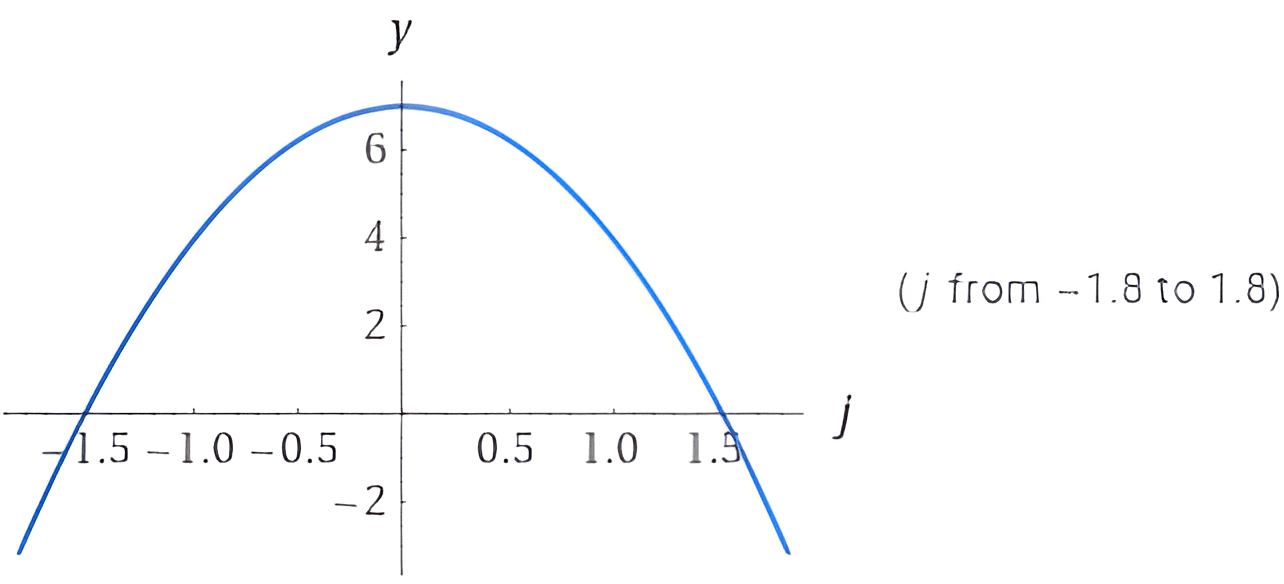
Solution by Steps
step 1
Expand the expression: (5+j3)(2−j)−(3+j)
step 2
Use distributive property: 5⋅2+5⋅(−j)+j3⋅2+j3⋅(−j)−(3+j)
step 3
Simplify: 10−5j+6j−3j2−3−j
step 4
Since j2=−1: 10−5j+6j+3−3−j
step 5
Combine like terms: 10+3−5j+6j−j−3
step 6
Final result: 10+3−3−j=10−j
step 1
Expand the expression: (1−j2)2
step 2
Use distributive property: (1−j2)(1−j2)
step 3
Simplify: 1−j2−j2+(j2)2
step 4
Since j2=−1: 1−2j−2j+4
step 5
Combine like terms: 1+4−4j
step 6
Final result: 5−4j
step 1
Simplify the expression: 3−j45−j8
step 2
Multiply numerator and denominator by the conjugate of the denominator: (3−j4)(3+j4)(5−j8)(3+j4)
step 3
Simplify: 9+1615+20j−24−j32
step 4
Combine like terms: 25−9+20j−32j
step 5
Final result: 25−9−12j=−259−2512j
step 1
Expand the expression: 21(1+j)2
step 2
Use distributive property: 21(1+2j+j2)
step 3
Since j2=−1: 21(1+2j−1)
step 4
Combine like terms: 21(2j)
step 5
Final result: j
step 1
Simplify the expression: 5−j31−5+j31
step 2
Multiply numerator and denominator by the conjugate of the denominator: (5−j3)(5+j3)(5+j3)−(5−j3)
step 3
Simplify: 25+95+j3−5+j3
step 4
Combine like terms: 342j3
step 5
Final result: 346j=173j
step 1
Use the quadratic formula: x=2a−b±b2−4ac
step 2
Substitute a=1, b=2, c=2: x=2⋅1−2±22−4⋅1⋅2
step 3
Simplify: x=2−2±4−8
step 4
Since −4=2j: x=2−2±2j
step 5
Final result: x=−1±j
step 1
Rewrite the equation: x3=−8
step 2
Find the cube roots: x=3−8
step 3
Simplify: x=−2
step 4
Find the complex roots: x=1−j3 and x=1+j3
step 5
Final result: x=−2,1−j3,1+j3
step 1
Rewrite the equation: zz∗+3(z−z∗)=13+j12
step 2
Simplify: zz∗+3z−3z∗=13+j12
step 3
Use the property z∗=z: zz+3z−3z=13+j12
step 4
Solve for z: z=±12j+13
step 5
Final result: z=±12j+13
step 1
Multiply z by j: j(2−j3)
step 2
Simplify: 2j−j23
step 3
Since j2=−1: 2j+3
step 4
Final result: 3+2j
step 1
Find the conjugate of z: 2−j3
step 2
Conjugate: 2+j3
step 3
Final result: 2+j3
step 1
Find the reciprocal of z: 2−j31
step 2
Multiply numerator and denominator by the conjugate of the denominator: (2−j3)(2+j3)1⋅(2+j3)
step 3
Simplify: 4+92+j3
step 4
Final result: 132+j3
step 1
Find the conjugate of the conjugate of z: (2+j3)∗
step 2
Conjugate: 2−j3
step 3
Final result: 2−j3
step 1
Substitute z1, z2, and z3: z=3+j4+(−5+j12)2+j3+(3+j4)(−5+j12)
step 2
Simplify the numerator: 2+j3+(3⋅−5+3⋅j12+j4⋅−5+j4⋅j12)
step 3
Simplify: 2+j3+(−15+j36−j20−48)
step 4
Combine like terms: 2+j3−15−48+j36−j20
step 5
Final result: −61+j19
step 1
Cross-multiply: (2+x−jy)(1+j2)=(3x+jy)
step 2
Expand: 2+x+2j+j2x−yj−2y=3x+jy
step 3
Separate real and imaginary parts: 2+x−2y=3x and 2j+j2x−yj=jy
step 4
Solve for x and y: 2−2y=2x and 2+2x−y=y
step 5
Final result: x=−1 and y=−9/2
step 1
Plot the point (1,1) on the Argand diagram
step 2
Find the modulus: 12+12=2
step 3
Find the argument: tan−1(1/1)=π/4
step 4
Final result: Modulus = 2, Argument = π/4
step 1
Plot the point (3,−1) on the Argand diagram
step 2
Find the modulus: (3)2+(−1)2=2
step 3
Find the argument: tan−1(−1/3)=−π/6
step 4
Final result: Modulus = 2, Argument = −π/6
step 1
Plot the point (−1,3) on the Argand diagram
step 2
Find the modulus: (−1)2+(3)2=2
step 3
Find the argument: tan−1(3/−1)=2π/3
step 4
Final result: Modulus = 2, Argument = 2π/3
step 1
Plot the point (−1,−3) on the Argand diagram
step 2
Find the modulus: (−1)2+(−3)2=2
step 3
Find the argument: tan−1(−3/−1)=−2π/3
step 4
Final result: Modulus = 2, Argument = −2π/3
step 1
Polar form: 1ejπ/2
step 2
Exponential form: ejπ/2
step 3
Final result: ejπ/2
step 1
Polar form: 2e−jπ/4
step 2
Exponential form: 2e−jπ/4
step 3
Final result: 2e−jπ/4
step 1
Polar form: 2e−jπ/6
step 2
Exponential form: 2e−jπ/6
step 3
Final result: 2e−jπ/6
step 1
Polar form: 5ejπ/2
step 2
Exponential form: 5ejπ/2
step 3
Final result: 5ejπ/2
step 1
Simplify: 4−j2
step 2
Since j2=−1: 4+1=5
step 3
Final result: 5
step 1
Polar form: 74e−jπ/4
step 2
Exponential form: 74e−jπ/4
step 3
Final result: 74e−jπ/4
step 1
Simplify the expression: 3−j4(2−j)(3+j2)
step 2
Multiply numerator and denominator by the conjugate of the denominator: (3−j4)(3+j4)(2−j)(3+j2)(3+j4)
step 3
Simplify: 9+166+j8−j3−j22
step 4
Combine like terms: 256−2+j8−j3
step 5
Final result: 254+j5=254+255j
step 1
Find the modulus: ∣z13z22∣=∣23⋅42∣=64
step 2
Find the argument: arg(z13z22)=3⋅3π+2⋅−32π=π−34π=−3π
step 3
Final result: Modulus = 64, Argument = −3π
step 1
Find the modulus: ∣z12z24∣=∣22⋅44∣=1024
step 2
Find the argument: arg(z12z24)=2⋅3π+4⋅−32π=32π−38π=−2π
step 3
Final result: Modulus = $
This is basic algebra. Please answer all the questions.
Generated Graph
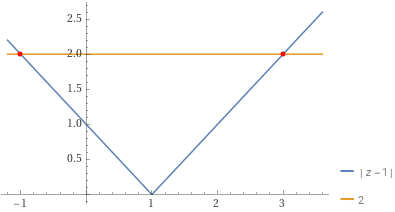
Solution by Steps
step 1
Given the equation Re(z−jz+j)=1, we need to find the locus of z in the complex plane
step 2
From the Asksia-LL calculator, the solutions are:
- \operatorname{Re}(z)<\operatorname{Re}(j) and (Re(j)(Re(z)−Re(j)))/Im(j)+Im(z)=Im(j) and \operatorname{Im}(j)<0
- \operatorname{Re}(z)>\operatorname{Re}(j) and (Re(j)(Re(z)−Re(j)))/Im(j)+Im(z)=Im(j) and \operatorname{Im}(j)<0
- Re(j)=Re(z) and \operatorname{Im}(z)<0 and Im(j)=0 and \operatorname{Re}(j)<0
- Re(j)=Re(z) and \operatorname{Im}(z)>0 and Im(j)=0 and \operatorname{Re}(j)<0
step 1
Given the equation z−jz+j=3, we need to find the locus of z in the complex plane
step 2
From the Asksia-LL calculator, the solutions are:
- z=1+3einj(−1+3ein) and j=0 and n∈R
- z=2j and j<0
- z=2j and j<0
- z=2j and j>0
step 1
Given the equation tanarg(z−jz+j)=3, we need to find the locus of z in the complex plane
step 2
From the Asksia-LL calculator, there are no real solutions
step 1
Given the equation ∣z−1∣=2, we need to find the locus of z in the complex plane
step 2
From the Asksia-LL calculator, the solutions are:
- z=1+2ein and n∈R
- z=−1
- z=3
step 1
Given the equation ∣z−2−j3∣=4, we need to find the locus of z in the complex plane
step 2
From the Asksia-LL calculator, the solutions are:
- z=3j+4ein+2 and n∈R
- z=3(j+2)
- z=3j−2
step 1
Given the equation ∣z−4∣=3∣z+1∣, we need to find the locus of z in the complex plane
step 2
From the Asksia-LL calculator, the solutions are:
- −27≤Re(z)≤41 and Im(z)=±(21−4Re(z)2−13Re(z)+27)
- z=−27
- z=41
step 1
Given the equation z−2z+1=2, we need to find the locus of z in the complex plane
step 2
From the Asksia-LL calculator, the solutions are:
- z=−1+2ein1+4ein and n∈R
- z=1
- z=5
step 1
Given the equation x2+y2+4x=0, we need to describe the circle in terms of z
step 2
The equation can be rewritten as (x+2)2+y2=4
step 3
In terms of z, this represents a circle with center −2 and radius 2
Answer
The loci and Cartesian equations for the given complex number problems are provided above.
Key Concept
Complex number loci and Cartesian equations
Explanation
The solutions involve finding the loci of complex numbers in the Argand diagram and converting complex number equations to Cartesian form.
This is basic algebra. Please answer all the questions.
Generated Graph
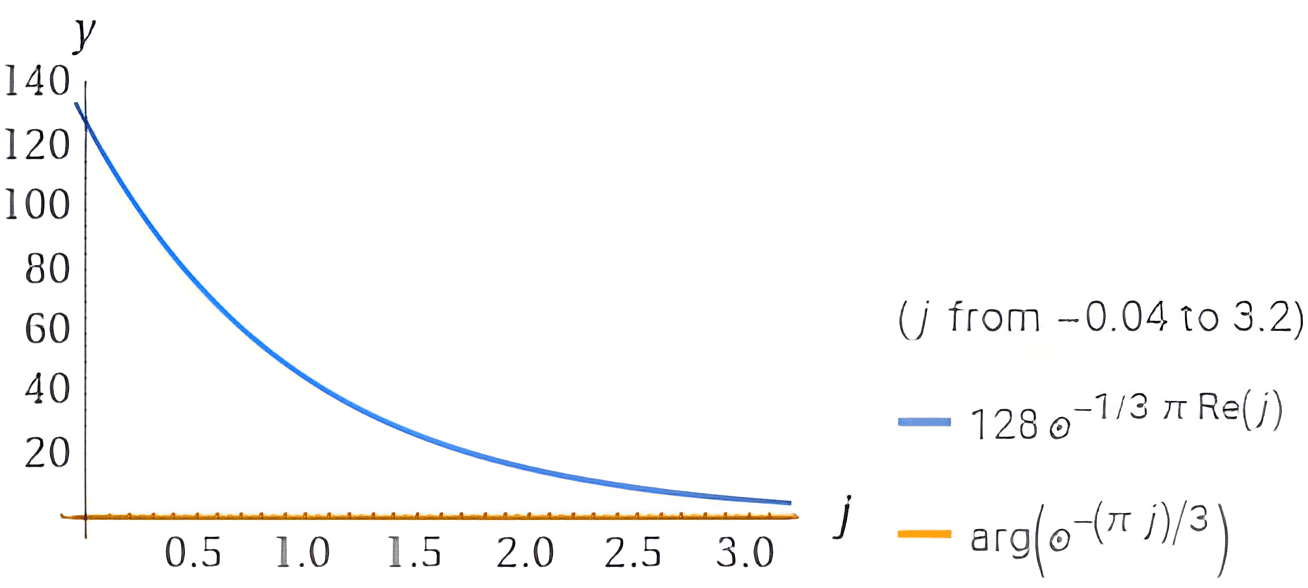
Solution by Steps
step 1
Given z1=2ej3π and z2=4e−j32π, we need to find the modulus and argument of z13z22
step 2
Calculate the modulus: ∣z13z22∣=∣2ej3π∣3⋅∣4e−j32π∣2=23⋅42=8⋅16=128
step 3
Calculate the argument: arg(z13z22)=3⋅3π+2⋅(−32π)=π−34π=−3π
Answer
Modulus: 128, Argument: −3π
Key Concept
Modulus and Argument of Complex Numbers
Explanation
The modulus is the product of the magnitudes, and the argument is the sum of the angles.
step 1
Given z1=2ej3π and z2=4e−j32π, we need to find the modulus and argument of z12z24
step 2
Calculate the modulus: ∣z12z24∣=∣2ej3π∣2⋅∣4e−j32π∣4=22⋅44=4⋅256=1024
step 3
Calculate the argument: arg(z12z24)=2⋅3π+4⋅(−32π)=32π−38π=−2π
Answer
Modulus: 1024, Argument: −2π
Key Concept
Modulus and Argument of Complex Numbers
Explanation
The modulus is the product of the magnitudes, and the argument is the sum of the angles.
step 1
Given z1=2ej3π and z2=4e−j32π, we need to find the modulus and argument of z23z12
step 2
Calculate the modulus: ∣z23z12∣=∣4e−j32π∣3∣2ej3π∣2=4322=644=161
step 3
Calculate the argument: arg(z23z12)=2⋅3π−3⋅(−32π)=32π+2π=38π
Answer
Modulus: 161, Argument: 38π
Key Concept
Modulus and Argument of Complex Numbers
Explanation
The modulus is the quotient of the magnitudes, and the argument is the difference of the angles.
step 1
Use de Moivre's theorem to calculate (1+j)3. First, convert 1+j to polar form: r=12+12=2 and θ=tan−1(1)=4π
step 2
Apply de Moivre's theorem: (2ej4π)3=(2)3ej43π=22ej43π
Answer
22ej43π
Key Concept
De Moivre's Theorem
Explanation
De Moivre's theorem allows us to raise complex numbers in polar form to a power by raising the modulus to the power and multiplying the argument by the power.
step 1
Use de Moivre's theorem to calculate (3−j)3. First, convert 3−j to polar form: r=(3)2+(−1)2=2 and θ=tan−1(3−1)=−6π
step 2
Apply de Moivre's theorem: (2e−j6π)3=23e−j63π=8e−j2π
Answer
8e−j2π
Key Concept
De Moivre's Theorem
Explanation
De Moivre's theorem allows us to raise complex numbers in polar form to a power by raising the modulus to the power and multiplying the argument by the power.
step 1
Use de Moivre's theorem to calculate (−1+j3)3.First,convert-1+j\sqrt{3}topolarform:r = \sqrt{(-1)^2 + (\sqrt{3})^2} = 2and\theta = \tan^{-1}\left(\frac{\sqrt{3}}{-1}\right) = \frac{2\pi}{3}$
step 2
Apply de Moivre's theorem: (2ej32π)3=23ej2π=8ej2π=8
Answer
8
Key Concept
De Moivre's Theorem
Explanation
De Moivre's theorem allows us to raise complex numbers in polar form to a power by raising the modulus to the power and multiplying the argument by the power.
step 1
Use de Moivre's theorem to calculate (−1−j3)3. First, convert −1−j3 to polar form: r=(−1)2+(−3)2=2 and θ=tan−1(−1−3)=−32π
step 2
Apply de Moivre's theorem: (2e−j32π)3=23e−j2π=8e−j2π=8
Answer
8
Key Concept
De Moivre's Theorem
Explanation
De Moivre's theorem allows us to raise complex numbers in polar form to a power by raising the modulus to the power and multiplying the argument by the power.
step 1
Find the three values of (8+j8)31. First, convert 8+j8 to polar form: r=82+82=82 and θ=tan−1(1)=4π
step 2
Apply the cube root: (82ej4π)31=(82)31ej12π=232ej12π
step 3
Find the three roots: 232ej12π,232ej12π+32π,232ej12π+34π
Answer
232ej12π,232ej12π+32π,232ej12π+34π
Key Concept
Cube Roots of Complex Numbers
Explanation
The cube roots of a complex number are found by taking the cube root of the modulus and dividing the argument by 3, then adding multiples of 32π.
step 1
Find the fourth root of (3−j). First, convert 3−j to polar form: r=2 and θ=−6π
step 2
Apply the fourth root: (2e−j6π)41=241e−j24π
Answer
241e−j24π
Key Concept
Roots of Complex Numbers
Explanation
The roots of a complex number are found by taking the root of the modulus and dividing the argument by the root, then adding multiples of n2π.
step 1
Find the cube root of (j8). First, convert j8 to polar form: r=8 and θ=2π
step 2
Apply the cube root: (8ej2π)31=831ej6π=2ej6π
Answer
2ej6π
Key Concept
Roots of Complex Numbers
Explanation
The roots of a complex number are found by taking the root of the modulus and dividing the argument by the root, then adding multiples of n2π.
step 1
Find the fourth root of (−1). First, convert −1 to polar form: r=1 and θ=π
step 2
Apply the fourth root: (1ejπ)41=141ej4π=ej4π
Answer
ej4π
Key Concept
Roots of Complex Numbers
Explanation
The roots of a complex number are found by taking the root of the modulus and dividing the argument by the root, then adding multiples of n2π.
step 1
The locus of z when Rez=5 is a vertical line in the complex plane where the real part of z is always 5
Answer
Vertical line at Rez=5
Key Concept
Locus of Complex Numbers
Explanation
The locus of a complex number with a fixed real part is a vertical line at that real part.
step 1
The locus of z when ∣z−1∣=3 is a circle in the complex plane with center at 1 and radius 3
Answer
Circle with center at 1 and radius 3
Key Concept
Locus of Complex Numbers
Explanation
The locus of a complex number with a fixed distance from a point is a circle centered at that point with the given radius.
step 1
The locus of z when z+1z−1=3 is a circle in the complex plane. This represents a circle with a specific transformation
Answer
Circle with a specific transformation
Key Concept
Locus of Complex Numbers
Explanation
The locus of a complex number with a fixed ratio of distances from two points is a circle.
step 1
The locus of z when arg(z∣−2)=π/4 is a ray in the complex plane starting from −2 and making an angle of π/4 with the positive real axis
Answer
Ray starting from −2 making an angle of π/4 with the positive real axis
Key Concept
Locus of Complex Numbers
Explanation
The locus of a complex number with a fixed argument relative to a point is a ray starting from that point at the given angle.
© 2023 AskSia.AI all rights reserved