
AskSia
Plus

The position function of a moving object is \( s(t)=t^{\frac{5}{2}}(7-t), t \geq...
Mar 7, 2024

The position function of a moving object is s(t)=t25(7−t),t≥0, in metres, at time t, in seconds. show steps
a) Calculate the object's velocity and acceleration at any time t.
b) After how many seconds does the object stop ?
c) When does the motion of the object change direction ?
d) When is its acceleration positive ?
e) When does the object return to its original position ?

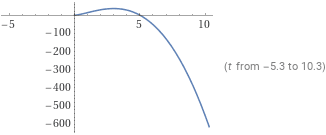
Generated Graph
Solution by Steps
step 1
To find the velocity, we differentiate the position function s(t)=t25(7−t)
step 2
Using the product rule, dtd[t25(7−t)]=dtd[t25]⋅(7−t)+t25⋅dtd[−t]
step 3
Differentiating t25 and −t gives 25t23 and −1 respectively
step 4
Substituting the derivatives, we get v(t)=25t23(7−t)−t25
step 5
Simplifying, v(t)=235t23−27t25−t25
step 6
Combining like terms, v(t)=235t23−29t25
step 7
To find the acceleration, we differentiate the velocity function v(t)
step 8
Differentiating v(t) gives a(t)=dtd[235t23]−dtd[29t25]
step 9
Differentiating t23 and t25 gives 23⋅235t21 and 25⋅29t23 respectively
step 10
Substituting the derivatives, we get a(t)=4105t21−445t23
Answer
Velocity: v(t)=235t23−29t25, Acceleration: a(t)=4105t21−445t23
Key Concept
Differentiation of power functions using the power rule and the product rule.
Explanation
The velocity is the first derivative of the position function, and the acceleration is the derivative of the velocity function.
Solution by Steps
step 1
The object stops when its velocity is zero
step 2
Set the velocity function v(t)=235t23−29t25 equal to zero
step 3
Solve 235t23−29t25=0 for t
step 4
Factor out t23, getting t23(235−29t)=0
step 5
Set each factor equal to zero, t23=0 and 235−29t=0
step 6
Solving 235−29t=0 gives t=935
Answer
The object stops after t=935 seconds.
Key Concept
Setting the velocity function equal to zero to find when the object stops.
Explanation
The object's velocity is zero when t=935 seconds, which is when the object stops moving.
Solution by Steps
step 1
The object changes direction when the velocity changes sign
step 2
Find the values of t where v(t)=235t23−29t25 is zero or undefined
step 3
We already found that v(t)=0 at t=935 seconds
step 4
The velocity is undefined at t=0, but since t≥0, we only consider t=935
Answer
The object changes direction at t=935 seconds.
Key Concept
The change in direction occurs when the velocity function changes sign.
Explanation
The velocity function changes sign at t=935 seconds, indicating a change in direction.
Solution by Steps
step 1
The acceleration is positive when a(t) = \frac{105}{4}t^{\frac{1}{2}} - \frac{45}{4}t^{\frac{3}{2}} > 0
step 2
Solve \frac{105}{4}t^{\frac{1}{2}} - \frac{45}{4}t^{\frac{3}{2}} > 0 for t
step 3
Factor out t21, getting t^{\frac{1}{2}}(\frac{105}{4} - \frac{45}{4}t) > 0
step 4
Set the factors equal to zero, t21=0 and 4105−445t=0
step 5
Solving 4105−445t=0 gives t=45105
step 6
The acceleration is positive for 0 < t < \frac{105}{45}
Answer
The acceleration is positive for 0 < t < \frac{105}{45} seconds.
Key Concept
Determining when the acceleration function is greater than zero.
Explanation
The acceleration is positive when t is between 0 and 45105 seconds.
Solution by Steps
step 1
The object returns to its original position when s(t)=t25(7−t)=0
step 2
Solve t25(7−t)=0 for t
step 3
Set each factor equal to zero, t25=0 and 7−t=0
step 4
Solving 7−t=0 gives t=7
Answer
The object returns to its original position at t=0 and t=7 seconds.
Key Concept
Setting the position function equal to zero to find when the object returns to its original position.
Explanation
The object is at its original position at the start t=0 and when t=7 seconds.
© 2023 AskSia.AI all rights reserved