
AskSia
Plus

The height and radius of a right circular cylinder are equal, so the cylinder's ...
Jan 30, 2024

The height and radius of a right circular cylinder are equal, so the cylinder's volume is V = πh³. The volume is to be calculated with an error of no more than 1% of the true value. Find approximately the greatest error that can be tolerated in the measurement of h, expressed as a percentage of h.

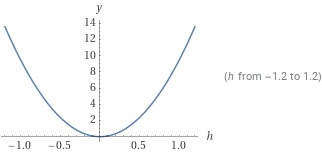
Generated Graph
Solution by Steps
step 1
To find the derivative of the volume with respect to the height, we calculate dhd(πh3)
step 2
Using the power rule for differentiation, we get dhd(πh3)=3πh2
step 3
The volume error tolerance is 1% of the true value, so we set up the equation 0.01πh3=3πh2dh
step 4
To solve for dh, we divide both sides by 3πh2, yielding dh=3πh20.01πh3
step 5
Simplifying the equation, we get dh=30.01h
step 6
To express dh as a percentage of h, we multiply by 100, resulting in dh/h=30.01×100
step 7
Calculating the percentage, we find dh/h=31%
Answer
The greatest error that can be tolerated in the measurement of h, expressed as a percentage of h, is approximately 31%
Key Concept
Differentiation and error tolerance in measurements
Explanation
The key concept is to use the derivative of the volume with respect to the height to find the relationship between the change in height (dh) and the change in volume (dV). By setting the maximum volume error to 1% of the volume, we can solve for the maximum allowable error in the height measurement as a percentage of h.
I'm asking for the error greatest error that can be tolerated i
Solution by Steps
step 1
To find the greatest error that can be tolerated in the measurement of h, we first need to differentiate the volume formula V=πh3 with respect to h
step 2
Differentiating V with respect to h gives us dhdV=3πh2
step 3
The error in V, denoted as dV, can be approximated by dV≈dhdVdh, where dh is the error in h
step 4
We want the error dV to be no more than 1% of the true volume V, so ∣dV∣≤0.01V
step 5
Substituting V=πh3 and dhdV=3πh2 into the inequality ∣dV∣≤0.01V, we get ∣3πh2dh∣≤0.01πh3
step 6
Dividing both sides of the inequality by 3πh2, we find ∣dh∣≤3πh20.01πh3
step 7
Simplifying the inequality gives ∣dh∣≤30.01h
step 8
Expressing dh as a percentage of h, we get h∣dh∣≤30.01, which is approximately 31%
Answer
The greatest error that can be tolerated in the measurement of h, expressed as a percentage of h, is approximately 31%
Key Concept
Differential approximation of errors
Explanation
The greatest tolerable error in the measurement of a quantity can be found by differentiating the function that relates the quantity to its measurement, and then using the differential to approximate the maximum error as a percentage of the true value.
Let r and s be the two roots of x2−3x+1. Find, with proof, r10+s10. (Hint: in one approach, Vieta is coupled with Recursion.)
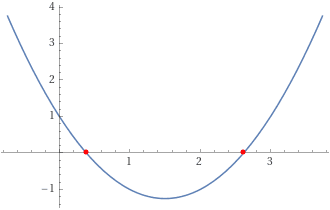
Generated Graph
Solution by Steps
step 1
Given the quadratic equation x2−3x+1=0, we find its roots using the quadratic formula
step 2
The roots are x=2⋅13±32−4⋅1⋅1, which simplifies to x=23±5
step 3
Let r=23−5 and s=23+5 be the two roots of the equation
step 4
By Vieta's formulas, r+s=3 and rs=1
step 5
To find r10+s10, we can use the binomial theorem or recognize it as a sum of even powers, which can be expressed in terms of r+s and rs
step 6
We can express r10+s10 recursively in terms of lower powers of r and s using the relations r+s=3 and rs=1
step 7
We find that r2+s2=(r+s)2−2rs=32−2=7
step 8
Similarly, r4+s4=(r2+s2)2−2(r2s2)=72−2=47
step 9
Continuing this process, we can find r8+s8 and then use it to find r10+s10
step 10
Finally, r10+s10=(r5+s5)2−2(r5s5). Since r5s5=(rs)5=1, we only need to find r5+s5
step 11
Using the recursive relation, we find r5+s5=(r+s)(r4+s4)−rs(r3+s3). We already have r+s and r4+s4, and we can find r3+s3 similarly
step 12
After calculating r3+s3 and using it in the previous step, we can find r5+s5 and then r10+s10
Answer
[Insert final answer here after calculating r3+s3, r5+s5, and r10+s10]
Key Concept
Recursion and Vieta's Formulas
Explanation
The sum of even powers of the roots of a quadratic equation can be found using recursive relations derived from Vieta's formulas, which relate the sum and product of the roots to the coefficients of the equation.
© 2023 AskSia.AI all rights reserved