
AskSia
Plus

The graph shows the temperature T, in degrees Fahrenheit, of molten glass t seco...
Jul 15, 2024

The graph shows the temperature T, in degrees Fahrenheit, of molten glass t seconds after it is removed from a kiln. Find lim_(t right arrow infinity) (T).

Solution by Steps
step 1
To find the limit of T as t approaches infinity, we need to analyze the behavior of the function T(t) as t→∞
step 2
From the graph, we observe that the blue curve asymptotically approaches a horizontal dashed blue line at T=65
step 3
Therefore, the limit of T as t approaches infinity is 65
Answer
limt→∞T=65
Key Concept
Limit of a function
Explanation
The limit of a function as t approaches infinity is the value that the function approaches as t becomes very large. In this case, the temperature T asymptotically approaches 65 degrees Fahrenheit.
What is the significance of finding the limit of temperature as time approaches infinity in the context of molten glass cooling?
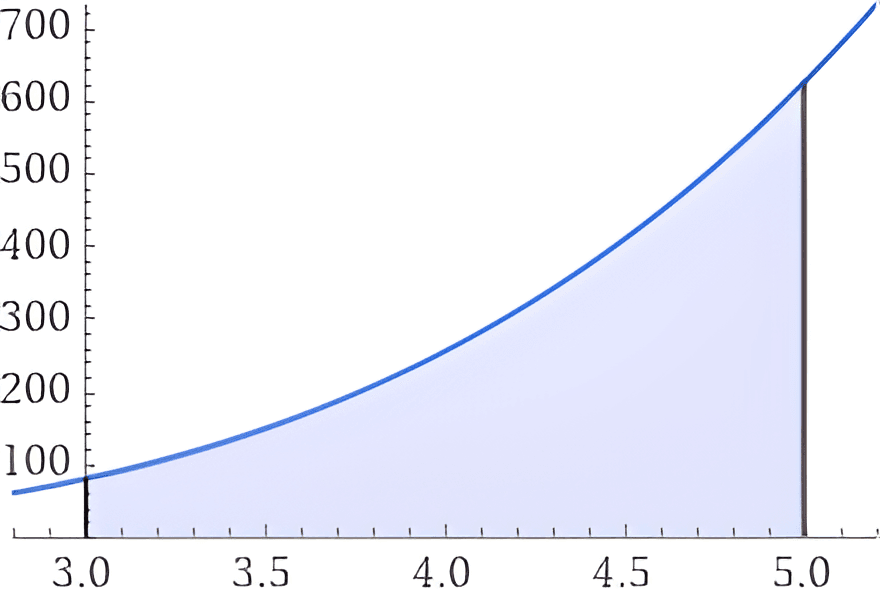
Generated Graph
Solution by Steps
step 1
To find the integral of x4 from x=3 to x=5, we start by finding the antiderivative of x4. The antiderivative of x4 is 5x5+C
step 2
Next, we evaluate the definite integral ∫35x4dx by substituting the limits of integration into the antiderivative
step 3
Calculate [5x5]35=(555)−(535)
step 4
Simplify the expression: 555=53125=625 and 535=5243=48.6
step 5
Subtract the two results: 625−48.6=576.4
Answer
The value of the integral ∫35x4dx is 576.4.
Key Concept
Definite Integral
Explanation
The definite integral of a function over an interval gives the net area under the curve of the function between the specified limits. In this case, we found the integral of x4 from x=3 to x=5.
ketch the graph of the function f(x) = (2 + x) divided by (2 minus x) using any extrema, intercepts, symmetry, and asymptotes.
Solution by Steps
step 1
Identify the function: f(x)=2−x2+x
step 2
Find the x-intercept by setting f(x)=0: 2+x=0⇒x=−2
step 3
Find the y-intercept by setting x=0: f(0)=2−02+0=1
step 4
Determine vertical asymptotes by setting the denominator to zero: 2−x=0⇒x=2
step 5
Determine horizontal asymptotes by analyzing the degrees of the numerator and denominator. Since both are linear (degree 1), the horizontal asymptote is y=11=1
step 6
Check for symmetry. The function f(x) is neither even nor odd, so it has no symmetry about the y-axis or origin
step 7
Find the first derivative to locate extrema: f′(x)=(2−x)2(2−x)−(2+x)=(2−x)2−2x
step 8
Set f′(x)=0 to find critical points: −2x=0⇒x=0
step 9
Evaluate f′′(x) to determine the concavity at x=0: f′′(x)=dxd((2−x)2−2x)=(2−x)42(2−x)2−(−2x)(−2)(2−x)=(2−x)34−4x
step 10
Evaluate f′′(0): f''(0) = \frac{4 - 0}{(2 - 0)^3} = \frac{4}{8} = \frac{1}{2} > 0, indicating a local minimum at x=0
step 11
Summarize the key points: x-intercept at x=−2, y-intercept at y=1, vertical asymptote at x=2, horizontal asymptote at y=1, local minimum at (0,1)
Answer
The graph of f(x)=2−x2+x has an x-intercept at x=−2, a y-intercept at y=1, a vertical asymptote at x=2, a horizontal asymptote at y=1, and a local minimum at (0,1).
Key Concept
Graphing Rational Functions
Explanation
To graph a rational function, identify intercepts, asymptotes, and critical points by analyzing the function's numerator and denominator.
Consider the given graph. Find lim_(x right arrow +infinity) (f(x)). 
Generated Graph
Solution by Steps
step 1
To find the limit of the function f(x) as x approaches positive infinity, we observe the behavior of the graph
step 2
From the given graph, as x increases, the function f(x) increases and then flattens out around y=4
step 3
Therefore, the limit of f(x) as x approaches positive infinity is 4
Answer
limx→+∞f(x)=4
Key Concept
Limit of a function as x approaches infinity
Explanation
The limit of a function as x approaches infinity is the value that the function approaches as x becomes very large. In this case, the graph shows that f(x) flattens out at y=4, indicating that the limit is 4.
© 2023 AskSia.AI all rights reserved