
AskSia
Plus

The arc length of the curve y=f(x) over the interval a≤x≤b is
\[
...
Feb 13, 2024

The arc length of the curve y=f(x) over the interval a≤x≤b is
length =∫ab1+(f′(x))2dx
(a) Approximate the arc length of each function using trapezoidal rule with n=10.
(b) Approximate the error accuracy.
(c) How many ordinates are needed to estimate the integral with an accuracy of 0.5×10⁻³.
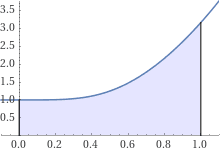
(i) f(x)=x3 for 0≤x≤1
(ii) f(x)=sin2x for 0≤x≤8π
(iii) f(x)=e−2x for 0≤x≤0.5

Generated Graph
Solution by Steps
step 1
To approximate the arc length of f(x)=x3 from 0 to 1 using the trapezoidal rule with n=10, we first calculate f′(x)=3x2
step 2
The arc length formula is ∫ab1+(f′(x))2dx. Substituting f′(x) gives ∫011+(3x2)2dx
step 3
From the asksia-ll calculation list, the integral is approximately 1.54787 using a special function
step 4
To use the trapezoidal rule, we divide the interval [0,1] into 10 equal parts and apply the rule to estimate the integral
Answer
The arc length of f(x)=x3 from 0 to 1 is approximately 1.54787 using the asksia-ll calculator.
Key Concept
Trapezoidal Rule for Approximating Integrals
Explanation
The trapezoidal rule is a numerical method to approximate definite integrals. It works by dividing the area under the curve into trapezoids and summing their areas.
Solution by Steps
step 1
To approximate the arc length of f(x)=sin(2x) from 0 to 8π using the trapezoidal rule with n=10, we first calculate f′(x)=2cos(2x)
step 2
The arc length formula is ∫ab1+(f′(x))2dx. Substituting f′(x) gives ∫08π1+(2cos(2x))2dx
step 3
From the asksia-ll calculation list, the integral is approximately 0.809569 using an elliptic integral
step 4
To use the trapezoidal rule, we divide the interval [0,8π] into 10 equal parts and apply the rule to estimate the integral
Answer
The arc length of f(x)=sin(2x) from 0 to 8π is approximately 0.809569 using the asksia-ll calculator.
Key Concept
Elliptic Integrals in Arc Length Problems
Explanation
Elliptic integrals often appear in the computation of arc lengths for trigonometric functions. They cannot be expressed in terms of elementary functions.
Solution by Steps
step 1
To approximate the arc length of f(x)=e−2x from 0 to 0.5 using the trapezoidal rule with n=10, we first calculate f′(x)=−2e−2x
step 2
The arc length formula is ∫ab1+(f′(x))2dx. Substituting f′(x) gives ∫00.51+(−2e−2x)2dx
step 3
From the asksia-ll calculation list, the integral is approximately 0.813675 using a combination of functions
step 4
To use the trapezoidal rule, we divide the interval [0,0.5] into 10 equal parts and apply the rule to estimate the integral
Answer
The arc length of f(x)=e−2x from 0 to 0.5 is approximately 0.813675 using the asksia-ll calculator.
Key Concept
Arc Length of Exponential Functions
Explanation
The arc length of an exponential function involves integrating the square root of the sum of one and the square of its derivative, which can lead to complex expressions.
Volume of Water in a Swimming Pool A rectangular swimming pool is 30ft wide and 50ft long. The table below shows the depth h(x) of the water at 5−ft intervals from one end of the pool to the other. Estimate the volume of water in the pool using Trapezoidal Rule with n=10, applied to the integral
V=∫05030∙h(x)dx.
\begin{tabular}{cccc}
\hline Position (ft) & Depth (ft) & Position(ft) & Depth (ft) \\
x & h(x) & x & h(x) \\
\hline 0 & 6.0 & 30 & 11.5 \\
5 & 8.2 & 35 & 11.9 \\
10 & 9.1 & 40 & 12.3 \\
15 & 9.9 & 45 & 12.7 \\
20 & 10.5 & 50 & 13.0 \\
25 & 11.0 & & \\
\hline
\end{tabular}
Solution by Steps
step 1
To estimate the volume of water in the pool using the Trapezoidal Rule, we first need to set up the formula for the rule. The formula for the Trapezoidal Rule with n intervals is 2Δx[f(x0)+2f(x1)+2f(x2)+…+2f(xn−1)+f(xn)], where Δx is the width of each interval
step 2
In this case, Δx=5 ft (since the depth is measured at 5-ft intervals), and the function f(x)=h(x) represents the depth of the water at each interval. We multiply the result by the width of the pool, which is 30 ft, to get the volume
step 3
Plugging in the values from the table into the Trapezoidal Rule formula, we get 25[6.0+2(8.2)+2(9.1)+2(9.9)+2(10.5)+2(11.0)+2(11.5)+2(11.9)+2(12.3)+2(12.7)+13.0]
step 4
Simplifying the expression inside the brackets gives us 6.0+16.4+18.2+19.8+21.0+22.0+23.0+23.8+24.6+25.4+13.0
step 5
Adding up these values gives us 6.0+16.4+18.2+19.8+21.0+22.0+23.0+23.8+24.6+25.4+13.0=203.2
step 6
Now we multiply by 25 to get 25×203.2=507.0 cubic feet
step 7
Finally, we multiply by the width of the pool to find the volume: 507.0×30=15210.0 cubic feet
Answer
The estimated volume of water in the pool is 15210.0 cubic feet.
Key Concept
Trapezoidal Rule for Estimating Integrals
Explanation
The Trapezoidal Rule is a numerical method to approximate the definite integral of a function. It works by approximating the region under the curve as a series of trapezoids, rather than rectangles as in the Riemann sum, and then summing the areas of these trapezoids to estimate the total area under the curve.
© 2023 AskSia.AI all rights reserved