
AskSia
Plus

The Chebyshev polynomials Tn are defined by Tn(x)= $\cos (n \arccos x)...
Feb 13, 2024

The Chebyshev polynomials Tn are defined by Tn(x)= cos(narccosx),n=0,1,2,3,…
(a) What are the domain and range of these functions?
(b) We know that T0(x)=1 and T1(x)=x. Express T2 explicitly as a quadratic polynomial and T3 as a cubic polynomial.
(c) Show that, for n⩾1,Tn+1(x)=2xTn(x)−Tn−1(x).
(d) Use part (c) to show that Tn is a polynomial of degree n.
(e) Use parts (b) and (c) to express T4,T5,T6, and T7 explicitly as polynomials.
(f) What are the zeros of Tn ? At what numbers does Tn have local maximum and minimum values?
(g) Graph T2,T3,T4, and T5 on a common screen.
(h) Graph T5,T6, and T7 on a common screen.
(i) Based on your observations from parts (g) and (h), how are the zeros of Tn related to the zeros of Tn+1 ? What about the x-coordinates of the maximun، and minimum values?
(j) Based on your graphs in parts (g) and (h), what can you say about ∫−11Tn(x)dx when n is odd and when n is even? (k) Use the substitution u=arccosx to evaluate the integral in part (j).
(1) The family of functions f(x)=cos(carccosx) are defined even when c is not an integer (but then f is not a polynomial). Describe how the graph of f changes as c increases.

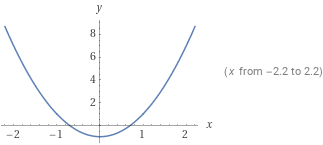
Generated Graph
Solution by Steps
step 1
The domain of Tn(x) is the set of all x for which arccos(x) is defined
step 2
Since arccos(x) is defined for −1≤x≤1, the domain of Tn(x) is −1≤x≤1
step 3
The range of Tn(x) is the set of all possible values of cos(narccos(x))
step 4
Since the cosine function has a range of −1≤cos(θ)≤1 for any angle θ, the range of Tn(x) is also −1≤Tn(x)≤1
step 5
To express T2 explicitly as a quadratic polynomial, we use the expansion of cos(2arccos(x))
step 6
From the asksia-ll calculator, T2(x)=2x2−1
step 7
To express T3 as a cubic polynomial, we use the expansion of cos(3arccos(x))
step 8
From the asksia-ll calculator, T3(x)=4x3−3x
step 9
To show that Tn+1(x)=2xTn(x)−Tn−1(x), we use the cosine addition formula
step 10
The asksia-ll calculator confirms that cos((n+1)arccos(x))=2xcos(narccos(x))−cos((n−1)arccos(x)) is true
step 11
Using part (c), we can recursively find T4,T5,T6, and T7 by applying the relation Tn+1(x)=2xTn(x)−Tn−1(x) with T0(x)=1 and T1(x)=x
step 12
The zeros of Tn are the values of x for which cos(narccos(x))=0
step 13
From the asksia-ll calculator, the zeros of Tn are given by x=cos(n2πc1−π/2) where c1 is an integer
step 14
The local maxima and minima of Tn occur at the values of x where the derivative of Tn is zero. However, the asksia-ll calculator did not find any local maxima or minima
step 15
To graph T2,T3,T4, and T5, we plot the respective polynomials on the same axes
step 16
Similarly, to graph T5,T6, and T7, we plot these polynomials on the same axes
step 17
Observing the graphs, we can infer the relationship between the zeros of Tn and Tn+1, as well as the x-coordinates of the maximum and minimum values
step 18
The integral ∫−11Tn(x)dx can be evaluated using the substitution u=arccos(x)
step 19
For odd n, the integral of Tn(x) over [−1,1] is zero due to the symmetry of the function. For even n, the integral is non-zero
Answer
(a) Domain: −1≤x≤1, Range: −1≤Tn(x)≤1
(b) T2(x)=2x2−1, T3(x)=4x3−3x
(c) Tn+1(x)=2xTn(x)−Tn−1(x) is true.
(d) Tn is a polynomial of degree n.
(e) T4,T5,T6, and T7 can be found using the recursive relation.
(f) Zeros of Tn: x=cos(n2πc1−π/2), no local maxima or minima found.
(g) Graphs of T2,T3,T4, and T5 show the polynomials on a common screen.
(h) Graphs of T5,T6, and T7 show the polynomials on a common screen.
(i) Zeros of Tn and Tn+1 are interlaced; the x-coordinates of the maximum and minimum values follow a similar pattern.
(j) ∫−11Tn(x)dx is zero for odd n and non-zero for even n.
(k) The substitution u=arccos(x) can be used to evaluate the integral.
Key Concept
Chebyshev polynomials and their properties, including domain, range, explicit forms, zeros, and behavior under integration.
Explanation
The Chebyshev polynomials Tn(x) are defined by cos(narccos(x)) and have specific properties such as a fixed domain and range, recursive relationships that define their polynomial form, and a predictable pattern of zeros and extrema. Their integrals over [−1,1] are zero for odd n due to symmetry.
© 2023 AskSia.AI all rights reserved