
AskSia
Plus

THE UNIVERSITY
of ADELAIDE
COIIIGE
DEGREE TRANSFER BRIDGING PROGRAM
CORE MATHEM...
May 29, 2024



Generated Graph
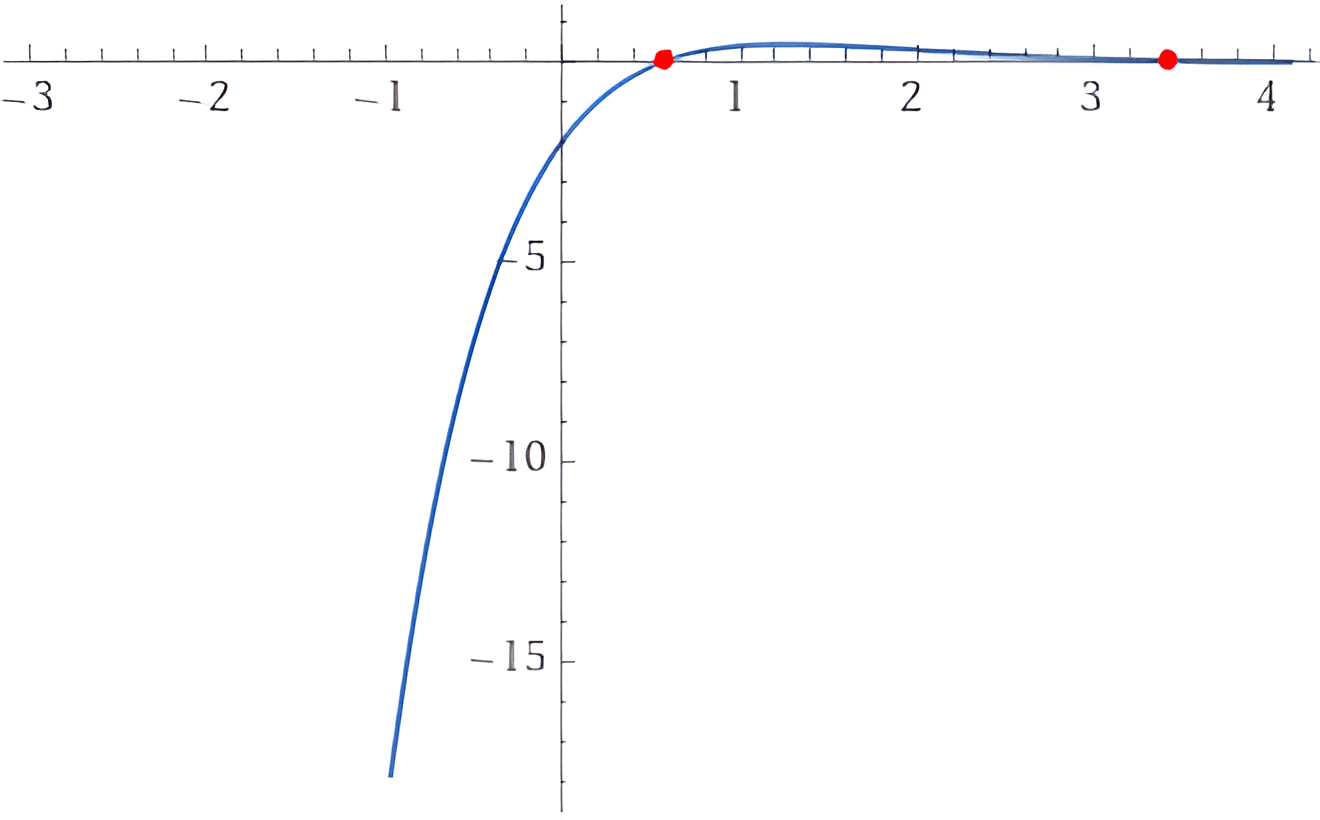
Solution by Steps
step 1
Find the first derivative of f(x): f′(x)=e−x(−2x+x2)−(x2−2x)e−x=e−x(x2−4x+2)
step 2
Set f′(x)=0 to find critical points: e−x(x2−4x+2)=0⟹x2−4x+2=0⟹x=2±2
step 3
Find the second derivative of f(x): f′′(x)=e−x(x2−6x+6)
step 4
Evaluate f′′(x) at the critical points: f′′(2−2) and f′′(2+2)
step 5
Classify the stationary points:
- If f''(x) > 0, the point is a local minimum.
- If $f''(x) < 0, the point is a local maximum
step 6
Set f′′(x)=0 to find potential inflection points: e−x(x2−6x+6)=0⟹x2−6x+6=0⟹x=3±3
step 7
Use a sign diagram to determine the concavity changes around x=3±3
step 8
Analyze the sign of f′′(x) in the intervals determined by the inflection points:
- Concave up where f''(x) > 0
- Concave down where f''(x) < 0
step 1
Find the first derivative of g(x): g′(x)=5x4−9x2+4x
step 2
Set g′(x)=0 to find critical points: 5x4−9x2+4x=0⟹x(5x3−9x+4)=0⟹x=0,x=1,x=101(−5±105)
step 3
Find the second derivative of g(x): g′′(x)=20x3−18x+4
step 4
Evaluate g′′(x) at the critical points: g′′(0), g′′(1), g′′(101(−5±105))
step 5
Classify the stationary points:
- If g''(x) > 0, the point is a local minimum.
- If $g''(x) < 0, the point is a local maximum
step 6
Set g′′(x)=0 to find potential inflection points: 20x3−18x+4=0
step 7
Use a sign diagram to determine the concavity changes around the roots of 20x3−18x+4=0
step 8
Analyze the sign of g′′(x) in the intervals determined by the inflection points:
- Concave up where g''(x) > 0
- Concave down where g''(x) < 0
Answer
The stationary points for f(x) are x=2±2, and for g(x) are x=0,1,101(−5±105). The points of inflection for f(x) are x=3±3, and for g(x) are the roots of 20x3−18x+4=0. The intervals of concavity are determined by the sign of the second derivatives.
Key Concept
Stationary points and concavity
Explanation
Stationary points are found by setting the first derivative to zero, and concavity is determined by the sign of the second derivative.
© 2023 AskSia.AI all rights reserved