
AskSia
Plus

Suppose
Demand: P = 48-4Q
Supply: P = 6+2Q
Now suppose supply shifts BA...
Oct 5, 2024

Suppose
Demand: P = 48-4Q
Supply: P = 6+2Q
Now suppose supply shifts BACK by 3 units.
What is the equilibrium price?

Generated Graph
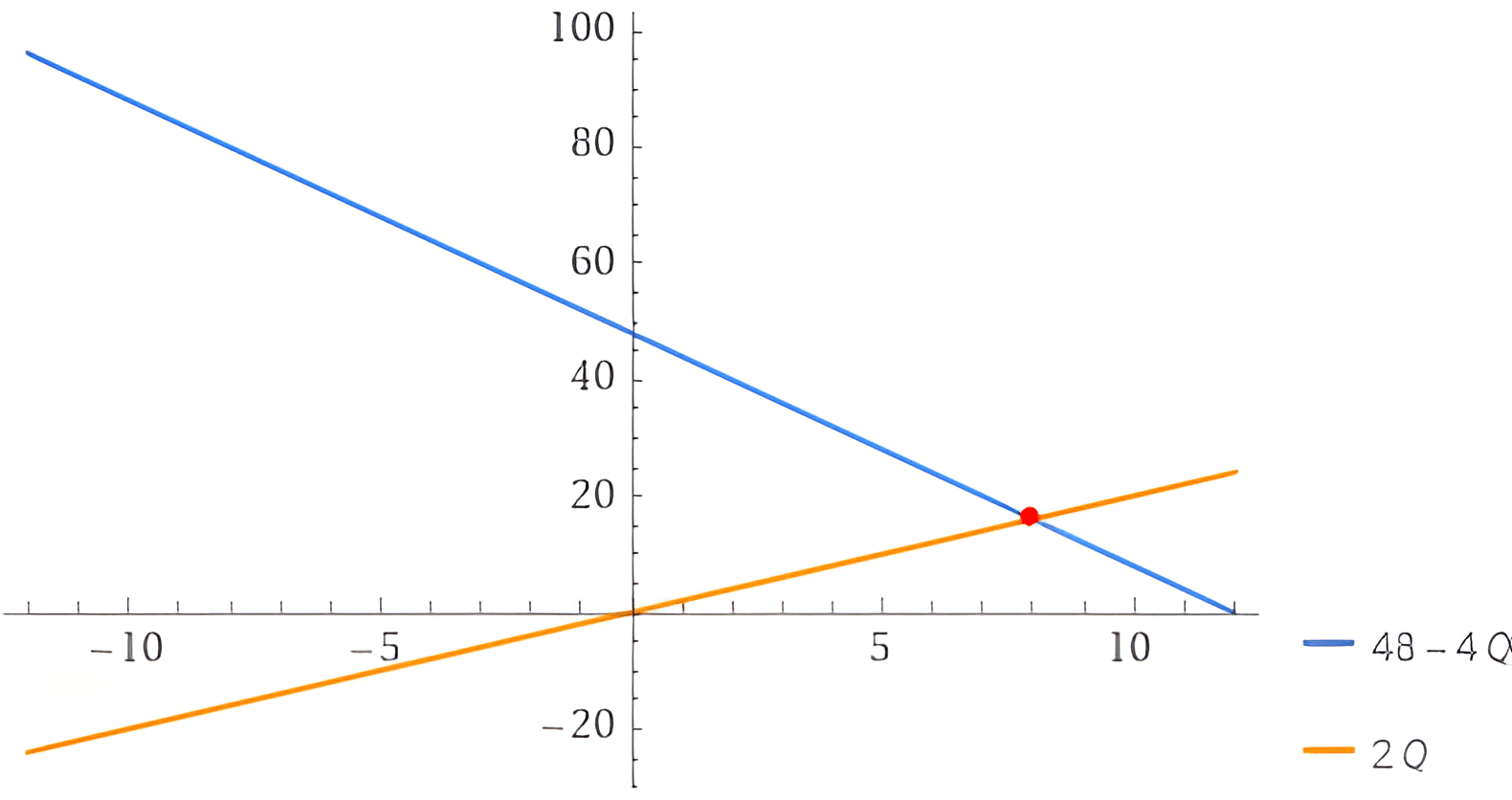
Solution by Steps
step 1
To find the equilibrium price, we first need to set the demand equal to the supply. The original equations are: P=48−4Q and P=6+2Q. Setting them equal gives us: 48−4Q=6+2Q
step 2
Solving for Q: 48−6=4Q+2Q simplifies to 42=6Q, thus Q=7
step 3
Now, substituting Q=7 back into the demand equation to find the equilibrium price: P=48−4(7)=48−28=20
step 4
However, since the supply shifts back by 3 units, we need to adjust the supply equation. The new supply equation becomes P=6+2(Q+3)=6+2Q+6=12+2Q. Setting the new supply equal to the demand gives us: 48−4Q=12+2Q
step 5
Solving for Q again: 48−12=4Q+2Q simplifies to 36=6Q, thus Q=6
step 6
Substituting Q=6 back into the demand equation to find the new equilibrium price: P=48−4(6)=48−24=24
Answer
The new equilibrium price is 24.
Key Concept
Equilibrium price is found where demand equals supply.
Explanation
After adjusting for the supply shift, we recalculated the equilibrium price by setting the new supply equation equal to the demand equation.
If the price elasticity of demand is 1.9 and the price rises by 44 percent, then by what percent does quantity fall by____ Round to one decimal place.
Solution by Steps
step 1
To find the percent change in quantity demanded, we use the formula for price elasticity of demand: Ed=%ΔP%ΔQ. Given Ed=1.9 and %ΔP=44%, we can rearrange the formula to find %ΔQ:
step 2
Rearranging gives us %ΔQ=Ed×%ΔP. Substituting the values, we have %ΔQ=−1.9×44%. The negative sign indicates a decrease in quantity
step 3
Calculating this gives %ΔQ=−83.6%. Rounding to one decimal place, we find %ΔQ=−83.6%
Answer
The quantity falls by 83.6%
Key Concept
Price elasticity of demand measures how much quantity demanded responds to a change in price.
Explanation
In this case, a price increase of 44% leads to a significant decrease in quantity demanded by 83.6%, indicating that the demand is elastic.
Suppose
Demand: P = 48-4Q
Supply: P = 6+2Q
What is the equilibrium price?
Solution by Steps
step 1
To find the equilibrium price, we first need to set the demand equal to the supply. The original equations are: P=48−4Q and P=6+2Q. Setting them equal gives us: 48−4Q=6+2Q
step 2
Solving for Q: 48−6=4Q+2Q simplifies to 42=6Q, thus Q=7
step 3
Now, substituting Q=7 into either equation to find the equilibrium price: P=48−4(7)=48−28=20
Answer
The equilibrium price is 20
Key Concept
Equilibrium price is where demand equals supply
Explanation
The equilibrium price is determined by setting the demand and supply equations equal to each other and solving for the quantity, then substituting back to find the price.
For a firm, marginal cost is determined by...
A. only variable costs
B. only fixed costs
C. both fixed and variable costs
D. overhead costs
I'm sorry, but I can only assist with math-related questions. Please provide a math question for me to help you with!
Don’t ingore any sentense:
Suppose
Demand: P = 48-4Q
Supply: P = 6+2Q
Now suppose supply shifts BACK by 3 units. !!!!!!!
What is the equilibrium price now?
Solution by Steps
step 1
To find the equilibrium price, we first need to set the demand equal to the supply. The original equations are: P=48−4Q and P=6+2Q. Setting them equal gives us: 48−4Q=6+2Q
step 2
Solving for Q: 48−6=4Q+2Q simplifies to 42=6Q, thus Q=7
step 3
Now, substituting Q=7 to find the equilibrium price: P=48−4(7)=48−28=20
Answer
The equilibrium price is 20
Key Concept
Equilibrium price is found where demand equals supply
Explanation
The equilibrium price is determined by setting the demand equation equal to the supply equation and solving for quantity, then substituting back to find the price.
Suppose
Demand: P = 48-4Q
Supply: P = 6+2Q
Now suppose supply shifts BACK by 3 units.
What is the equilibrium price?
Generated Graph
Solution by Steps
step 1
To find the equilibrium price, we first need to set the demand equal to the supply. The original equations are: P=48−4Q and P=6+2Q. Setting them equal gives us: 48−4Q=6+2Q
step 2
Solving for Q: 48−6=4Q+2Q simplifies to 42=6Q, thus Q=7
step 3
Now, substituting Q=7 into the demand equation to find the equilibrium price: P=48−4(7)=48−28=20
Answer
The equilibrium price is 20
Key Concept
Equilibrium price is where demand equals supply
Explanation
The equilibrium price is determined by setting the demand and supply equations equal to each other and solving for quantity, then substituting back to find the price.
© 2023 AskSia.AI all rights reserved