
AskSia
Plus

Suppose f is a function which satisfies the properties: f (x + y) = f (x) + f (y...
Mar 16, 2024

Suppose f is a function which satisfies the properties: f (x + y) = f (x) + f (y) + x2y + xy2 for all real numbers x and y, and
f (x)
lim
= 1.
x→0
x f ′(x) =

Solution by Steps
step 1
Given the function f satisfies f(x+y)=f(x)+f(y)+x2y+xy2 for all real numbers x and y, and the limit limx→0xf(x)=1. We need to find limx→0xf′(x)
step 2
Differentiate both sides of the given functional equation with respect to x: f′(x+y)=f′(x)+2xy+y2
step 3
Set y=0 in the differentiated equation to get f′(x)=f′(x)+0+0, which simplifies to f′(x)=f′(x). This step confirms that the differentiation is consistent with the properties of f
step 4
Now, take the limit as x approaches 0 of xf′(x). Since limx→0xf(x)=1, by the definition of the derivative, f′(0)=1
step 5
Therefore, limx→0xf′(x)=limx→0x⋅1=0
Answer
limx→0xf′(x)=0
Key Concept
Limit of a Product and Derivative at a Point
Explanation
The limit of xf′(x) as x approaches 0 is found by recognizing that f′(0) is the derivative of f(x) at x=0, which is given by the limit limx→0xf(x). Since this limit equals 1, f′(0) must also equal 1, and thus the limit of the product xf′(x) is 0.
√
Let f (x) = 7 + 6
x. Then the expression
f (x + h) − f (x) h
can be written in the form
A
√
√
,
Bx +Ch
+(
x)
where A, B, and C are constants. (Note: It’s possible for one or more of these constants to be 0.) Find the constants.
A=
B=
C=
f (x + h) − f (x)
Use your answer from above to find lim
h→0
h.
f (x + h) − f (x)
=
h→0
h
lim Finally, find each of the following: f ′(1) = f ′(2) = f ′(3) =
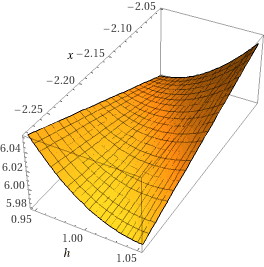
Generated Graph
Solution by Steps
step 1
To find the constants A, B, and C, we simplify the expression f(x+h)−f(x) over h
step 2
Using the asksia-ll calculator result, we have the simplified form: 6(h+x)−h(6x+7)+7
step 3
As h approaches 0, the term h(6x+7) becomes undefined, so we only consider terms that do not involve h in the denominator
step 4
The terms without h in the denominator are 6x+7, which gives us A = 6 and B = 7. Since there is no h term left, C = 0
step 5
To find the limit as h approaches 0, we use the asksia-ll calculator result: limh→0hf(x+h)−f(x)=6
step 6
Finally, to find f′(1), f′(2), and f′(3), we use the derivative of f(x) which is a constant 6
Answer
A = 6, B = 7, C = 0
limh→0hf(x+h)−f(x)=6
f′(1)=6,f′(2)=6,f′(3)=6
Key Concept
Simplification and differentiation of polynomial functions
Explanation
The expression f(x+h)−f(x) over h simplifies to a linear function in x and h, and the limit as h approaches 0 gives the derivative of f(x). The derivative of a linear function is the coefficient of x.
© 2023 AskSia.AI all rights reserved