
AskSia
Plus

Question 9
1pts
Consider a firm with a production function given by...
May 15, 2024



Solution by Steps
step 1
The production function is given by F(L,K)=L+K+ln(LK)
step 2
To find the marginal rate of technical substitution (MRTS), we need to compute the partial derivatives of F with respect to L and K
step 3
The partial derivative of F with respect to L is ∂L∂F=1+L1
step 4
The partial derivative of F with respect to K is ∂K∂F=1+K1
step 5
The MRTS is given by the negative ratio of these partial derivatives: MRTS=−∂K∂F∂L∂F
step 6
At the point (4,1), we substitute L=4 and K=1 into the partial derivatives: ∂L∂F=1+41=1.25 and ∂K∂F=1+11=2
step 7
Therefore, the MRTS at the point (4,1) is MRTS=−21.25=−0.625
Answer
The marginal rate of technical substitution at the point (4,1) is −0.625.
Key Concept
Marginal Rate of Technical Substitution (MRTS)
Explanation
The MRTS is the rate at which one input can be substituted for another input while keeping the output level constant. It is calculated as the negative ratio of the marginal products of the inputs.

Solution by Steps
step 1
The utility function is given by U(x1,x2)=x12x22+x1+x2
step 2
To find the marginal utility with respect to x1, we compute the partial derivative of U with respect to x1:
∂x1∂U=2x1x22+1
step 3
We are given that the marginal utility with respect to x1 at the point (x1,3) is 10. Therefore, we substitute x2=3 and set the partial derivative equal to 10:
2x1(3)2+1=10
step 4
Simplifying the equation:
18x1+1=10
18x1=9
x1=189=21
Answer
x1=21
Key Concept
Marginal Utility Calculation
Explanation
The marginal utility with respect to a variable is found by taking the partial derivative of the utility function with respect to that variable and then solving for the given conditions.
step 1
The utility function is given by U(x1,x2)=x12x22+x1+x2
step 2
To find the marginal utility with respect to x2, we compute the partial derivative of U with respect to x2:
∂x2∂U=2x12x2+1
step 3
We are given that the marginal utility with respect to x2 at the point (5,x2) is 5. Therefore, we substitute x1=5 and set the partial derivative equal to 5:
2(5)2x2+1=5
step 4
Simplifying the equation:
50x2+1=5
50x2=4
x2=504=252
Answer
x2=252
Key Concept
Marginal Utility Calculation
Explanation
The marginal utility with respect to a variable is found by taking the partial derivative of the utility function with respect to that variable and then solving for the given conditions.

Solution by Steps
step 1
The marginal cost function is given by MC=−Q2+80Q
step 2
The total cost function C(Q) is related to the marginal cost by the differential equation dQdC=MC
step 3
Therefore, the differential equation is dQdC=−Q2+80Q
step 1
Integrate the marginal cost function to find the total cost function: ∫(−Q2+80Q)dQ
step 2
The integral of −Q2 is −3Q3 and the integral of 80Q is 40Q2
step 3
Therefore, C(Q)=−3Q3+40Q2+C0, where C0 is the constant of integration
step 4
Given that the fixed costs are 500, we set C(0)=500
step 5
Thus, C0=500
step 6
The total cost function is C(Q)=−3Q3+40Q2+500
step 1
Use the total cost function C(Q)=−3Q3+40Q2+500
step 2
Calculate C(3): C(3)=−333+40⋅32+500=−9+360+500=851
step 3
Calculate C(12): C(12)=−3123+40⋅122+500=−576+5760+500=5684
step 4
The cost of producing units from Q=3 to Q=12 is C(12)−C(3)=5684−851=4833
Answer
The cost of producing units from Q=3 to Q=12 is 4833.
step 1
The marginal cost function is given by MC=Q2−42Q+200
step 2
The total cost function C(Q) is related to the marginal cost by the differential equation dQdC=MC
step 3
Therefore, the differential equation is dQdC=Q2−42Q+200
step 4
Integrate the marginal cost function to find the total cost function: ∫(Q2−42Q+200)dQ
step 5
The integral of Q2 is 3Q3, the integral of −42Q is −21Q2, and the integral of 200 is 200Q
step 6
Therefore, C(Q)=3Q3−21Q2+200Q+C0, where C0 is the constant of integration
step 7
Given that the fixed costs are 900, we set C(0)=900
step 8
Thus, C0=900
step 9
The total cost function is C(Q)=3Q3−21Q2+200Q+900
step 1
Use the total cost function C(Q)=3Q3−21Q2+200Q+900
step 2
Calculate C(12): C(12)=3123−21⋅122+200⋅12+900
step 3
Simplify: C(12)=31728−3024+2400+900=576−3024+2400+900=852
Answer
The total cost of producing 12 units is 852.
Key Concept
Marginal Cost and Total Cost Functions
Explanation
The marginal cost function represents the cost of producing one more unit of a good. By integrating the marginal cost function and adding fixed costs, we can find the total cost function.

Solution by Steps
step 1
The given differential equation is dtdP=0.01P. This is a first-order linear differential equation
step 2
To solve it, we separate the variables: PdP=0.01dt
step 3
Integrate both sides: ∫P1dP=∫0.01dt
step 4
This gives lnP=0.01t+C, where C is the integration constant
step 5
Exponentiate both sides to solve for P: P=e0.01t+C=eC⋅e0.01t
step 6
Let eC=P0, the initial population. Thus, P=P0e0.01t
Answer
P=P0e0.01t
step 1
Given P=58.6 million in 1998, let t=0 at the start of 1998. Thus, P0=58.6
step 2
We need to find the population in the year 2200. The time difference from 1998 to 2200 is t=2200−1998=202 years
step 3
Substitute P0=58.6 and t=202 into the equation P=P0e0.01t:
step 4
P=58.6⋅e0.01⋅202
step 5
Calculate e0.01⋅202≈e2.02≈7.53
step 6
Thus, P≈58.6⋅7.53≈441.258 million
Answer
P≈441.258 million
step 1
We need to find the time t when the population reaches 70 million
step 2
Use the equation P=P0e0.01t with P=70 and P0=58.6:
step 3
70=58.6⋅e0.01t
step 4
Divide both sides by 58.6: 58.670=e0.01t
step 5
Calculate 58.670≈1.195
step 6
Take the natural logarithm of both sides: ln(1.195)=0.01t
step 7
Solve for t: t=0.01ln(1.195)≈0.010.178≈17.8 years
Answer
t≈17.8 years
step 1
The given differential equation is dtdI=−0.05I
step 2
Separate the variables: IdI=−0.05dt
step 3
Integrate both sides: ∫I1dI=∫−0.05dt
step 4
This gives lnI=−0.05t+C, where C is the integration constant
step 5
Exponentiate both sides to solve for I: I=e−0.05t+C=eC⋅e−0.05t
step 6
Let eC=I0, the initial investment. Thus, I=I0e−0.05t
step 7
Given I0=£12000 and t=5.5 years, substitute these values into the equation:
step 8
I=12000⋅e−0.05⋅5.5
step 9
Calculate e−0.275≈0.759
step 10
Thus, I≈12000⋅0.759≈9108
Answer
£9108
step 1
We need to find the time t when the investment value falls to £5000
step 2
Use the equation I=I0e−0.05t with I=5000 and I0=12000:
step 3
5000=12000⋅e−0.05t
step 4
Divide both sides by 12000: 120005000=e−0.05t
step 5
Calculate 120005000≈0.4167
step 6
Take the natural logarithm of both sides: ln(0.4167)=−0.05t
step 7
Solve for t: t=−0.05ln(0.4167)≈−0.05−0.875≈17.5 years
Answer
17.5 years
Key Concept
Differential Equations in Population Growth and Depreciation
Explanation
The problems involve solving first-order linear differential equations to model population growth and investment depreciation. The solutions require separating variables, integrating, and applying initial conditions.
matrics
Solution by Steps
step 1
To find the marginal rate of technical substitution (MRTS), we need to understand the firm's production function. The MRTS is the rate at which one input can be substituted for another while keeping the output constant
step 2
The MRTS is calculated as the negative ratio of the marginal products of the inputs. If the production function is Q=f(K,L), where K is capital and L is labor, then the MRTS is given by:
MRTS=−∂Q/∂K∂Q/∂L
step 3
To find the marginal products, we take the partial derivatives of the production function with respect to each input. For example, if the production function is Q=K0.5L0.5, then:
∂L∂Q=0.5K0.5L−0.5
∂K∂Q=0.5K−0.5L0.5
step 4
Substituting these into the MRTS formula, we get:
MRTS=−0.5K−0.5L0.50.5K0.5L−0.5=−LK
step 5
To find the MRTS at a specific point, substitute the values of K and L at that point. For example, if K=4 and L=2, then:
MRTS=−24=−2
Answer
The marginal rate of technical substitution (MRTS) at the given point is -2.
Key Concept
Marginal Rate of Technical Substitution (MRTS)
Explanation
The MRTS measures the rate at which one input can be substituted for another while keeping the output constant. It is calculated as the negative ratio of the marginal products of the inputs.

Solution by Steps
step 1
To find the transpose of matrix A, we need to switch its rows and columns. Matrix A is given as:
A=(14amp;5amp;7amp;6amp;9)
step 2
The transpose of matrix A, denoted as AT, is obtained by switching the rows and columns:
AT=156amp;4amp;7amp;9
step 3
To find the transpose of matrix B, we need to switch its rows and columns. Matrix B is given as:
B=4−123amp;4amp;3amp;1amp;3
step 4
The transpose of matrix B, denoted as BT, is obtained by switching the rows and columns:
BT=(44amp;−1amp;3amp;2amp;1amp;3amp;3)
Answer
The transpose of matrix A is:
AT=156amp;4amp;7amp;9
The transpose of matrix B is:
BT=(44amp;−1amp;3amp;2amp;1amp;3amp;3)
Key Concept
Transpose of a Matrix
Explanation
The transpose of a matrix is obtained by switching its rows and columns. This means that the element at the i-th row and j-th column of the original matrix becomes the element at the j-th row and i-th column of the transposed matrix.

Solution by Steps
step 1
To find A+B, we add the corresponding elements of matrices A and B
step 2
A=20−2amp;3amp;3amp;6 and B=1−12amp;7amp;4amp;2
step 3
Adding the corresponding elements:
A+B=2+10+(−1)−2+2amp;3+7amp;3+4amp;6+2=3−10amp;10amp;7amp;8
Answer
A+B=3−10amp;10amp;7amp;8
step 1
To find A−B, we subtract the corresponding elements of matrix B from matrix A
step 2
A=20−2amp;3amp;3amp;6 and B=1−12amp;7amp;4amp;2
step 3
Subtracting the corresponding elements:
A−B=2−10−(−1)−2−2amp;3−7amp;3−4amp;6−2=11−4amp;−4amp;−1amp;4
Answer
A−B=11−4amp;−4amp;−1amp;4
Key Concept
Matrix Addition and Subtraction
Explanation
Matrix addition and subtraction involve adding or subtracting corresponding elements from each matrix.

Solution by Steps
step 1
Given the matrix A=20−2amp;3amp;3amp;6, we need to calculate 5A
step 2
To find 5A, we multiply each element of matrix A by 5
step 3
Performing the multiplication:
5A=520−2amp;3amp;3amp;6=5⋅25⋅05⋅(−2)amp;5⋅3amp;5⋅3amp;5⋅6=100−10amp;15amp;15amp;30
step 4
The resulting matrix after multiplication is:
5A=100−10amp;15amp;15amp;30
Answer
5A=100−10amp;15amp;15amp;30
Key Concept
Matrix Scalar Multiplication
Explanation
To multiply a matrix by a scalar, multiply each element of the matrix by the scalar.
Solution by Steps
step 1
Given the identity matrix I of size 3×3, we need to calculate 3I
step 2
The 3×3 identity matrix I is:
I=100amp;0amp;1amp;0amp;0amp;0amp;1
step 3
To find 3I, we multiply each element of the identity matrix I by 3
step 4
Performing the multiplication:
3I=3100amp;0amp;1amp;0amp;0amp;0amp;1=3⋅13⋅03⋅0amp;3⋅0amp;3⋅1amp;3⋅0amp;3⋅0amp;3⋅0amp;3⋅1=300amp;0amp;3amp;0amp;0amp;0amp;3
step 5
The resulting matrix after multiplication is:
3I=300amp;0amp;3amp;0amp;0amp;0amp;3
Answer
3I=300amp;0amp;3amp;0amp;0amp;0amp;3
Key Concept
Identity Matrix
Explanation
The identity matrix is a square matrix with ones on the diagonal and zeros elsewhere. Multiplying it by a scalar scales the diagonal elements by that scalar.

Solution by Steps
step 1
To find the product of matrices A and B, we need to perform matrix multiplication
step 2
Given A=(3amp;9amp;−1) and B=231, we multiply each element of A by the corresponding element of B and sum the results
step 3
The product A×B is calculated as follows:
A×B=3⋅2+9⋅3+(−1)⋅1=6+27−1=32
step 4
For the second example, given A=(1amp;−1) and B=(1−1), we perform the same matrix multiplication process
step 5
The product A×B is calculated as follows:
A×B=1⋅(−1)+(−1)⋅1=−1−1=−2
Answer
The product of the first pair of matrices is 32. The product of the second pair of matrices is −2.
Key Concept
Matrix Multiplication
Explanation
Matrix multiplication involves multiplying corresponding elements and summing the results.

Solution by Steps
step 1
To find the product of matrices A and C, we need to multiply each element of the rows of A by the corresponding elements of the columns of C and sum the products
step 2
Matrix A is given by:
A=(1−2amp;2amp;4)
Matrix C is given by:
C=(35amp;−2amp;0)
step 3
Calculate the element in the first row and first column of AC:
(1⋅3)+(2⋅5)=3+10=13
step 4
Calculate the element in the first row and second column of AC:
(1⋅−2)+(2⋅0)=−2+0=−2
step 5
Calculate the element in the second row and first column of AC:
(−2⋅3)+(4⋅5)=−6+20=14
step 6
Calculate the element in the second row and second column of AC:
(−2⋅−2)+(4⋅0)=4+0=4
step 7
Combine the results to form the matrix AC:
AC=(1314amp;−2amp;4)
Answer
AC=(1314amp;−2amp;4)
step 1
To find the product of matrices C and A, we need to multiply each element of the rows of C by the corresponding elements of the columns of A and sum the products
step 2
Matrix C is given by:
C=(35amp;−2amp;0)
Matrix A is given by:
A=(1−2amp;2amp;4)
step 3
Calculate the element in the first row and first column of CA:
(3⋅1)+(−2⋅−2)=3+4=7
step 4
Calculate the element in the first row and second column of CA:
(3⋅2)+(−2⋅4)=6−8=−2
step 5
Calculate the element in the second row and first column of CA:
(5⋅1)+(0⋅−2)=5+0=5
step 6
Calculate the element in the second row and second column of CA:
(5⋅2)+(0⋅4)=10+0=10
step 7
Combine the results to form the matrix CA:
CA=(75amp;−2amp;10)
Answer
CA=(75amp;−2amp;10)
step 1
To find the product of matrices A and B, we need to multiply each element of the rows of A by the corresponding elements of the columns of B and sum the products
step 2
Matrix A is given by:
A=(1−2amp;2amp;4)
Matrix B is given by:
B=(01amp;2amp;0amp;2amp;5)
step 3
Calculate the element in the first row and first column of AB:
(1⋅0)+(2⋅1)=0+2=2
step 4
Calculate the element in the first row and second column of AB:
(1⋅2)+(2⋅0)=2+0=2
step 5
Calculate the element in the first row and third column of AB:
(1⋅2)+(2⋅5)=2+10=12
step 6
Calculate the element in the second row and first column of AB:
(−2⋅0)+(4⋅1)=0+4=4
step 7
Calculate the element in the second row and second column of AB:
(−2⋅2)+(4⋅0)=−4+0=−4
step 8
Calculate the element in the second row and third column of AB:
(−2⋅2)+(4⋅5)=−4+20=16
step 9
Combine the results to form the matrix AB:
AB=(24amp;2amp;−4amp;12amp;16)
Answer
AB=(24amp;2amp;−4amp;12amp;16)
Key Concept
Matrix Multiplication
Explanation
Matrix multiplication involves taking the dot product of rows and columns from the two matrices being multiplied. The resulting matrix has dimensions based on the number of rows of the first matrix and the number of columns of the second matrix.

Solution by Steps
step 1
First, we need to multiply matrices A and B. Matrix A is given by:
A=(52amp;1amp;6amp;0amp;−1)
and matrix B is given by:
B=410amp;3amp;1amp;2
step 2
To find the product AB, we perform matrix multiplication. The element in the first row and first column of AB is calculated as:
(5⋅4)+(1⋅1)+(0⋅0)=20+1+0=21
step 3
The element in the first row and second column of AB is calculated as:
(5⋅3)+(1⋅1)+(0⋅2)=15+1+0=16
step 4
The element in the second row and first column of AB is calculated as:
(2⋅4)+(6⋅1)+(−1⋅0)=8+6+0=14
step 5
The element in the second row and second column of AB is calculated as:
(2⋅3)+(6⋅1)+(−1⋅2)=6+6−2=10
step 6
Therefore, the product AB is:
AB=(2114amp;16amp;10)
step 7
Comparing this with the given matrix:
AB=(x14amp;16amp;y)
we can see that x=21 and y=10
Answer
x=21, y=10
Key Concept
Matrix Multiplication
Explanation
Matrix multiplication involves taking the dot product of rows and columns from the two matrices.

Solution by Steps
step 2
To calculate A−B, we subtract the corresponding elements of matrices A and B:
A−B=(1−40−(−7)amp;−4−3amp;−9−0)=(−37amp;−7amp;−9)
step 3
To calculate A+4B, we first multiply matrix B by 4 and then add the result to matrix A:
4B=4(4−7amp;3amp;0)=(16−28amp;12amp;0)
A+4B=(10amp;−4amp;−9)+(16−28amp;12amp;0)=(17−28amp;8amp;−9)
step 4
To calculate A+I, where I is the identity matrix of the same size as A:
I=(10amp;0amp;1)
A+I=(10amp;−4amp;−9)+(10amp;0amp;1)=(20amp;−4amp;−8)
step 5
To calculate AI, where I is the identity matrix:
AI=(10amp;−4amp;−9)⋅(10amp;0amp;1)=(10amp;−4amp;−9)
step 6
To calculate A+C, we note that A is a 2×2 matrix and C is a 2×3 matrix. Since the matrices have different dimensions, the operation A+C is not defined
[question number] Answer
A
Key Concept
Matrix Addition and Subtraction
Explanation
Matrix addition and subtraction are performed element-wise, and the matrices must have the same dimensions.

Solution by Steps
step 2
det(A)=(1⋅4)−(2⋅3)=4−6=−2
step 3
Calculate the determinant of matrix B=(36amp;4amp;8) using the formula det(B)=ad−bc
step 4
det(B)=(3⋅8)−(4⋅6)=24−24=0
step 5
Calculate the product of matrices A and B: AB=(13amp;2amp;4)(36amp;4amp;8)
step 6
AB=((1⋅3+2⋅6)(3⋅3+4⋅6)amp;(1⋅4+2⋅8)amp;(3⋅4+4⋅8))=(1533amp;20amp;44)
step 7
Calculate the determinant of matrix AB: det(AB)=(15⋅44)−(20⋅33)=660−660=0
step 8
Compare det(AB) with det(A)⋅det(B): 0=−2⋅0=0
step 9
Since det(AB)=det(A)⋅det(B), the statement is True
True
Key Concept
Determinant of a Product of Matrices
Explanation
The determinant of the product of two matrices is equal to the product of their determinants.

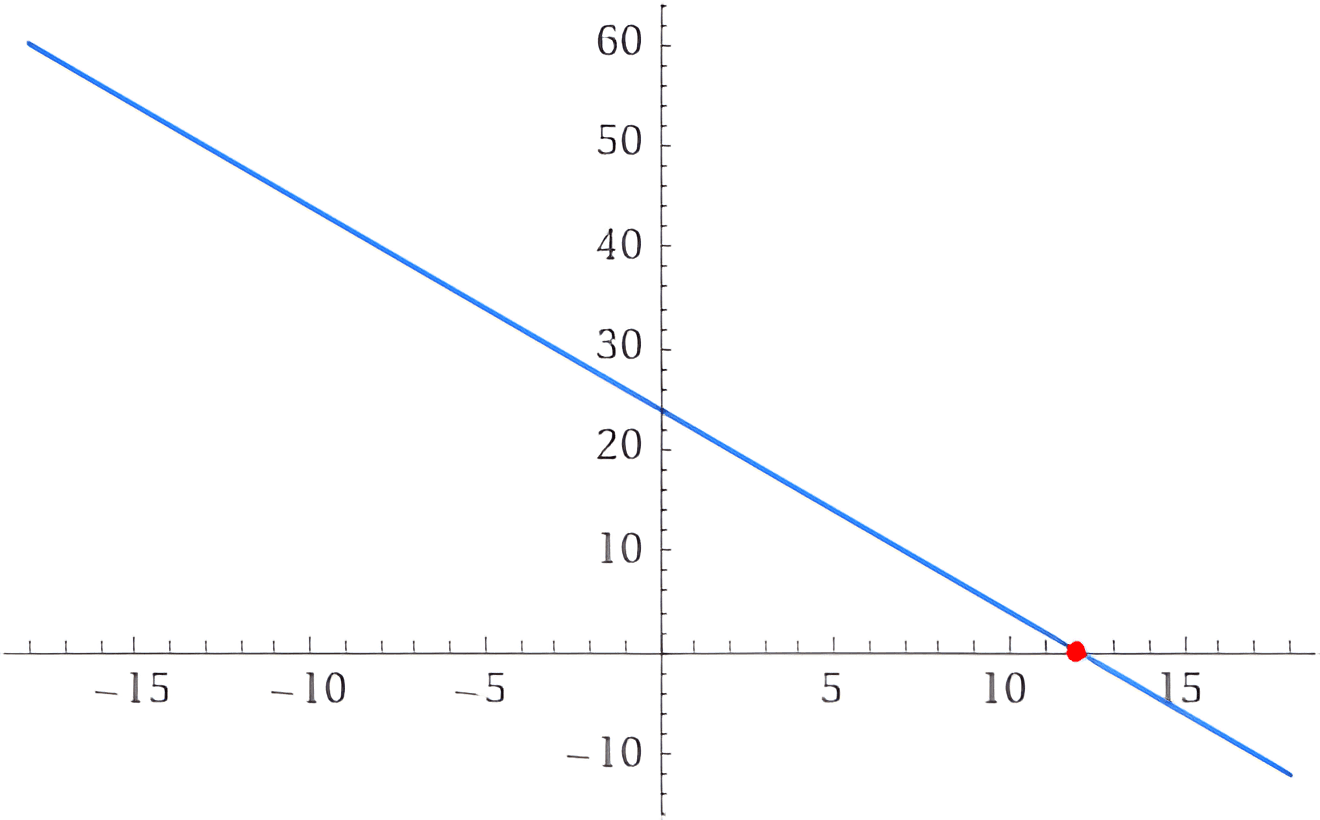
Generated Graph
Solution by Steps
step 1
Given the inverse demand functions for goods X and Y are P=24−x and P=32−y respectively. To find the optimal levels of x and y, we need to maximize the revenue for each good
step 2
The revenue for good X is RX=PX⋅x=(24−x)⋅x
step 3
To find the maximum revenue, we take the derivative of RX with respect to x and set it to zero: dxd[(24−x)⋅x]=0
step 4
Simplifying the derivative: dxd[24x−x2]=24−2x=0
step 5
Solving for x: 24−2x=0⟹x=12
step 6
Similarly, the revenue for good Y is RY=PY⋅y=(32−y)⋅y
step 7
To find the maximum revenue, we take the derivative of RY with respect to y and set it to zero: dyd[(32−y)⋅y]=0
step 8
Simplifying the derivative: dyd[32y−y2]=32−2y=0
step 9
Solving for y: 32−2y=0⟹y=16
Answer
The optimal levels of production are x=12 and y=16.
Key Concept
Revenue Maximization
Explanation
To find the optimal levels of production for goods X and Y, we maximize the revenue functions by taking the derivative with respect to each variable and setting it to zero. This gives us the values of x and y that maximize revenue.
© 2023 AskSia.AI all rights reserved