
AskSia
Plus

Question \#1: Create a system of linear equations with no solutions, one soluti...
May 27, 2024



Solution by Steps
step 1
To create a system of linear equations with no solutions, we need two lines that are parallel but not coincident. For example, consider the equations:
y=2x+3
y=2x+5
These lines have the same slope but different y-intercepts, so they will never intersect
step 2
To create a system of linear equations with one solution, we need two lines that intersect at exactly one point. For example, consider the equations:
y=2x+3
y=−x+1
These lines have different slopes, so they will intersect at exactly one point
step 3
To create a system of linear equations with infinitely many solutions, we need two lines that are coincident. For example, consider the equations:
y=2x+3
2y=4x+6
These lines are actually the same line, so they will intersect at every point on the line
step 4
To verify the solutions algebraically, we solve each system of equations. For the system with no solutions:
y=2x+3
y=2x+5
Subtracting the first equation from the second:
0=2
This is a contradiction, so there are no solutions
step 5
For the system with one solution:
y=2x+3
y=−x+1
Setting the equations equal to each other:
2x+3=−x+1
3x=−2
x=−32
Substituting back into the first equation:
y=2(−32)+3
y=−34+3
y=35
So the solution is (−32,35)
step 6
For the system with infinitely many solutions:
y=2x+3
2y=4x+6
Dividing the second equation by 2:
y=2x+3
This is the same as the first equation, so there are infinitely many solutions
step 7
To verify the solutions graphically, we plot each system of equations on a graph. For the system with no solutions, the lines will be parallel and never intersect. For the system with one solution, the lines will intersect at exactly one point. For the system with infinitely many solutions, the lines will be coincident and overlap completely
Answer
No solutions: y=2x+3 and y=2x+5
One solution: y=2x+3 and y=−x+1
Infinitely many solutions: y=2x+3 and 2y=4x+6
Key Concept
System of Linear Equations
Explanation
A system of linear equations can have no solutions (parallel lines), one solution (intersecting lines), or infinitely many solutions (coincident lines). The number of solutions can be determined by comparing the slopes and y-intercepts of the lines.

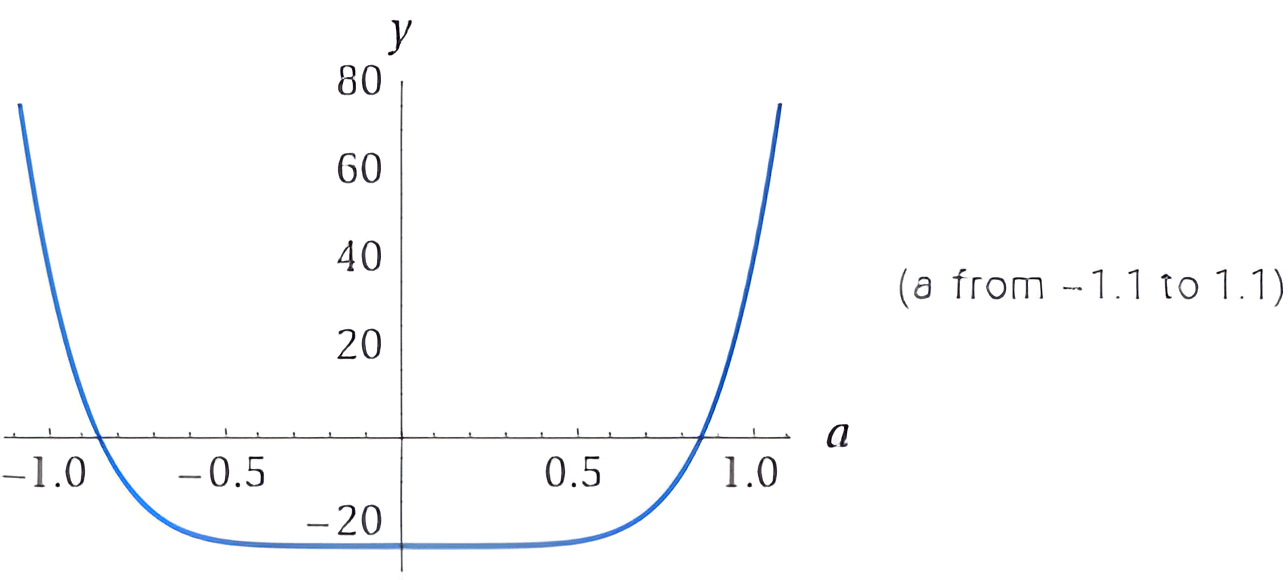
Generated Graph
Solution by Steps
step 1
To factor the expression 64a6−25, we recognize it as a difference of squares: 64a6−25=(8a3)2−52
step 2
Using the difference of squares formula, a2−b2=(a−b)(a+b), we get: (8a3−5)(8a3+5)
step 3
Therefore, the fully factored form of 64a6−25 is (8a3−5)(8a3+5)
step 4
To factor the expression 4x2y−44xy+72y, we first factor out the common term 4y: 4y(x2−11x+18)
step 5
Next, we factor the quadratic x2−11x+18. We look for two numbers that multiply to 18 and add to −11, which are −2 and −9
step 6
Thus, x2−11x+18=(x−2)(x−9)
step 7
Therefore, the fully factored form of 4x2y−44xy+72y is 4y(x−2)(x−9)
step 8
To factor the expression 6n2−11ny−10y2, we look for two numbers that multiply to 6⋅(−10)=−60 and add to −11. These numbers are −15 and 4
step 9
We rewrite the middle term using these numbers: 6n2−15ny+4ny−10y2
step 10
We factor by grouping: 3n(2n−5y)+2y(2n−5y)
step 11
We factor out the common binomial factor: (3n+2y)(2n−5y)
step 12
Therefore, the fully factored form of 6n2−11ny−10y2 is (3n+2y)(2n−5y)
[3] Answer
A
Key Concept
Factoring Polynomials
Explanation
Factoring polynomials involves recognizing patterns such as the difference of squares, common factors, and factoring by grouping.
© 2023 AskSia.AI all rights reserved