
AskSia
Plus

Question #1: Create a system of linear equations with no solutions, one solution...
May 13, 2024

Question #1: Create a system of linear equations with no solutions, one solution, and infinitely many solutions. Explain how you determine the number of solutions without solving them. Then, verify the solutions by solving them, both algebraically and graphically (by free-hand).

Solution by Steps
step 1
To create a system with no solutions, the equations must be parallel and have different y-intercepts
step 2
Example: x+y=2 and x+y=5. These lines are parallel and will never intersect
step 3
To verify algebraically, subtract the first equation from the second: (x+y)−(x+y)=5−2, which simplifies to 0=3, a contradiction
step 4
To create a system with one solution, the equations must be intersecting lines
step 5
Example: x+y=2 and x−y=0. These lines intersect at a single point
step 6
To verify algebraically, solve the system: from x−y=0, we get x=y. Substituting into the first equation, x+x=2, so x=1 and y=1
step 7
To create a system with infinitely many solutions, the equations must be the same line or multiples of each other
step 8
Example: x+y=2 and 2x+2y=4. These represent the same line
step 9
To verify algebraically, divide the second equation by 2: 2x+2y=4 becomes x+y=2, which is the same as the first equation
step 10
To verify graphically, plot the equations on a coordinate plane. For no solutions, the lines will be parallel. For one solution, the lines will intersect at a point. For infinitely many solutions, the lines will coincide
[question 1] Answer
No solutions: x+y=2, x+y=5. One solution: x+y=2, x−y=0. Infinitely many solutions: x+y=2, 2x+2y=4.
Key Concept
Determining the number of solutions in a system of linear equations without solving
Explanation
Systems with no solutions have parallel lines with different y-intercepts. Systems with one solution have intersecting lines. Systems with infinitely many solutions have coinciding lines or are multiples of each other.

Solution by Steps
step 1
Choose three non-collinear points that do not form vertical or horizontal lines. For example, let's take points A(1,2), B(4,6), and C(7,2)
step 2
Calculate the distances between the points using the distance formula d=(x2−x1)2+(y2−y1)2
step 3
For AB: dAB=(4−1)2+(6−2)2=32+42=5
step 4
For BC: dBC=(7−4)2+(2−6)2=32+(−4)2=5
step 5
For AC: dAC=(7−1)2+(2−2)2=62+02=6
step 6
Calculate the slopes of the sides using the slope formula m=x2−x1y2−y1
step 7
For AB: mAB=4−16−2=34
step 8
For BC: mBC=7−42−6=−34
step 9
For AC: mAC=7−12−2=0
step 10
Determine if the triangle is right-angled by checking if the Pythagorean theorem holds for the lengths of the sides
step 11
Check if dAB2+dBC2=dAC2: 52+52=62 which simplifies to 25+25=36, which is not true. Thus, it is not a right-angled triangle by side lengths
step 12
Determine if the triangle is right-angled by checking if the product of the slopes of two perpendicular lines is -1
step 13
Check if mAB⋅mBC=−1: 34⋅−34=−916, which is not -1. Thus, it is not a right-angled triangle by slopes
step 14
Use trigonometry to find an internal angle. We can use the law of cosines or the arccosine of the dot product of two vectors
step 15
Using the law of cosines to find angle ∠ABC: cos(∠ABC)=2⋅dAB⋅dBCdAB2+dBC2−dAC2
step 16
Calculate cos(∠ABC): cos(∠ABC)=2⋅5⋅552+52−62=5025+25−36=5014=257
step 17
Find ∠ABC by taking the arccosine of 257
[question a] Answer
The triangle formed by points A(1,2), B(4,6), and C(7,2) is not a right-angled triangle as determined by both the Pythagorean theorem and the slopes of the sides.
Key Concept
Determining a right-angled triangle using side lengths and slopes
Explanation
A triangle is right-angled if the square of the length of one side is equal to the sum of the squares of the lengths of the other two sides (Pythagorean theorem), or if the product of the slopes of two sides is -1 (perpendicular slopes).
Solution by Steps
step 18
To find the internal angle ∠ABC, we use the arccosine of the calculated cosine value
step 19
∠ABC=arccos(257)
[question b] Answer
The internal angle ∠ABC can be found using the law of cosines and the arccosine function.
Key Concept
Finding an internal angle using the law of cosines
Explanation
The law of cosines relates the lengths of the sides of a triangle to the cosine of one of its angles, allowing us to find that angle using the arccosine function.
Fully factor the following expressions, where possible, by selecting the appropriate strategy.
64a6 – 25
4x2y – 44xy + 72y
6n2 – 11ny – 10y2
Generated Graph
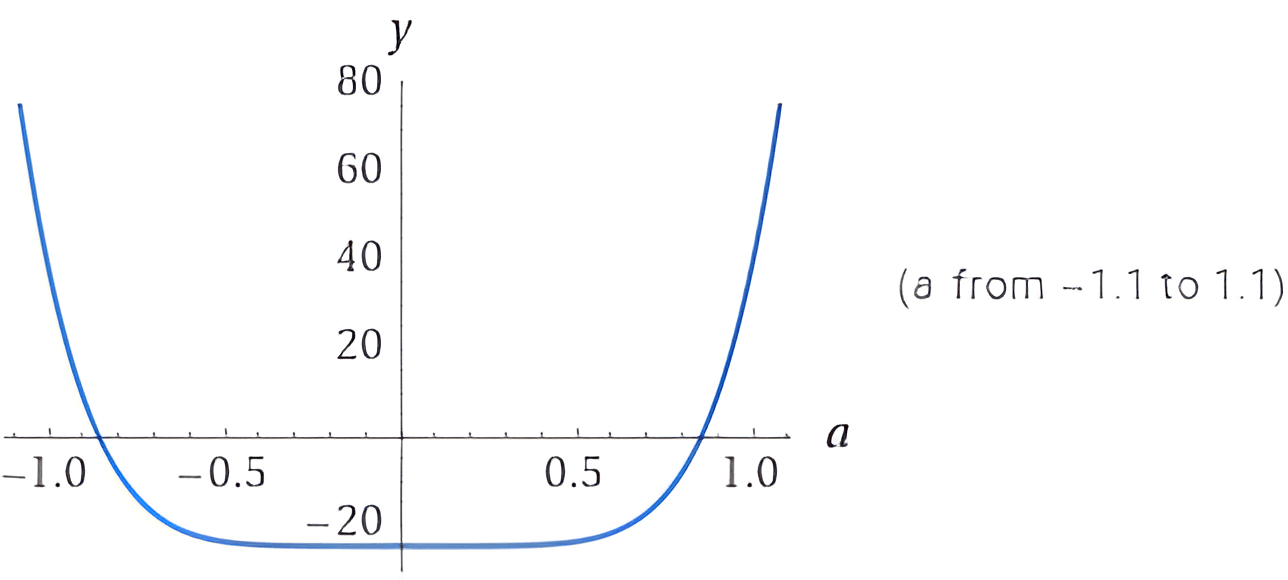
Solution by Steps
step 1
Identify the expression as a difference of squares: 64a6−25 can be written as (8a3)2−(5)2
step 2
Factor the difference of squares: (8a3)2−(5)2=(8a3−5)(8a3+5)
1 Answer
(8a3−5)(8a3+5)
Key Concept
Factoring a difference of squares
Explanation
The expression is a difference of two squares, which factors into the product of the sum and difference of the square roots of the individual terms.
step 1
Factor out the common factor: In 4x2y−44xy+72y, the common factor is 4y
step 2
Factor the quadratic: x2−11x+18 factors into (x−2)(x−9)
step 3
Combine the factored quadratic with the common factor: 4y(x−2)(x−9)
2 Answer
4y(x−2)(x−9)
Key Concept
Factoring by grouping
Explanation
First, factor out the common factor from all terms, then factor the resulting quadratic expression.
step 1
Recognize the trinomial as a quadratic in n: 6n2−11ny−10y2
step 2
Find two numbers that multiply to 6×(−10y2)=−60y2 and add to −11y
step 3
The numbers are 2y and −30y. Rewrite the middle term: 6n2+2ny−30ny−10y2
step 4
Factor by grouping: (6n2+2ny)+(−30ny−10y2)
step 5
Factor out the common factors: 2ny(3n+1)−10y(3n+1)
step 6
Factor out the common binomial: (3n+1)(2ny−10y)
step 7
Factor out the common factor from the second term: (3n+1)(2n−5)y
3 Answer
(3n+1)(2n−5)y
Key Concept
Factoring a quadratic trinomial
Explanation
The trinomial is factored by finding two numbers that multiply to the product of the coefficient of n2 and the constant term, and add to the coefficient of the middle term, then using grouping to factor completely.
© 2023 AskSia.AI all rights reserved