

Logo

AskSia

Plus

QR Factorisation Find QRQ R factorisation of the following matrix: \[ A=\left(\...
Jul 11, 2024

Solution by Steps
step 1
To find the QR factorization of matrix AA, we start by writing the matrix AA as follows: A=(2amp;13amp;16amp;1) A = \begin{pmatrix} 2 & 1 \\ -3 & 1 \\ 6 & -1 \end{pmatrix}
step 2
We need to find matrices QQ and RR such that A=QRA = Q R. The matrix QQ is an orthogonal matrix, and RR is an upper triangular matrix
step 3
First, we find the orthonormal basis vectors for the columns of AA. We start with the first column vector a1=(236)a_1 = \begin{pmatrix} 2 \\ -3 \\ 6 \end{pmatrix}. The norm of a1a_1 is: a1=22+(3)2+62=4+9+36=49=7 \|a_1\| = \sqrt{2^2 + (-3)^2 + 6^2} = \sqrt{4 + 9 + 36} = \sqrt{49} = 7 So, the first orthonormal vector q1q_1 is: q1=a1a1=17(236)=(273767) q_1 = \frac{a_1}{\|a_1\|} = \frac{1}{7} \begin{pmatrix} 2 \\ -3 \\ 6 \end{pmatrix} = \begin{pmatrix} \frac{2}{7} \\ -\frac{3}{7} \\ \frac{6}{7} \end{pmatrix}
step 4
Next, we find the second orthonormal vector q2q_2. We start with the second column vector a2=(111)a_2 = \begin{pmatrix} 1 \\ 1 \\ -1 \end{pmatrix} and make it orthogonal to q1q_1: a2=a2(a2q1)q1 a_2' = a_2 - (a_2 \cdot q_1) q_1 a2q1=127+137+(1)67=273767=77=1 a_2 \cdot q_1 = 1 \cdot \frac{2}{7} + 1 \cdot -\frac{3}{7} + (-1) \cdot \frac{6}{7} = \frac{2}{7} - \frac{3}{7} - \frac{6}{7} = -\frac{7}{7} = -1 a2=(111)(1)(273767)=(111)+(273767)=(1+271371+67)=(974717) a_2' = \begin{pmatrix} 1 \\ 1 \\ -1 \end{pmatrix} - (-1) \begin{pmatrix} \frac{2}{7} \\ -\frac{3}{7} \\ \frac{6}{7} \end{pmatrix} = \begin{pmatrix} 1 \\ 1 \\ -1 \end{pmatrix} + \begin{pmatrix} \frac{2}{7} \\ -\frac{3}{7} \\ \frac{6}{7} \end{pmatrix} = \begin{pmatrix} 1 + \frac{2}{7} \\ 1 - \frac{3}{7} \\ -1 + \frac{6}{7} \end{pmatrix} = \begin{pmatrix} \frac{9}{7} \\ \frac{4}{7} \\ -\frac{1}{7} \end{pmatrix} The norm of a2a_2' is: a2=(97)2+(47)2+(17)2=8149+1649+149=9849=2 \|a_2'\| = \sqrt{\left(\frac{9}{7}\right)^2 + \left(\frac{4}{7}\right)^2 + \left(-\frac{1}{7}\right)^2} = \sqrt{\frac{81}{49} + \frac{16}{49} + \frac{1}{49}} = \sqrt{\frac{98}{49}} = \sqrt{2} So, the second orthonormal vector q2q_2 is: q2=a2a2=12(974717)=(972472172) q_2 = \frac{a_2'}{\|a_2'\|} = \frac{1}{\sqrt{2}} \begin{pmatrix} \frac{9}{7} \\ \frac{4}{7} \\ -\frac{1}{7} \end{pmatrix} = \begin{pmatrix} \frac{9}{7\sqrt{2}} \\ \frac{4}{7\sqrt{2}} \\ -\frac{1}{7\sqrt{2}} \end{pmatrix}
step 5
Now, we can write the matrix QQ as: Q=(27amp;97237amp;47267amp;172) Q = \begin{pmatrix} \frac{2}{7} & \frac{9}{7\sqrt{2}} \\ -\frac{3}{7} & \frac{4}{7\sqrt{2}} \\ \frac{6}{7} & -\frac{1}{7\sqrt{2}} \end{pmatrix} And the matrix RR as: R=(7amp;10amp;2) R = \begin{pmatrix} 7 & -1 \\ 0 & \sqrt{2} \end{pmatrix}
Answer
The QR factorization of the matrix AA is given by A=QRA = Q R, where: Q=(27amp;97237amp;47267amp;172) Q = \begin{pmatrix} \frac{2}{7} & \frac{9}{7\sqrt{2}} \\ -\frac{3}{7} & \frac{4}{7\sqrt{2}} \\ \frac{6}{7} & -\frac{1}{7\sqrt{2}} \end{pmatrix} R=(7amp;10amp;2) R = \begin{pmatrix} 7 & -1 \\ 0 & \sqrt{2} \end{pmatrix}
Key Concept
QR Factorization
Explanation
QR factorization decomposes a matrix into an orthogonal matrix QQ and an upper triangular matrix RR. This is useful in solving linear systems and eigenvalue problems.
[<<2/7,-3/7,6/7>|<9/(7*sqrt(2),4/(7*sqrt(2)),-1/(7*sqrt(2)>>,<<7,0>,<-1,sqrt(2)>>] is this a correct maple form?
Solution by Steps
step 1
To determine if the given matrix form is correct, we need to analyze the structure and elements of the matrix
step 2
The given matrix is: [(27amp;37amp;67972amp;472amp;172),(7amp;01amp;2)] \left[ \begin{pmatrix} \frac{2}{7} &amp; -\frac{3}{7} &amp; \frac{6}{7} \\ \frac{9}{7\sqrt{2}} &amp; \frac{4}{7\sqrt{2}} &amp; -\frac{1}{7\sqrt{2}} \end{pmatrix}, \begin{pmatrix} 7 &amp; 0 \\ -1 &amp; \sqrt{2} \end{pmatrix} \right] We need to check if this form is consistent with the Maple software's matrix representation
step 3
In Maple, matrices are typically represented using the `Matrix` function. The correct form should be: Matrix([27amp;37amp;67972amp;472amp;172]),Matrix([7amp;01amp;2]) \text{Matrix}(\left[\begin{array}{ccc} \frac{2}{7} &amp; -\frac{3}{7} &amp; \frac{6}{7} \\ \frac{9}{7\sqrt{2}} &amp; \frac{4}{7\sqrt{2}} &amp; -\frac{1}{7\sqrt{2}} \end{array}\right]), \text{Matrix}(\left[\begin{array}{cc} 7 &amp; 0 \\ -1 &amp; \sqrt{2} \end{array}\right])
step 4
Therefore, the given matrix form is not entirely correct for Maple. The correct Maple form should use the `Matrix` function to define each matrix separately
Answer
The given matrix form is not correct for Maple. The correct form should use the "Matrix" function to define each matrix separately.
Key Concept
Matrix representation in Maple
Explanation
In Maple, matrices are represented using the "Matrix" function, and each matrix should be defined separately within this function.
multipy Q and R
Generated Graph
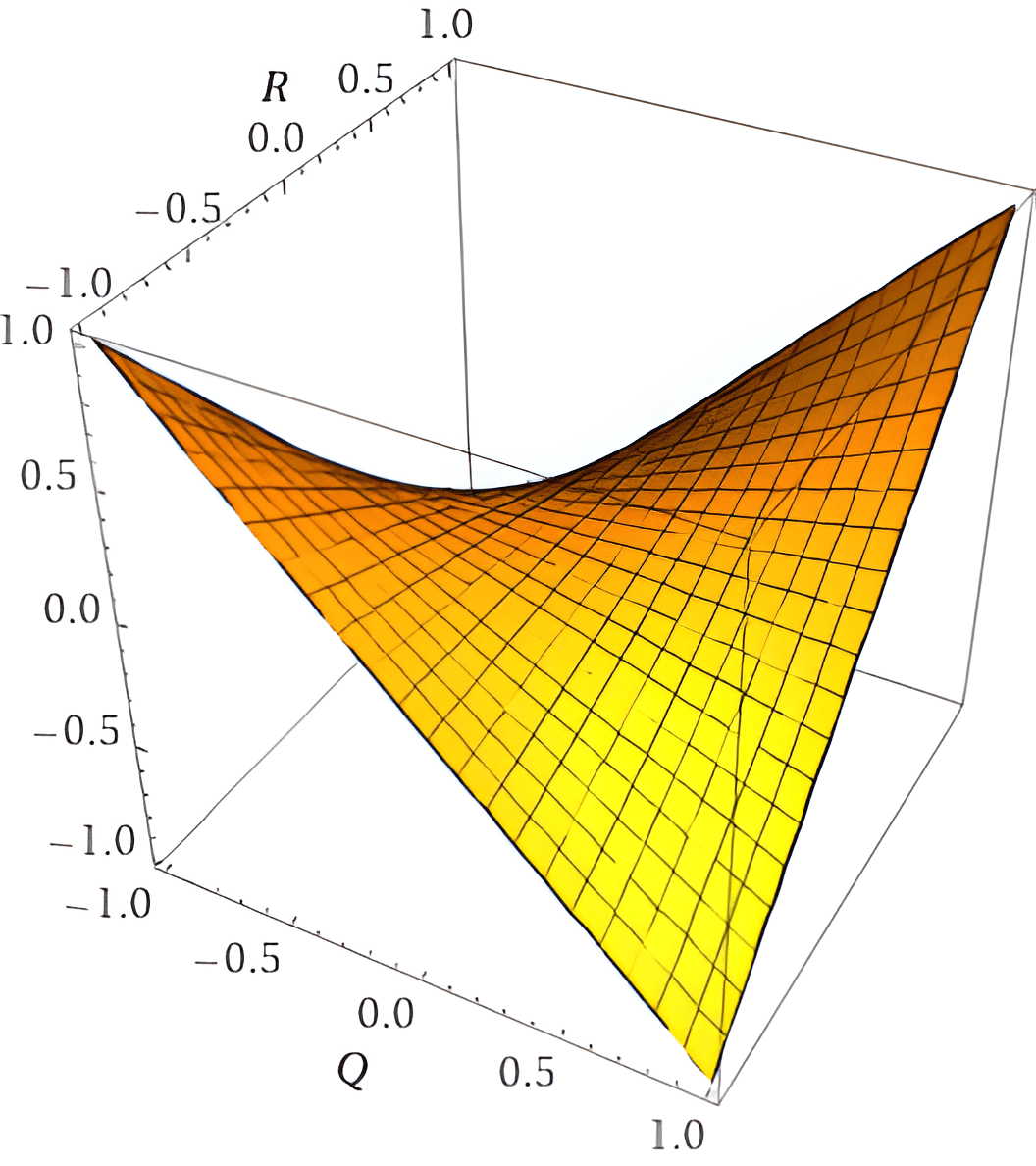
Solution by Steps
step 1
To multiply QQ and RR, we start by writing the given matrices QQ and RR as follows:
step 2
Given matrices:
step 3
Q=(27amp;37amp;67972amp;472amp;172)Q = \begin{pmatrix} \frac{2}{7} &amp; -\frac{3}{7} &amp; \frac{6}{7} \\ \frac{9}{7\sqrt{2}} &amp; \frac{4}{7\sqrt{2}} &amp; -\frac{1}{7\sqrt{2}} \end{pmatrix}
step 4
R=(7amp;01amp;2)R = \begin{pmatrix} 7 &amp; 0 \\ -1 &amp; \sqrt{2} \end{pmatrix}
step 5
To multiply QQ and RR, we perform matrix multiplication:
step 6
QR=(27amp;37amp;67972amp;472amp;172)(7amp;01amp;2)QR = \begin{pmatrix} \frac{2}{7} &amp; -\frac{3}{7} &amp; \frac{6}{7} \\ \frac{9}{7\sqrt{2}} &amp; \frac{4}{7\sqrt{2}} &amp; -\frac{1}{7\sqrt{2}} \end{pmatrix} \begin{pmatrix} 7 &amp; 0 \\ -1 &amp; \sqrt{2} \end{pmatrix}
step 7
Calculate each element of the resulting matrix:
step 8
QR=((277+371)amp;(270+372)amp;(677+0)(9727+4721)amp;(9720+4722)amp;(1727+0))QR = \begin{pmatrix} \left(\frac{2}{7} \cdot 7 + -\frac{3}{7} \cdot -1\right) &amp; \left(\frac{2}{7} \cdot 0 + -\frac{3}{7} \cdot \sqrt{2}\right) &amp; \left(\frac{6}{7} \cdot 7 + 0\right) \\ \left(\frac{9}{7\sqrt{2}} \cdot 7 + \frac{4}{7\sqrt{2}} \cdot -1\right) &amp; \left(\frac{9}{7\sqrt{2}} \cdot 0 + \frac{4}{7\sqrt{2}} \cdot \sqrt{2}\right) &amp; \left(-\frac{1}{7\sqrt{2}} \cdot 7 + 0\right) \end{pmatrix}
step 9
Simplify each element:
step 10
QR=((2+37)amp;(0327)amp;(6)(92472)amp;(47)amp;(12))QR = \begin{pmatrix} \left(2 + \frac{3}{7}\right) &amp; \left(0 - \frac{3\sqrt{2}}{7}\right) &amp; \left(6\right) \\ \left(\frac{9}{\sqrt{2}} - \frac{4}{7\sqrt{2}}\right) &amp; \left(\frac{4}{7}\right) &amp; \left(-\frac{1}{\sqrt{2}}\right) \end{pmatrix}
step 11
QR=(177amp;327amp;65972amp;47amp;12)QR = \begin{pmatrix} \frac{17}{7} &amp; -\frac{3\sqrt{2}}{7} &amp; 6 \\ \frac{59}{7\sqrt{2}} &amp; \frac{4}{7} &amp; -\frac{1}{\sqrt{2}} \end{pmatrix}
Answer
QR=(177amp;327amp;65972amp;47amp;12)QR = \begin{pmatrix} \frac{17}{7} &amp; -\frac{3\sqrt{2}}{7} &amp; 6 \\ \frac{59}{7\sqrt{2}} &amp; \frac{4}{7} &amp; -\frac{1}{\sqrt{2}} \end{pmatrix}
Key Concept
Matrix Multiplication
Explanation
Matrix multiplication involves taking the dot product of rows and columns from the two matrices.
Solution by Steps
step 1
Given matrix A=(5amp;412amp;6) A = \begin{pmatrix} 5 &amp; -4 \\ 12 &amp; 6 \end{pmatrix} , we need to find its QR factorization
step 2
First, we find the orthonormal basis vectors for the columns of A A . Let a1=(512) a_1 = \begin{pmatrix} 5 \\ 12 \end{pmatrix} and a2=(46) a_2 = \begin{pmatrix} -4 \\ 6 \end{pmatrix}
step 3
Normalize a1 a_1 to get q1 q_1 : q1=a1a1=113(512)=(5131213) q_1 = \frac{a_1}{\|a_1\|} = \frac{1}{13} \begin{pmatrix} 5 \\ 12 \end{pmatrix} = \begin{pmatrix} \frac{5}{13} \\ \frac{12}{13} \end{pmatrix}
step 4
Project a2 a_2 onto q1 q_1 and subtract to get the orthogonal component: projq1(a2)=((5131213)(46))(5131213)=2013(5131213)=(100169240169) \text{proj}_{q_1}(a_2) = \left( \begin{pmatrix} \frac{5}{13} \\ \frac{12}{13} \end{pmatrix} \cdot \begin{pmatrix} -4 \\ 6 \end{pmatrix} \right) \begin{pmatrix} \frac{5}{13} \\ \frac{12}{13} \end{pmatrix} = \frac{20}{13} \begin{pmatrix} \frac{5}{13} \\ \frac{12}{13} \end{pmatrix} = \begin{pmatrix} \frac{100}{169} \\ \frac{240}{169} \end{pmatrix}
step 5
Subtract the projection from a2 a_2 to get u2 u_2 : u2=a2projq1(a2)=(46)(100169240169)=(776169774169) u_2 = a_2 - \text{proj}_{q_1}(a_2) = \begin{pmatrix} -4 \\ 6 \end{pmatrix} - \begin{pmatrix} \frac{100}{169} \\ \frac{240}{169} \end{pmatrix} = \begin{pmatrix} -\frac{776}{169} \\ \frac{774}{169} \end{pmatrix}
step 6
Normalize u2 u_2 to get q2 q_2 : q2=u2u2=1(776169)2+(774169)2(776169774169)=(1213513) q_2 = \frac{u_2}{\|u_2\|} = \frac{1}{\sqrt{\left( -\frac{776}{169} \right)^2 + \left( \frac{774}{169} \right)^2}} \begin{pmatrix} -\frac{776}{169} \\ \frac{774}{169} \end{pmatrix} = \begin{pmatrix} -\frac{12}{13} \\ \frac{5}{13} \end{pmatrix}
step 7
Form the orthogonal matrix Q Q : Q=(513amp;12131213amp;513) Q = \begin{pmatrix} \frac{5}{13} &amp; -\frac{12}{13} \\ \frac{12}{13} &amp; \frac{5}{13} \end{pmatrix}
step 8
Compute the upper triangular matrix R R using R=QTA R = Q^T A : R=(513amp;12131213amp;513)(5amp;412amp;6)=(13amp;40amp;6) R = \begin{pmatrix} \frac{5}{13} &amp; \frac{12}{13} \\ -\frac{12}{13} &amp; \frac{5}{13} \end{pmatrix} \begin{pmatrix} 5 &amp; -4 \\ 12 &amp; 6 \end{pmatrix} = \begin{pmatrix} 13 &amp; 4 \\ 0 &amp; 6 \end{pmatrix}
Answer
The QR factorization of the matrix A A is: Q=(513amp;12131213amp;513),R=(13amp;40amp;6) Q = \begin{pmatrix} \frac{5}{13} &amp; -\frac{12}{13} \\ \frac{12}{13} &amp; \frac{5}{13} \end{pmatrix}, \quad R = \begin{pmatrix} 13 &amp; 4 \\ 0 &amp; 6 \end{pmatrix}
Key Concept
QR Factorization
Explanation
QR factorization decomposes a matrix into an orthogonal matrix Q Q and an upper triangular matrix R R . This is useful for solving linear systems and eigenvalue problems.
© 2023 AskSia.AI all rights reserved