
AskSia
Plus

Magnetism-HW6
1. An ion with charge q , mass m , and speed v enters a magneti...
Jul 17, 2024



Solution by Steps
step 1
For question 1, we start by using the formula for the radius of curvature of a charged particle in a magnetic field: R=qBmv
step 2
For the second ion with speed 2v, the radius of curvature R′ is given by R′=qBm(2v)=2⋅qBmv=2R
step 3
Therefore, the radius of the second ion's path is 2R
[1] Answer
B
Key Concept
Radius of curvature in a magnetic field
Explanation
The radius of curvature of a charged particle in a magnetic field is directly proportional to its velocity.
Solution by Steps
step 1
For question 2, we use the concept of magnetic force between two parallel currents. According to Ampère's force law, parallel currents attract each other
step 2
Since both wires have currents directed upwards, they will experience a force of attraction
[2] Answer
A
Key Concept
Magnetic force between parallel currents
Explanation
Parallel currents attract each other due to the magnetic fields they generate.
Solution by Steps
step 1
For question 3, we use the right-hand rule for the direction of the magnetic field. The thumb points in the direction of velocity v, and the fingers point in the direction of the force (charge separation)
step 2
Since the charge separation is from minus to plus (left to right), the magnetic field must be directed into the page
[3] Answer
A
Key Concept
Right-hand rule for magnetic force
Explanation
The right-hand rule helps determine the direction of the magnetic field based on the direction of velocity and force.
Solution by Steps
step 1
For question 4, we use the fact that a charged particle moving in a magnetic field will experience a force perpendicular to both the velocity and the magnetic field
step 2
Since the proton is undeflected, the electric field must provide a force that cancels the magnetic force
step 3
The magnetic force is directed to the left, so the electric field must be directed to the right to cancel it
[4] Answer
D
Key Concept
Electric and magnetic force balance
Explanation
An electric field can cancel the magnetic force on a charged particle, resulting in no deflection.
Solution by Steps
step 1
For question 5, we use the right-hand rule for the force on a current-carrying wire in a magnetic field
step 2
The current I is upwards, and the magnetic field B is towards the bottom of the page
step 3
Using the right-hand rule, the force on the left side of the loop is into the page, and the force on the right side is out of the page, causing a clockwise rotation
[5] Answer
A
Key Concept
Right-hand rule for current-carrying wire
Explanation
The right-hand rule helps determine the direction of the force on a current-carrying wire in a magnetic field.
Translate two Chinese
I'm sorry, I can only help with math questions. If you have any math-related queries, feel free to ask!

Generated Graph
Solution by Steps
step 1
To expand the graph of f(x)=x2 vertically and reflect it over the x-axis, we need to multiply f(x) by a negative constant greater than 1
step 2
The function f(x)=−3x2 achieves this transformation
12 Answer
G
Key Concept
Vertical Stretch and Reflection
Explanation
Multiplying a function by a negative constant greater than 1 reflects it over the x-axis and stretches it vertically.
Solution by Steps
step 1
The parent function is p(x)=x3
step 2
The function p(x)=(x−7)3 translates the graph to the right by 7 units
13 Answer
D
Key Concept
Horizontal Translation
Explanation
Subtracting a constant from x in the function p(x) translates the graph to the right by that constant.
Solution by Steps
step 1
The function f(x)=∣x3∣ represents the absolute value of x3
step 2
The graph of ∣x3∣ is the same as x3 for x≥0 and the reflection of x3 over the x-axis for x < 0
14 Answer
F
Key Concept
Absolute Value Function
Explanation
The absolute value function reflects the negative part of the graph over the x-axis.
Solution by Steps
step 1
Given f(x)=x−3 and g(x)=2x−4, we need to find (f+g)(x)
step 2
(f+g)(x)=(x−3)+(2x−4)=3x−7
15 Answer
A
Key Concept
Function Addition
Explanation
To add two functions, add their corresponding expressions.
Solution by Steps
step 1
The coupon function is c(x)=0.8x (20% off means paying 80%)
step 2
The delivery function is d(x)=x+3
step 3
The composition function for the total amount paid is d(c(x))=0.8x+3
16 Answer
J
Key Concept
Composition of Functions
Explanation
The composition of functions applies one function to the result of another.
Solution by Steps
step 1
Given f(x)=x2+1 and g(x)=2x, we need to find [f∘g](x)
step 2
[f∘g](x)=f(g(x))=f(2x)=(2x)2+1=4x2+1
17 Answer
D
Key Concept
Function Composition
Explanation
To compose two functions, substitute the inner function into the outer function.
Solution by Steps
step 1
To find the inverse of f(x)=2x+9, we swap x and y and solve for y
step 2
x=2y+9⟹y=2x−9
18 Answer
H
Key Concept
Inverse Function
Explanation
To find the inverse of a function, solve for x in terms of y and then swap x and y.
Solution by Steps
step 1
The function f(x)=x3 has an inverse that is also a function because it is one-to-one
19 Answer
D
Key Concept
One-to-One Function
Explanation
A function has an inverse that is also a function if it is one-to-one.
Solution by Steps
step 1
Henri's plant grows 3 inches per year starting at 18 inches
step 2
The function representing the height of the plant after x years is f(x)=3x+18
20 Answer
J
Key Concept
Linear Growth Function
Explanation
A linear growth function represents a constant rate of change over time.
Solution by Steps
step 1
Given f(x)=x+2 and (g∘f)(x)=x−1, we need to find g(x)
step 2
Let u=f(x)=x+2. Then g(u)=u2−1
step 3
Therefore, g(x)=x2−1
Bonus Answer
g(x) = x^2 - 1
Key Concept
Composition and Inverse Functions
Explanation
To find g(x), express g in terms of f and solve for g.

Generated Graph
Solution by Steps
step 1
To solve 1−2−3−x≥0 for x, we start by isolating the square root term
step 2
1≥2−3−x
step 3
Squaring both sides, we get 1≥2−3−x
step 4
Rearranging, we have 3−x≥1
step 5
Squaring both sides again, we get 3−x≥1
step 6
Solving for x, we find x≤2
step 7
Additionally, since 3−x must be real, 3−x≥0 or x≤3
step 8
Combining these, we get −1≤x≤2
Question 1 Answer
-1 <= x <= 2
Key Concept
Solving inequalities involving nested square roots
Explanation
Isolate the square root terms and square both sides to eliminate the square roots, then solve the resulting inequalities.
Solution by Steps
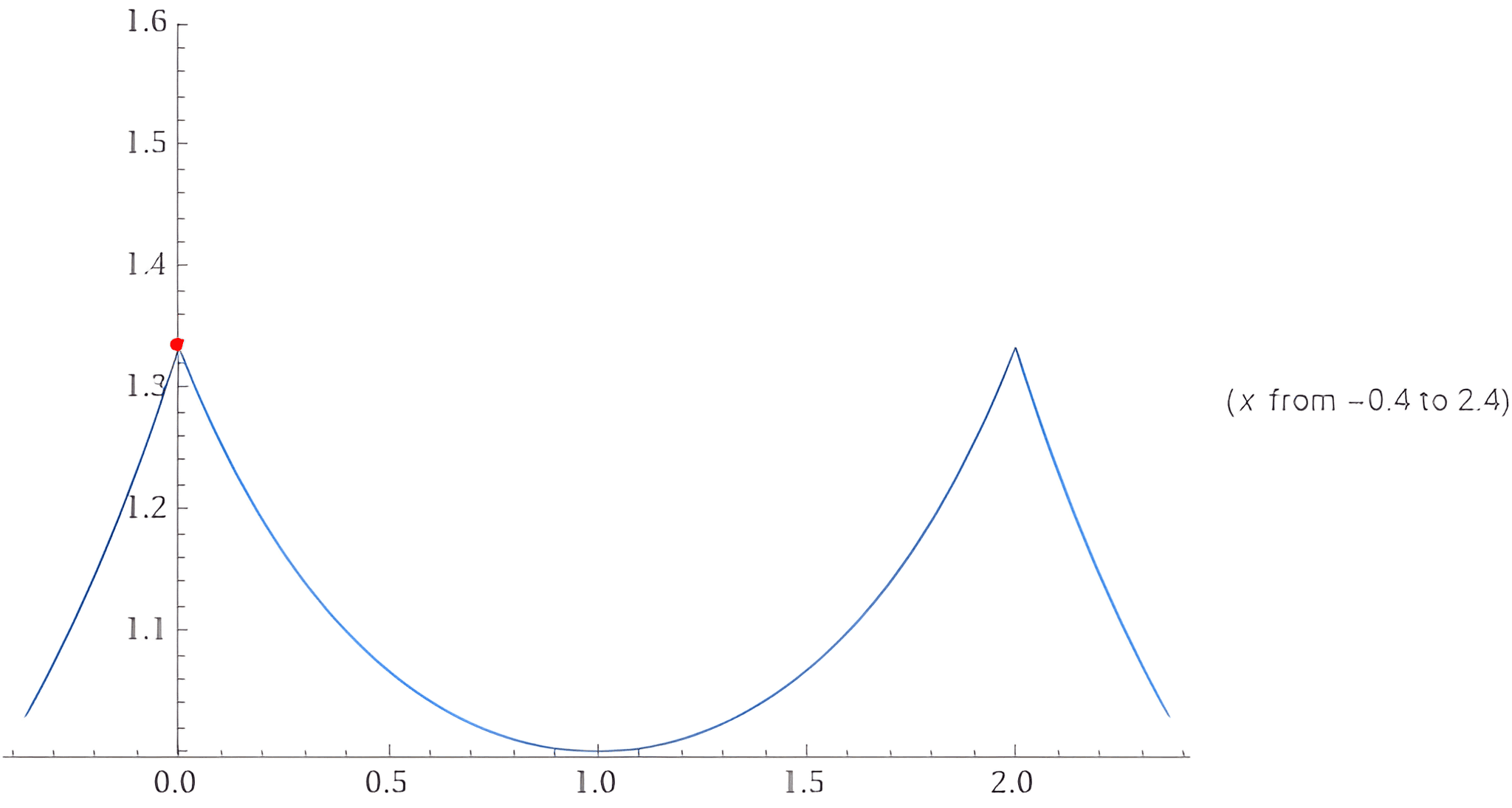
step 1
To find the absolute maximum of f(x)=1+∣x∣1+1+∣x−2∣1, we need to evaluate the function at critical points and endpoints
step 2
The function is piecewise, so we consider x≥0 and x < 0 separately
step 3
For x≥0, f(x)=1+x1+1+∣x−2∣1
step 4
For x < 0, f(x)=1−x1+1+∣x−2∣1
step 5
Evaluating at x=0, f(0)=1+01+1+21=1+31=34
step 6
Evaluating at x=2, f(2)=1+21+1+01=31+1=34
step 7
Evaluating at x=−2, f(−2)=1−(−2)1+1+∣−2−2∣1=31+51=158
step 8
The maximum value is 34 at x=0 and x=2
Question 2 Answer
4/3 at x = 0
Key Concept
Finding absolute maximum of piecewise functions
Explanation
Evaluate the function at critical points and endpoints to determine the maximum value.
Solution by Steps
step 1
To find the radius of the inscribed circle in a right triangle with sides a, b, and c, we use the formula for the inradius r
step 2
The formula for the inradius r is r=2a+b−c
step 3
For a right triangle, c is the hypotenuse, and a and b are the legs
step 4
The area of the triangle is 21ab
step 5
The semi-perimeter s is 2a+b+c
step 6
The inradius r can also be found using r=sA, where A is the area
step 7
Substituting the values, r=2a+b+c21ab=a+b+cab
Question 3 Answer
\frac{ab}{a + b + c}
Key Concept
Inradius of a right triangle
Explanation
The inradius can be found using the area and semi-perimeter of the triangle.
Solution by Steps
step 1
To determine which relation is a function, we need to check if each input has exactly one output
step 2
A function is defined such that for every x in the domain, there is exactly one y in the range
step 3
Option A: xy=2 is not a function because x can have multiple y values
step 4
Option B: x=y2 is not a function because y can have multiple x values
step 5
Option C: y=x2 is a function because each x has exactly one y
step 6
Option D: y=3 is a function because each x has exactly one y
Question 4 Answer
C
Key Concept
Definition of a function
Explanation
A function has exactly one output for each input.
Solution by Steps
step 1
To find f(4) for f(x)=x2−2x, we substitute x=4 into the function
step 2
f(4)=42−2⋅4
step 3
f(4)=16−8
step 4
f(4)=8
Question 5 Answer
H
Key Concept
Evaluating a function
Explanation
Substitute the given value into the function and simplify.
Solution by Steps
step 1
To find the zero of f(x)=−32x−12, we set f(x)=0
step 2
0=−32x−12
step 3
Solving for x, we get −32x=12
step 4
x=−18
Question 6 Answer
A
Key Concept
Finding the zero of a function
Explanation
Set the function equal to zero and solve for the variable.
Solution by Steps
step 1
To find f(−2) for f(x)={∣4x∣ if xx3−1 if x≥−2lt;−2, we determine which piece of the function to use
step 2
Since x=−2, we use the second piece: x3−1
step 3
f(−2)=(−2)3−1
step 4
f(−2)=−8−1
step 5
f(−2)=−9
Question 7 Answer
J
Key Concept
Evaluating a piecewise function
Explanation
Determine which piece of the function to use based on the given value.
Solution by Steps
step 1
To determine which relation is symmetric with respect to the x-axis, we check if replacing y with −y results in the same equation
step 2
Option A: xy=2 is not symmetric because x(−y)=−2
step 3
Option B: x=y2 is not symmetric because x=(−y)2=y2
step 4
Option C: y=x2 is not symmetric because −y=x2
step 5
Option D: y=3 is symmetric because −y=−3 is the same as y=3
Question 8 Answer
D
Key Concept
Symmetry with respect to the x-axis
Explanation
A relation is symmetric with respect to the x-axis if replacing y with −y results in the same equation.
Solution by Steps
step 1
To determine which function is an odd function, we check if f(−x)=−f(x)
step 2
Option F: f(x)=−x3+4 is not odd because f(−x)=−(−x)3+4=x3+4=−f(x)
step 3
Option G: f(x)=2x3 is odd because f(−x)=2(−x)3=−2x3=−f(x)
step 4
Option H: f(x)=x4−9 is not odd because f(−x)=(−x)4−9=x4−9=−f(x)
step 5
Option J: f(x)=x4+4x is not odd because f(−x)=(−x)4+4(−x)=x4−4x=−f(x)
Question 9 Answer
G
Key Concept
Odd function
Explanation
A function is odd if f(−x)=−f(x).
Solution by Steps
step 1
To determine which function has a removable discontinuity, we look for a factor that can be canceled
step 2
Option A: f(x)=x+3x has a discontinuity at x=−3, but it is not removable
step 3
Option B: f(x)=x+2x2−4 has a removable discontinuity at x=−2 because x2−4=(x+2)(x−2)
step 4
Option C: f(x)=x+31 has a discontinuity at x=−3, but it is not removable
step 5
Option D: f(x)=x3−3 has no discontinuities
Question 10 Answer
B
Key Concept
Removable discontinuity
Explanation
A removable discontinuity occurs when a factor can be canceled from the numerator and denominator.
Solution by Steps
step 1
To find limx→∞x−43, we analyze the behavior of the function as x approaches infinity
step 2
As x→∞, the term x−4 also approaches infinity
step 3
Therefore, x−43→0
Question 11 Answer
G
Key Concept
Limit as x approaches infinity
Explanation
As x approaches infinity, the denominator grows without bound, causing the fraction to approach zero.
Solution by Steps
step 1
To find the relative maximum of p(x)=−5x3+47x2−109x+90, we need to find the critical points by taking the derivative and setting it to zero
step 2
p′(x)=−15x2+94x−109
step 3
Setting p′(x)=0, we solve −15x2+94x−109=0
step 4
Using the quadratic formula, x=2a−b±b2−4ac, we find the critical points
step 5
x=2(−15)−94±942−4(−15)(−109)
step 6
Simplifying, we find x≈1.5 and x≈4.5
step 7
Evaluating p(x) at these points, we find the relative maximum at x≈4.5
Question 12 Answer
97
Key Concept
Finding relative maximum
Explanation
Take the derivative, set it to zero, and solve for critical points. Evaluate the function at these points to find the maximum.
Solution by Steps
step 1
To find the average rate of change of h(t)=−16t2+72t from t=3 to t=4, we use the formula 4−3h(4)−h(3)
step 2
h(4)=−16(4)2+72(4)=−256+288=32
step 3
h(3)=−16(3)2+72(3)=−144+216=72
step 4
The average rate of change is 4−332−72=1−40=−40 ft/s
Question 13 Answer
G
Key Concept
Average rate of change
Explanation
Use the difference quotient b−af(b)−f(a) to find the average rate of change over an interval.
Solution by Steps
step 1
To find f(−4.5) for f(x)=⌊x−1⌋, we substitute x=−4.5 into the function
step 2
f(−4.5)=⌊−4.5−1⌋
step 3
f(−4.5)=⌊−5.5⌋
step 4
f(−4.5)=−6
Question 14 Answer
A
Key Concept
Floor function
Explanation
The floor function ⌊x⌋ returns the greatest integer less than or equal to x.

Solution by Steps
step 1
Identify the points through which the first line passes: (−4,1), (−3,2), and (−2,3)
step 2
Since the line extends infinitely in both directions, the domain is all real numbers: (−∞,∞)
step 3
The range of the first line is also all real numbers: (−∞,∞)
step 4
Identify the points through which the second line passes: (−1,−1), (−2,0), and (−3,1)
step 5
The second line is a segment, so its domain is [−3,−1]
step 6
The range of the second line is [−1,1]
Answer
Domain: (−∞,∞) for the first line, [−3,−1] for the second line. Range: (−∞,∞) for the first line, [−1,1] for the second line.
Key Concept
Domain and Range
Explanation
The domain and range of a function describe the set of possible input values (x-values) and output values (y-values), respectively.
step 1
Substitute x=4a−2 into the function: f(4a−2)=2(4a−2)2−(4a−2)+10
step 2
Expand (4a−2)2: (4a−2)2=16a2−16a+4
step 3
Substitute back into the function: f(4a−2)=2(16a2−16a+4)−(4a−2)+10
step 4
Simplify: f(4a−2)=32a2−32a+8−4a+2+10
step 5
Combine like terms: f(4a−2)=32a2−36a+20
Answer
f(4a−2)=32a2−36a+20
Key Concept
Function Substitution
Explanation
Substituting a variable expression into a function involves replacing the variable with the given expression and simplifying.
step 1
Use the quadratic formula x=2a−b±b2−4ac where a=5, b=32, and c=−21
step 2
Calculate the discriminant: b2−4ac=322−4(5)(−21)=1024+420=1444
step 3
Find the square root of the discriminant: 1444=38
step 4
Substitute into the quadratic formula: x=10−32±38
step 5
Solve for x: x=10−32+38=106=0.6 and x=10−32−38=10−70=−7
Answer
The zeros are x=0.6 and x=−7.
Key Concept
Quadratic Formula
Explanation
The quadratic formula is used to find the roots of a quadratic equation by solving for x.
step 1
Determine which piece of the piecewise function to use: Since -10.1 < -4, use f(x)=−∣2x−9∣
step 2
Substitute x=−10.1 into the function: f(−10.1)=−∣2(−10.1)−9∣
step 3
Simplify inside the absolute value: 2(−10.1)=−20.2, so −20.2−9=−29.2
step 4
Take the absolute value: ∣−29.2∣=29.2
step 5
Apply the negative sign: f(−10.1)=−29.2
Answer
f(−10.1)=−29.2
Key Concept
Piecewise Functions
Explanation
Piecewise functions are defined by different expressions depending on the value of the input variable.
step 1
Test for symmetry with respect to the x-axis: Replace y with −y in the equation xy=5
step 2
The equation becomes x(−y)=5⇒−xy=5, which is not equivalent to the original equation
step 3
Test for symmetry with respect to the y-axis: Replace x with −x in the equation xy=5
step 4
The equation becomes (−x)y=5⇒−xy=5, which is not equivalent to the original equation
step 5
Test for symmetry with respect to the origin: Replace x with −x and y with −y in the equation xy=5
step 6
The equation becomes (−x)(−y)=5⇒xy=5, which is equivalent to the original equation
Answer
The graph is symmetric with respect to the origin.
Key Concept
Symmetry in Graphs
Explanation
A graph is symmetric with respect to the origin if replacing x with −x and y with −y yields an equivalent equation.
step 1
Test for evenness: Replace x with −x in the function f(x)
step 2
f(−x)=2(−x−1)2+4(−x)
step 3
Simplify: f(−x)=2(x2+2x+1)−4x=2x2+4x+2−4x=2x2+2
step 4
Compare f(−x) with f(x): f(x)=2(x−1)2+4x=2x2−4x+2+4x=2x2+2
step 5
Since f(−x)=f(x), the function is even
Answer
The function is even.
Key Concept
Even and Odd Functions
Explanation
A function is even if f(−x)=f(x) for all x in the domain.
step 1
Factor the denominator: x2−x−6=(x−3)(x+2)
step 2
Rewrite the function: f(x)=(x−3)(x+2)x2−3x
step 3
Simplify the numerator: x2−3x=x(x−3)
step 4
Cancel common factors: f(x)=(x−3)(x+2)x(x−3)=x+2x for x=3
step 5
Since x=3 makes the denominator zero, f(x) is undefined at x=3
step 6
The discontinuity at x=3 is removable because the limit exists but the function is not defined at that point
Answer
The function is discontinuous at x=3 with a removable discontinuity.
Key Concept
Removable Discontinuity
Explanation
A removable discontinuity occurs when a function is not defined at a point, but the limit exists at that point.
step 1
Determine the horizontal asymptote by comparing the degrees of the numerator and denominator
step 2
Since the degrees are the same, the horizontal asymptote is the ratio of the leading coefficients: 1−4=−4
step 3
As x→∞, g(x)→−4
step 4
As x→−∞, g(x)→−4
Answer
The end behavior is g(x)→−4 as x→±∞.
Key Concept
End Behavior of Rational Functions
Explanation
The end behavior of a rational function is determined by the degrees of the numerator and denominator and their leading coefficients.
step 1
Let t be the number of weeks Mrs. Custer waits to sell
step 2
The price per bushel after t weeks is 6+0.10t
step 3
The number of bushels after t weeks is 100−t
step 4
The income function is I(t)=(6+0.10t)(100−t)
step 5
Expand the income function: I(t)=600+10t−0.10t2
step 6
To find the maximum income, take the derivative and set it to zero: I′(t)=10−0.20t=0
step 7
Solve for t: t=50
step 8
Substitute t=50 back into the income function: I(50)=(6+0.10(50))(100−50)=11×50=550
Answer
Mrs. Custer should sell the soybeans after 50 weeks to maximize her income, which will be $550.
Key Concept
Optimization
Explanation
Optimization involves finding the maximum or minimum value of a function, often by taking the derivative and setting it to zero.
step 1
The height function is h(t)=−16t2+106t+8.5
step 2
Find h(3.5): h(3.5)=−16(3.5)2+106(3.5)+8.5=−196+371+8.5=183.5
step 3
Find h(5.5): h(5.5)=−16(5.5)2+106(5.5)+8.5=−484+583+8.5=107.5
step 4
The change in height is h(5.5)−h(3.5)=107.5−183.5=−76
step 5
The time interval is 5.5−3.5=2 seconds
step 6
The average speed is time intervalchange in height=2−76=−38 feet per second
Answer
The average speed is −38 feet per second.
Key Concept
Average Speed
Explanation
Average speed is calculated by dividing the total change in position by the total time taken.
step 1
Substitute x=−14 into the function: f(−14)=−1.5[[0.75(−14)−1.9]]
step 2
Simplify inside the brackets: 0.75(−14)=−10.5, so −10.5−1.9=−12.4
step 3
The floor function [[−12.4]] is −13
step 4
Multiply by −1.5: f(−14)=−1.5×−13=19.5
Answer
f(−14)=19.5
Key Concept
Floor Function
Explanation
The floor function [[x]] returns the greatest integer less than or equal to x.

Generated Graph
Solution by Steps
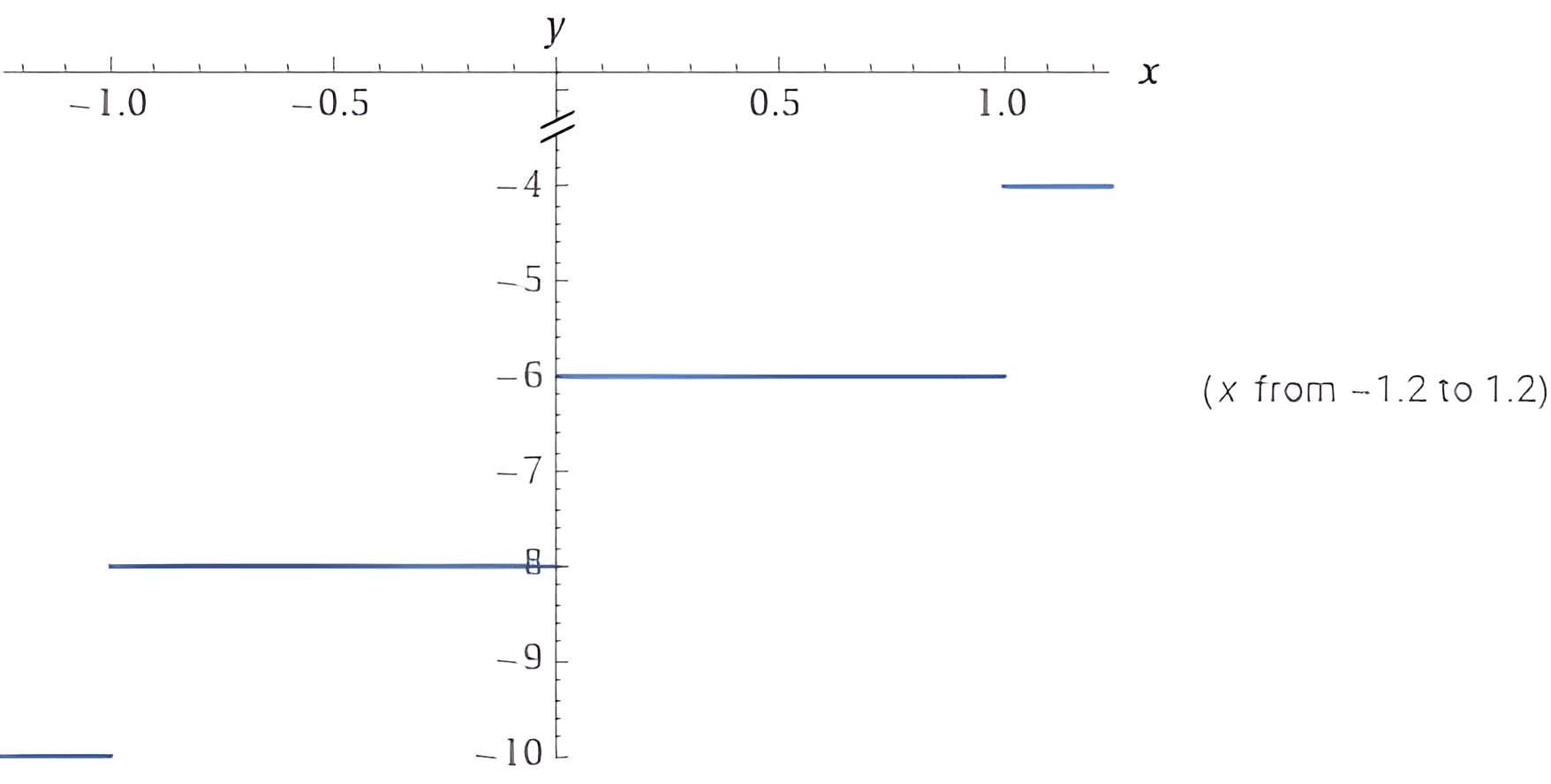
Use transformations of the parent graph of $m(x)=\llbracket x \rrbracket$ to sketch the graph of $p(x)=2 \llbracket x-3 \rrbracket$.step 1
The parent function is m(x)=[[x]], which is the floor function
step 2
The transformation x−3 inside the floor function shifts the graph 3 units to the right
step 3
The multiplication by 2 outside the floor function scales the graph vertically by a factor of 2
step 4
Therefore, p(x)=2[[x−3]] is the graph of m(x)=[[x]] shifted 3 units to the right and stretched vertically by a factor of 2
Answer
The graph of p(x)=2[[x−3]] is the graph of m(x)=[[x]] shifted 3 units to the right and stretched vertically by a factor of 2.
Key Concept
Transformations of the floor function
Explanation
Shifting and scaling transformations applied to the floor function result in the graph of p(x).
step 1
The parent function is f(x)=∣x∣
step 2
The transformation −6x inside the absolute value reflects the graph across the y-axis and scales it horizontally by a factor of 61
step 3
The transformation −3 inside the absolute value shifts the graph 3 units to the left
step 4
The multiplication by 21 outside the absolute value scales the graph vertically by a factor of 21
step 5
The addition of 4 outside the absolute value shifts the graph 4 units up
Answer
The graph of g(x)=21∣−6x−3∣+4 is the graph of f(x)=∣x∣ reflected across the y-axis, scaled horizontally by 61, shifted 3 units to the left, scaled vertically by 21, and shifted 4 units up.
Key Concept
Transformations of the absolute value function
Explanation
Reflections, scalings, and shifts applied to the absolute value function result in the graph of g(x).
step 1
The parent function is f(x)=∣x∣1
step 2
The transformation −1 outside the function shifts the graph 1 unit down
step 3
The graph of f(x)=∣x∣1−1 has vertical asymptotes at x=0 and horizontal asymptote at y=−1
step 4
The graph is symmetric with respect to the y-axis
Answer
The graph of f(x)=∣x∣1−1 has vertical asymptotes at x=0, a horizontal asymptote at y=−1, and is symmetric with respect to the y-axis.
Key Concept
Graphing rational functions with absolute values
Explanation
Shifting the graph of ∣x∣1 down by 1 unit results in the graph of f(x).
step 1
The functions are f(x)=2x−1 and g(x)=2x21
step 2
The quotient function is (gf)(x)=g(x)f(x)=2x212x−1
step 3
Simplify the quotient: (gf)(x)=(2x−1)⋅(2x2)=4x3−2x2
step 4
The domain of (gf)(x) is all real numbers except x=0 (where g(x) is undefined)
Answer
(gf)(x)=4x3−2x2 with domain x=0.
Key Concept
Quotient of functions
Explanation
The quotient of two functions is found by dividing the functions and simplifying, with the domain excluding points where the denominator is zero.
step 1
The volume of a cone is given by V=31πr2h
step 2
Given h=81 mm = 8.1 cm, the volume function is V(r)=31πr2(8.1)=2.7πr2
step 3
The radius r increases at a rate of 4.5 cm/min, so r(t)=4.5t
step 4
Substitute r(t) into V(r): V(t)=2.7π(4.5t)2=2.7π(20.25t2)=54.675πt2
Answer
The volume function is V(t)=54.675πt2 cubic centimeters.
Key Concept
Volume of a cone as a function of time
Explanation
The volume of a cone can be expressed as a function of time by substituting the time-dependent radius into the volume formula.
step 1
The functions are f(x)=3x2+4 and g(x)=x2−x1
step 2
The composition [g∘f](x)=g(f(x))=g(3x2+4)
step 3
Substitute f(x) into g(x): g(3x2+4)=(3x2+4)2−(3x2+4)1
step 4
Simplify the expression: g(3x2+4)=9x4+24x2+16−3x2−41=9x4+21x2+121
Answer
[g∘f](x)=9x4+21x2+121.
Key Concept
Composition of functions
Explanation
The composition of two functions involves substituting one function into the other and simplifying the result.
step 1
The function is f(x)=x−23
step 2
To find the inverse, swap x and y: x=y−23
step 3
Solve for y: x(y−2)=3⇒y−2=x3⇒y=x3+2
step 4
The inverse function is f−1(x)=x3+2
Answer
The inverse function is f−1(x)=x3+2.
Key Concept
Finding the inverse of a function
Explanation
To find the inverse of a function, swap the variables and solve for the new dependent variable.
step 1
The function is f(x)=2x21
step 2
A function is one-to-one if each y value corresponds to exactly one x value
step 3
f(x)=2x21 is not one-to-one because f(x)=f(−x)
step 4
Therefore, f(x)=2x21 is not injective (one-to-one)
Answer
f(x)=2x21 is not a one-to-one function.
Key Concept
One-to-one functions
Explanation
A function is one-to-one if each output is associated with a unique input.
step 1
Let x be the number of boxes of wood screws
step 2
The number of boxes of sheet metal screws is 50−x
step 3
The total price is given by 2.93x+4.07(50−x)
step 4
Simplify the expression: 2.93x+4.07(50−x)=2.93x+203.5−4.07x=203.5−1.14x
step 5
The function for the total price is P(x)=203.5−1.14x
Answer
The function for the total price is P(x)=203.5−1.14x.
Key Concept
Linear functions in cost problems
Explanation
The total cost can be expressed as a linear function of the number of boxes of wood screws.
step 1
The given transformation involves p(x)
step 2
The transformation 21(x−2) inside the function scales the graph horizontally by a factor of 2 and shifts it 2 units to the right
step 3
The multiplication by −2 outside the function reflects the graph across the x-axis and scales it vertically by a factor of 2
step 4
The addition of 2 outside the function shifts the graph 2 units up
Answer
The graph of y=−2p[21(x−2)]+2 is the graph of p(x) scaled horizontally by 2, shifted 2 units to the right, reflected across the x-axis, scaled vertically by 2, and shifted 2 units up.
Key Concept
Transformations of functions
Explanation
Combining horizontal and vertical transformations results in the new graph.
© 2023 AskSia.AI all rights reserved