
AskSia
Plus

Let 𝑓(𝑥) = ln((𝑒^𝑥 − 2)^2 + 1 ) (𝑏 is some parameter)
(a) Determine the domain ...
Jan 23, 2024

Let 𝑓(𝑥) = ln((𝑒^𝑥 − 2)^2 + 1 ) (𝑏 is some parameter)
(a) Determine the domain of 𝑓(𝑥), and whether 𝑓(𝑥) bounded (from above\below).
Justify your claims.
(b)Find the asymptotes of 𝑓(𝑥).
(c) Determine for which values of 𝑏, 𝑓(𝑥) has a critical point, then find and classify
this point.
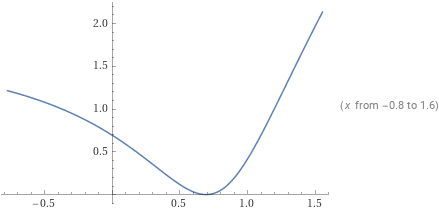
(d)Sketch a graph of 𝑓(𝑥)

Generated Graph
Solution by Steps
step 1
To determine the domain of f(x)=ln((ex−2)2+1), we need to find the values of x for which the argument of the logarithm is positive
step 2
The argument of the logarithm, (ex−2)2+1, is always positive because a square of a real number is non-negative and adding 1 ensures it's strictly positive
step 3
Therefore, the domain of f(x) is all real numbers, R
step 4
To determine if f(x) is bounded, we observe that the logarithm function grows without bound as its argument grows larger
step 5
Since (ex−2)2+1 grows without bound as x increases, f(x) is not bounded above
step 6
However, f(x) is bounded below because the logarithm of a positive number is always greater than the logarithm of 1, which is 0
Answer
The domain of f(x) is all real numbers, R, and f(x) is unbounded above and bounded below.
Key Concept
Domain of a Logarithmic Function
Explanation
The domain of a logarithmic function includes all real numbers for which the argument of the logarithm is positive.
step 1
To find the horizontal asymptotes of f(x), we examine the behavior of f(x) as x approaches infinity and negative infinity
step 2
As x approaches negative infinity, ex approaches 0, so (ex−2)2 approaches 4, and f(x) approaches ln(4+1)=ln(5)
step 3
As x approaches positive infinity, (ex−2)2 grows without bound, and so does f(x), indicating no horizontal asymptote in this direction
Answer
The horizontal asymptote of f(x) is y=ln(5) as x approaches negative infinity. There is no horizontal asymptote as x approaches positive infinity.
Key Concept
Horizontal Asymptotes of Logarithmic Functions
Explanation
Horizontal asymptotes are found by examining the limits of the function as x approaches positive or negative infinity.
step 1
To determine for which values of b, f(x) has a critical point, we find the derivative and set it equal to 0
step 2
The derivative of f(x) is given by dxdln((ex−2)2+1)
step 3
Setting the derivative equal to 0 and solving for x gives x=ln(2)
step 4
To classify the critical point, we would examine the second derivative or use the first derivative test
step 5
Since the derivative changes from positive to negative at x=ln(2), this is a local maximum
Answer
For b=ln(2), f(x) has a critical point, which is a local maximum.
Key Concept
Critical Points of a Function
Explanation
Critical points occur where the derivative is zero or undefined, and they are classified by examining the sign of the derivative around these points.
step 1
To sketch a graph of f(x), we use the domain, asymptotes, and critical points found in previous steps
step 2
The domain is all real numbers, so the graph extends infinitely in the x-direction
step 3
The horizontal asymptote at y=ln(5) as x approaches negative infinity is plotted
step 4
The critical point at x=ln(2) is marked, indicating a local maximum
step 5
The graph is drawn to increase from the horizontal asymptote, reach a peak at the critical point, and then continue to rise without bound
Answer
The graph of f(x) extends over all real numbers, has a horizontal asymptote at y=ln(5), a local maximum at x=ln(2), and rises without bound as x increases.
Key Concept
Graphing Logarithmic Functions
Explanation
The graph of a logarithmic function is determined by its domain, asymptotes, and critical points.
© 2023 AskSia.AI all rights reserved