
AskSia
Plus

Let (X, Y) be a random vector with density that is uniform on the unit disc {(x,...
Apr 15, 2024

Let (X, Y) be a random vector with density that is uniform on the unit disc {(x, y) ∈ R2 :
x2 + y2 ≤ 1}. Determine the distribution of the random variable Θ = arctan(Y/X).

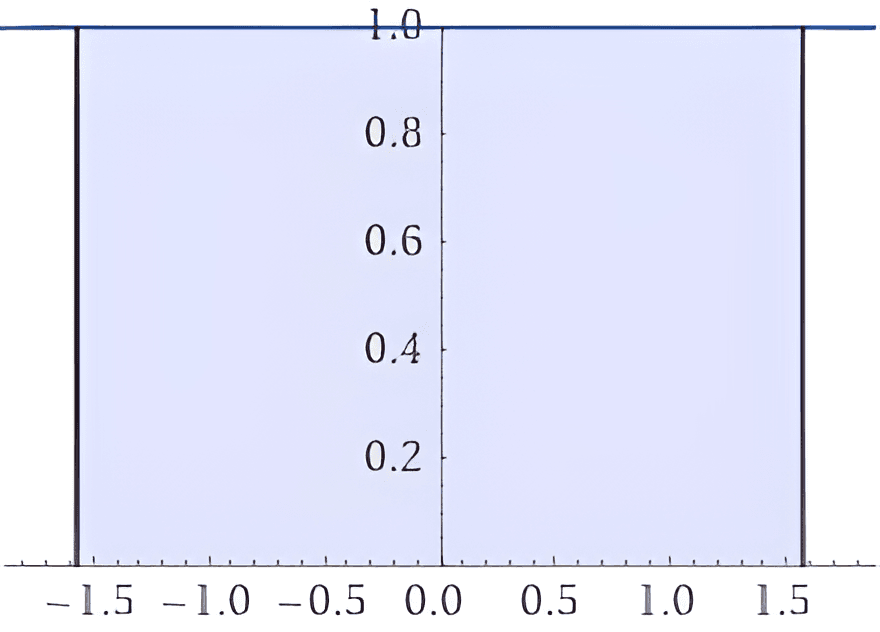
Generated Graph
Solution by Steps
step 1
To find the distribution of the random variable Θ=arctan(Y/X), we first note that the arctan function maps real numbers to the interval (−π/2,π/2)
step 2
Since the density is uniform on the unit disc, the angle Θ is uniformly distributed over (−π/2,π/2)
step 3
The probability density function (pdf) of Θ is constant over (−π/2,π/2) and zero elsewhere
step 4
To find the constant value of the pdf, we integrate the density over the interval (−π/2,π/2) and set the integral equal to 1, since the total probability must be 1
step 5
Using the asksia-ll calculation list, we have the integral of 1 from arctan(−∞) to arctan(+∞), which is equivalent to integrating from −π/2 to π/2
step 6
The result of the integral is π, as given by the asksia-ll calculator: ∫−π/2π/21dx=π
step 7
Therefore, the constant value of the pdf of Θ is 1/π, since ∫−π/2π/21/πdx=1
Answer
The distribution of the random variable Θ is uniform with the probability density function f(θ)=1/π for θ∈(−π/2,π/2) and f(θ)=0 elsewhere.
Key Concept
Uniform Distribution on an Interval
Explanation
The random variable Θ is uniformly distributed over the interval (−π/2,π/2) because every angle in the unit disc is equally likely, and the total probability over this interval is 1.
Find the probability generating function G(s) = E(sX) of a random variable X such that
P(X = n) = 1/2n, when n is a positive integer. What is the maximum real number r such
that the series expression of G(s) converges on the interval (−r, r)?
Solution by Steps
step 1
To find the probability generating function G(s), we sum the probabilities P(X=n) multiplied by sn, for n from 1 to infinity
step 2
The sum is given by ∑n=1∞2nsn
step 3
Using the result from asksia-ll calculator, the sum converges to G(s)=−s−22−ks(2k−sk) as k approaches infinity
step 4
Simplifying as k goes to infinity, we get G(s)=−s−2s
step 5
To find the radius of convergence r, we look at the interval (−r,r) where the series converges
step 6
From the asksia-ll calculator, the radius of convergence is given by the condition -2 < s < 2
step 7
Therefore, the maximum real number r such that the series expression of G(s) converges is r=2
Answer
The probability generating function is G(s)=−s−2s and the maximum real number r for the interval of convergence is r=2.
Key Concept
Probability Generating Function and Radius of Convergence
Explanation
The probability generating function G(s) for a discrete random variable is found by summing the product of sn and the probability P(X=n). The radius of convergence for the series expression of G(s) determines the interval in which the series converges.
The probability generating function of a random variable X is given by the formula es−1.
Determine the probability P(X = 2).
Solution by Steps
step 1
Identify the probability generating function (PGF) for the random variable X
step 2
The given PGF is G(s)=es−1
step 3
Expand G(s) using the Maclaurin series for es, which is es=1+s+2!s2+3!s3+⋯
step 4
Substitute the expansion into the PGF to get G(s)=(1+s+2!s2+3!s3+⋯)−1
step 5
Simplify to find the coefficient of s2 which represents P(X=2). The coefficient of s2 is 2!1
Answer
P(X=2)=2!1=21
Key Concept
Probability Generating Function (PGF)
Explanation
The coefficient of sn in the expansion of the PGF G(s) gives the probability P(X=n). For n=2, the coefficient of s2 is 2!1, which is the probability that X=2.
The probability generating function of a random variable X is given by the formula e^(s−1).
Determine the probability P(X = 2).
Solution by Steps
step 1
The probability generating function (PGF) for a random variable X is given by G(s)=es−1
step 2
To find the probability P(X=2), we need to find the coefficient of s2 in the expansion of G(s)
step 3
Expand G(s) using the Taylor series expansion of ex, which is ex=∑n=0∞n!xn
step 4
Substitute x with s−1 to get es−1=∑n=0∞n!(s−1)n
step 5
The coefficient of s2 in the expansion is the same as the coefficient of s2 in 2!(s−1)2, which is 21
Answer
P(X=2)=21
Key Concept
Probability Generating Function and Taylor Series Expansion
Explanation
The coefficient of s2 in the expansion of the probability generating function es−1 gives the probability P(X=2). The Taylor series expansion is used to find this coefficient.
© 2023 AskSia.AI all rights reserved