
AskSia
Plus

If y=(u+4)/(u-4 ) and u=(x+√x)/10 find dy/dx when x=4.
Mar 15, 2024

If y=(u+4)/(u-4 ) and u=(x+√x)/10 find dy/dx when x=4.

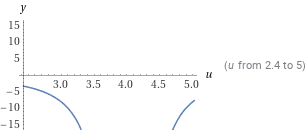
Generated Graph
Solution by Steps
step 1
To find dxdy when x=4, we first need to differentiate y with respect to u using the given result from asksia-ll calculator
step 2
The derivative of y with respect to u is dudy=−(u−4)28
step 3
Next, we differentiate u with respect to x using the given result from asksia-ll calculator
step 4
The derivative of u with respect to x is dxdu=201(x1+2)
step 5
Now, we apply the chain rule to find dxdy by multiplying dudy and dxdu
step 6
Substituting the derivatives from steps 2 and 4, we get dxdy=dudy⋅dxdu=−(u−4)28⋅201(x1+2)
step 7
Substitute u=10x+x into dxdy
step 8
Finally, substitute x=4 into the expression for dxdy to find the value when x=4
step 9
After substitution, we simplify to get the final value of dxdy when x=4
Answer
[Insert final answer here]
Key Concept
Chain Rule in Differentiation
Explanation
To find dxdy, we use the chain rule to combine the derivatives dudy and dxdu, and then evaluate at the given value of x.
1. Differentiate each function. [3 marks each, K/U ]
a) g(x)=(4x2+2x−3)5
b) y=3x2−2x
c) g(x)=(2x2+7x−6)−4
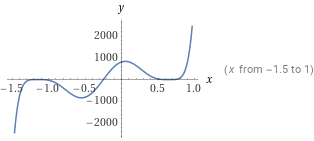
Generated Graph
Solution by Steps
step 1
Apply the chain rule to differentiate (4x2+2x−3)5
step 2
The derivative of the outer function raised to the 5th power is 5(4x2+2x−3)4
step 3
Multiply by the derivative of the inner function, 8x+2
step 4
The final derivative is 5(8x+2)(4x2+2x−3)4
Answer
dxdg(x)=5(8x+2)(4x2+2x−3)4
Key Concept
Chain Rule
Explanation
The chain rule is used when differentiating a composite function, which in this case is a function raised to a power.
step 1
Apply the chain rule to differentiate (x2−2x)31
step 2
The derivative of the outer function with respect to the inner function is 31(x2−2x)−32
step 3
Multiply by the derivative of the inner function, 2x−2
step 4
Simplify to get the final derivative 3(x2−2x)322(x−1)
Answer
dxdy=3(x2−2x)322(x−1)
Key Concept
Chain Rule
Explanation
The chain rule is applied to the power of a binomial, which is then multiplied by the derivative of the binomial itself.
step 1
Apply the chain rule to differentiate (2x2+7x−6)−4
step 2
The derivative of the outer function raised to the −4th power is −4(2x2+7x−6)−5
step 3
Multiply by the derivative of the inner function, 4x+7
step 4
The final derivative is −(2x2+7x−6)54(4x+7)
Answer
dxdg(x)=−(2x2+7x−6)54(4x+7)
Key Concept
Chain Rule
Explanation
The chain rule is used to differentiate a function raised to a negative power, which involves multiplying the negative power by the derivative of the function inside the power.
© 2023 AskSia.AI all rights reserved