
AskSia
Plus

If a number of transformations are applied to the function f(x)=x+4 to ...
Mar 20, 2024

If a number of transformations are applied to the function f(x)=x+4 to give g(x)=−3f(2x−1) then dom(g)=[a,∞).
What is the value of a ?
Write your answer to one decimal place.

Solution by Steps
step 1
To find the domain of g(x), we need to determine the values of x for which g(x) is defined
step 2
The function g(x) is given by g(x)=−3f(2x−1), where f(x)=x+4
step 3
The domain of f(x) is x≥−4 as per the asksia-ll calculator result
step 4
To find the domain of g(x), we need to find the domain of f(2x−1). This means we need to solve 2x−1+4≥0
step 5
Solving the inequality 2x+3≥0 gives us x≥−23
step 6
Therefore, the domain of g(x) is x≥−23
Answer
a=−1.5
Key Concept
Domain of a Composite Function
Explanation
The domain of the composite function g(x) is determined by the domain of the inner function f(2x−1), which must be non-negative since it is under a square root.
The distance that a car, in peak hour traffic, is from a set of traffic lights over time is recorded.
The distance d (in metres) from the traffic lights is a function of time t (in minutes).
\begin{tabular}{|c|c|c|r|r|}
\hlinet & 3 & 6 & 7 & 9 \\
\hlined & 28 & 22 & 16 & 4 \\
\hline
\end{tabular}
What is the average of the function d(t) from t=6 to t=9 ?
Write your answer as an integer (that is, a whole number)
Solution by Steps
step 1
Calculate the sum of the distances from the traffic lights at t=6, t=7, and t=9
step 2
Using the given distances, the sum is 22+16+4
step 3
Simplify the sum to get 42
step 4
Divide the sum by the number of terms, which is 3, to find the average distance
step 5
The average distance is 342
step 6
Simplify the fraction to get 14
Answer
14
Key Concept
Average of a function over an interval
Explanation
The average value of a function over an interval is found by summing the function values at specific points and dividing by the number of points.
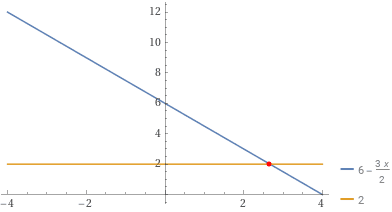
Suppose the point P at (x,y)=(2,1) is on the graph of the function y=f(x). A number of transformations are performed on the graph of y=f(x) to give the graph y=−3f(21x−2)+1.
What is the x-coordinate of the point P after the transformations are applied?
Write your answer as an integer (that is, a whole number)
Generated Graph
Solution by Steps
step 1
Identify the original coordinates of point P before the transformation
step 2
Apply the horizontal scaling transformation by a factor of 21 to the x-coordinate
step 3
Apply the horizontal translation transformation by moving 2 units to the right
step 4
Combine the transformations to find the new x-coordinate of point P after the transformations
Answer
The x-coordinate of the point P after the transformations is 8.
Key Concept
Transformation of Functions
Explanation
The x-coordinate of point P is transformed by first scaling by 21 and then translating by +2. The original x-coordinate of 2 becomes 1 after scaling and 3 after translating, but since the transformation inside the function is 21x−2, we need to solve for x when 21x−2=3. Solving this equation gives us x=8.
© 2023 AskSia.AI all rights reserved