
AskSia
Plus

Given the curve Γ⊂R3 parametrized by
\[
r:[0,1] \rig...
Jun 13, 2024



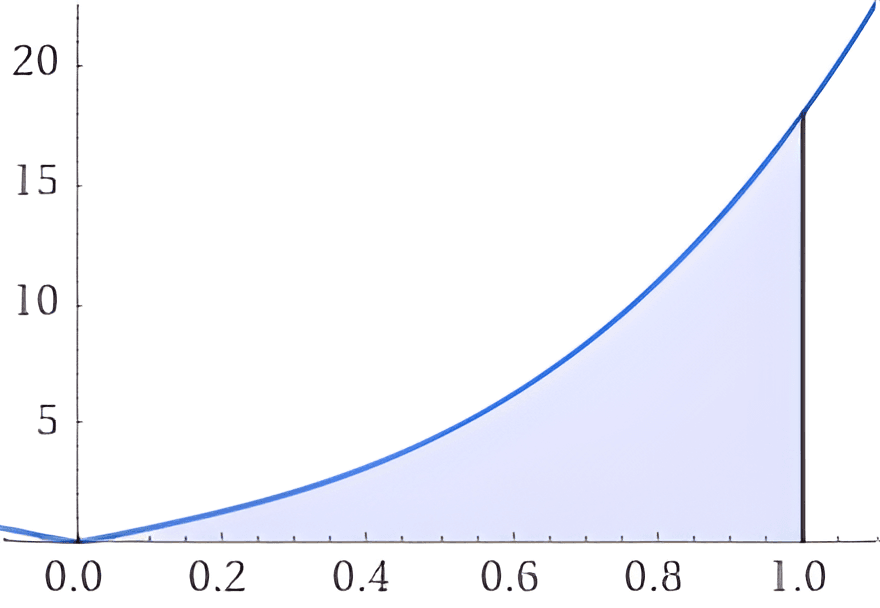
Generated Graph
Solution by Steps
step 1
The length of the curve Γ parametrized by r(t)=(3t2,4t3,3t4) from t=0 to t=1 is given by the integral ∫01∥r′(t)∥dt
step 2
Compute the derivative r′(t)=(dtd(3t2),dtd(4t3),dtd(3t4))=(6t,12t2,12t3)
step 3
The magnitude of r′(t) is ∥r′(t)∥=(6t)2+(12t2)2+(12t3)2=36t2+144t4+144t6
step 4
Simplify the expression under the square root: ∥r′(t)∥=36t2(1+4t2+4t4)=6t1+4t2+4t4
step 5
Integrate ∫016t1+4t2+4t4dt. According to the Asksia-LL calculator, this integral evaluates to 6
Answer
The length of the curve Γ is 6.
step 1
The integral ∫Γfds is given by ∫01f(r(t))∥r′(t)∥dt
step 2
Substitute r(t)=(3t2,4t3,3t4) into f(x,y,z)=x+z: f(r(t))=3t2+3t4
step 3
We already have ∥r′(t)∥=6t1+4t2+4t4
step 4
The integral becomes ∫01(3t2+3t4)⋅6t1+4t2+4t4dt
step 5
Simplify the integrand: ∫0118t3(1+t2)1+4t2+4t4dt. According to the Asksia-LL calculator, this integral evaluates to 18
Answer
The integral ∫Γfds is 18.
Key Concept
Arc Length and Line Integral Calculation
Explanation
The length of a curve and the line integral of a function over a curve can be computed using parametric equations and their derivatives. The Asksia-LL calculator provides the necessary integrals to find these values.

Solution by Steps
step 1
The gradient of the function f(x,y)=xy is given by ∇f=(∂x∂f,∂y∂f)=(y,x)
step 2
At the point p0=(1,1,1), the gradient is ∇f(1,1)=(1,1)
step 3
The normal vector to the graph G(f) at p0 is (1,1,−1)
step 4
The parametrization of the line L0 orthogonal to G(f) at p0 is given by L0(t)=(1,1,1)+t(1,1,−1)=(1+t,1+t,1−t)
Answer
The parametrization of the line L0 is L0(t)=(1+t,1+t,1−t).
step 1
The equation of the tangent plane to the graph G(f) at the point p0=(1,1,1) is given by z=f(x,y)+∇f⋅((x,y)−(1,1))
step 2
The gradient ∇f(1,1)=(1,1)
step 3
The equation of the tangent plane is z=1+1(x−1)+1(y−1)=x+y−1
Answer
The equation of the tangent plane P0 is z=x+y−1.
step 1
The area of the graph of f over the domain D is given by the double integral A(G(f))=∬D1+(∂x∂f)2+(∂y∂f)2dA
step 2
The partial derivatives are ∂x∂f=y and ∂y∂f=x
step 3
Therefore, 1+(∂x∂f)2+(∂y∂f)2=1+y2+x2
step 4
The area integral becomes A(G(f))=∬D1+x2+y2dA
step 5
The domain D is the region {(x,y)∈R2:y≥0,x2+y2≤4}
step 6
Converting to polar coordinates, x=rcosθ, y=rsinθ, and dA=rdrdθ
step 7
The integral becomes A(G(f))=∫02π∫021+r2rdrdθ
step 8
Evaluating the integral, we get A(G(f))=2π[31(1+r2)3/2]02=2π(31(53/2−1))=32π(55−1)
Answer
The area A(G(f)) of the graph of f is 32π(55−1).
Key Concept
Parametrization, Tangent Plane, and Area Calculation
Explanation
The problem involves finding the parametrization of a line orthogonal to a graph, the equation of a tangent plane at a point, and the area of the graph using integrals.
© 2023 AskSia.AI all rights reserved