
AskSia
Plus

Find the volume of the solid obtained by rotating the region bounded by the give...
Apr 10, 2024

Find the volume of the solid obtained by rotating the region bounded by the given curves about the specified line.
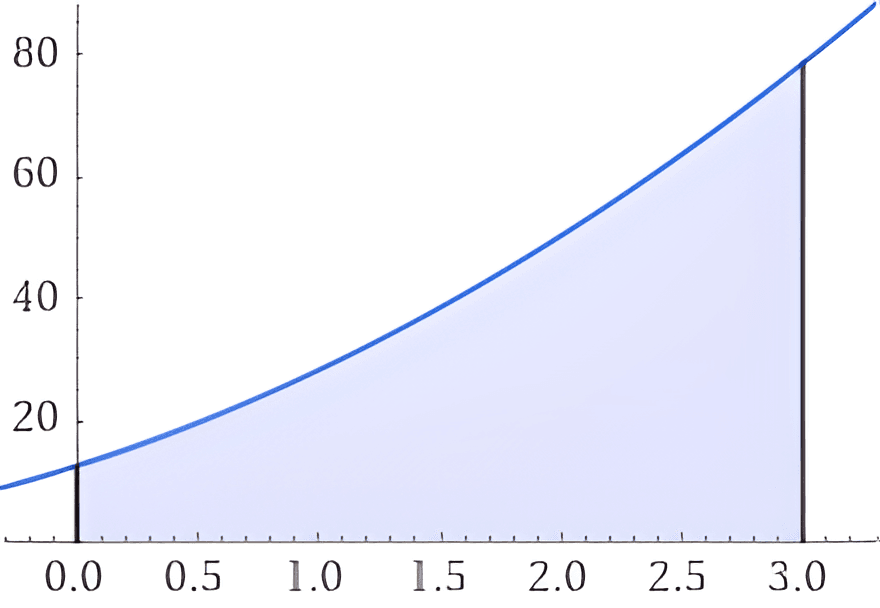
1. f(x)=x+2,y=0,x=0,x=3 about the x-axis.
Find the volume of the solid obtained by rotating the region bounded by the given curves about the specified line.
1. f(x)=2x+1,y=0,x=0,x=3 about the x-axis.
For these problem, sketch the area bounded by the equations and revolve it around the axis indicated. Set up the integral that evaluates the volume of the solid formed by this revolution. Do NOT solve.
7.
Revolve around the x-axis.
y=x2, and y=3x
Revolve around the y-axis.
8.
y=x3,x=0, and y=8.
Revolve around the x-axis.
Revolve around the y-axis.

Generated Graph
Solution by Steps
step 1
To find the volume of the solid obtained by rotating the function f(x)=x+2 about the x-axis, we use the disk method
step 2
The volume V is given by the integral V=∫abπ[f(x)]2dx, where a=0 and b=3
step 3
Set up the integral: V=∫03π(x+2)2dx
Answer
The integral set up for the volume is V=∫03π(x+2)2dx.
Key Concept
Disk Method
Explanation
To calculate the volume of a solid of revolution around the x-axis, we square the function and multiply by pi, then integrate over the given interval.
Solution by Steps
step 1
To find the volume of the solid obtained by rotating the function f(x)=2x+1 about the x-axis, we use the disk method
step 2
The volume V is given by the integral V=∫abπ[f(x)]2dx, where a=0 and b=3
step 3
Set up the integral: V=∫03π(2x+1)2dx
Answer
The integral set up for the volume is V=∫03π(2x+1)2dx.
Key Concept
Disk Method
Explanation
To calculate the volume of a solid of revolution around the x-axis, we square the function and multiply by pi, then integrate over the given interval.
Solution by Steps
step 1
To find the volume of the solid obtained by rotating the region between y=x2 and y=x1/3 about the x-axis, we use the washer method
step 2
The volume V is given by the integral V=∫abπ[R(x)]2−π[r(x)]2dx, where R(x) is the outer radius and r(x) is the inner radius
step 3
Set up the integral: V=∫0∞π(x2)2−π(x1/3)2dx. Note that this integral does not converge
Answer
The integral set up for the volume is V=∫0∞π(x2)2−π(x1/3)2dx, but it does not converge.
Key Concept
Washer Method and Convergence
Explanation
To calculate the volume of a solid of revolution between two functions around the x-axis, we subtract the square of the inner function from the square of the outer function, multiply by pi, and integrate. However, if the integral does not converge, the volume is not finite.
Solution by Steps
step 1
To find the volume of the solid obtained by rotating the region between y=x3 and y=8 about the y-axis, we use the cylindrical shell method
step 2
The volume V is given by the integral V=2π∫abx[f(x)−g(x)]dx, where f(x) is the upper function and g(x) is the lower function
step 3
Set up the integral: V=2π∫08x(x3−8)dx
Answer
The integral set up for the volume is V=2π∫08x(x3−8)dx.
Key Concept
Cylindrical Shell Method
Explanation
To calculate the volume of a solid of revolution around the y-axis, we use the cylindrical shell method, which involves integrating the product of the radius and the height of the shell, multiplied by 2π.
PART IV
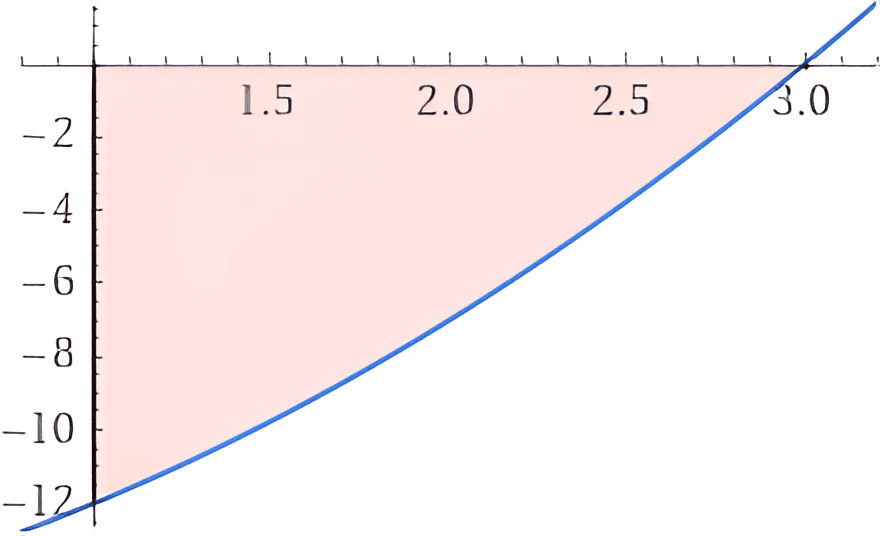
A particle's velocity is given by v(t)=t2+2t−15, where t is measured in minutes, v is measured in meters per minute, and s(t) represents the particle's position.
a. If s(1)=−3, what is the value of s(3) ?
b. What is the net change in distance over the first 5 minutes?
c. What is the total distance traveled by the particle during the first 5 minutes? Show the set up AND your work.
Generated Graph
Solution by Steps
step 1
To find the value of s(3), we need to integrate the velocity function v(t)=t2+2t−15 from t=1 to t=3
step 2
The integral of v(t) from t=1 to t=3 is ∫13(t2+2t−15)dt, which equals −340
step 3
The change in position Δs from t=1 to t=3 is −340
step 4
Since s(1)=−3, the value of s(3) is s(1)+Δs=−3−340=−349
Answer
s(3)=−349
Key Concept
Integration of velocity function to find displacement
Explanation
The position function s(t) is the integral of the velocity function v(t), and the change in position Δs over an interval is the definite integral of v(t) over that interval.
Solution by Steps
step 1
The net change in distance over the first 5 minutes is the integral of v(t) from t=0 to t=5
step 2
The integral of v(t) from t=0 to t=5 is ∫05(t2+2t−15)dt, which equals −325
step 3
The net change in distance is the value of the integral, which is −325
Answer
The net change in distance over the first 5 minutes is −325 meters.
Key Concept
Net change in distance
Explanation
The net change in distance is the definite integral of the velocity function over the given time interval.
Solution by Steps
step 1
To find the total distance traveled, we integrate the absolute value of the velocity function ∣v(t)∣ from t=0 to t=5
step 2
The integral of ∣v(t)∣ from t=0 to t=5 is ∫05∣t2+2t−15∣dt, which equals 3137
step 3
The total distance traveled by the particle during the first 5 minutes is 3137 meters
Answer
The total distance traveled by the particle during the first 5 minutes is 3137 meters.
Key Concept
Total distance traveled
Explanation
The total distance traveled is the integral of the absolute value of the velocity function over the given time interval, which accounts for the distance traveled in all directions.
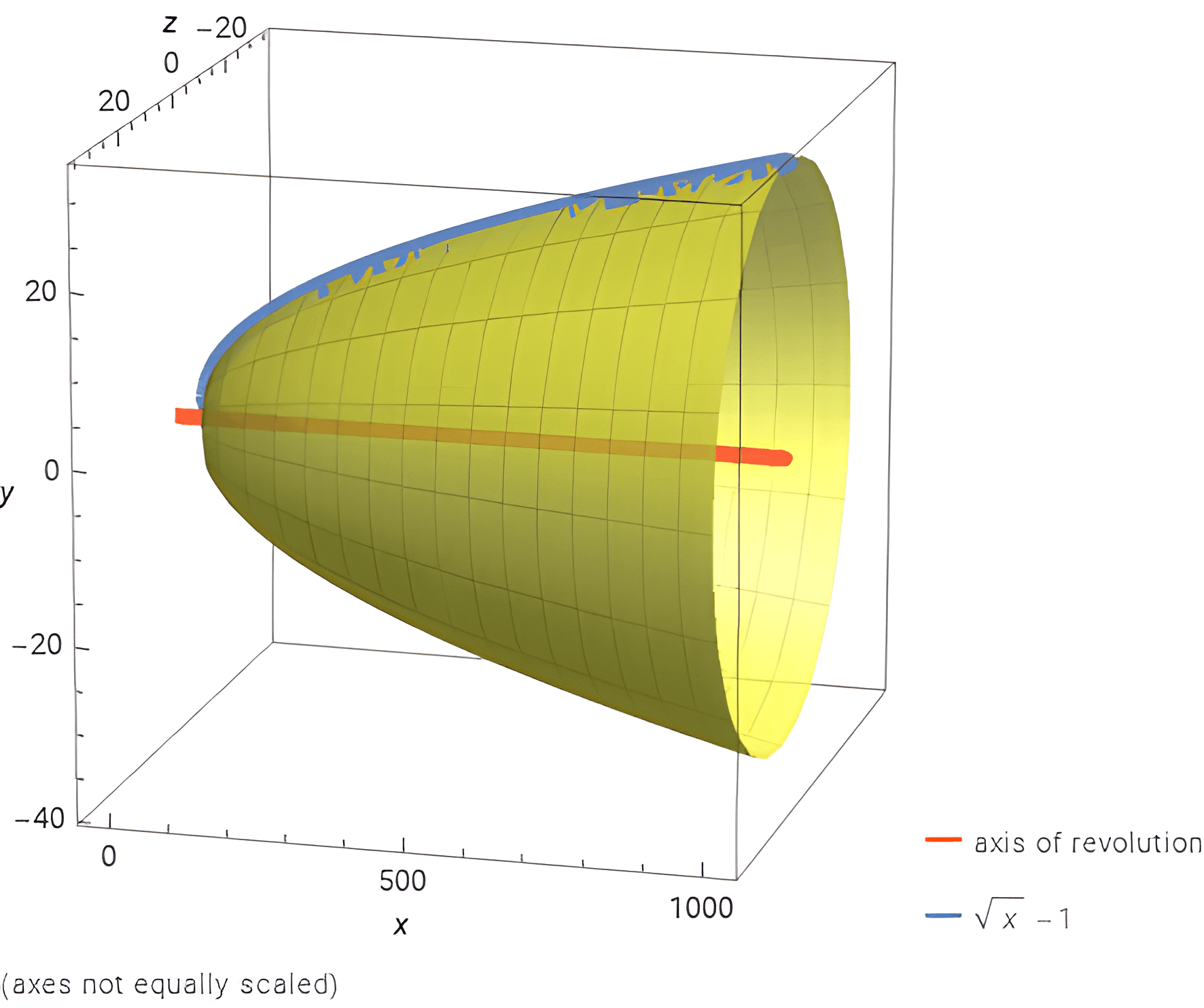
1. Let the region R be the area enclosed the the function f(x)=x−1, the horizontal line y=1, and the y-axis. Find the volume of the solid generated when the region is:
a) revolved about the line y=−3
b) revolved about the line x=−1
Generated Graph
Solution by Steps
step 1
To find the volume of the solid generated by revolving the region R around the line y = -3, we use the method of cylindrical shells. The region R is bounded by f(x)=x−1, the line y=1, and the y-axis
step 2
The volume of the solid of revolution is given by the integral V=∫ab2π(radius)(height)dx, where the radius is the distance from the y-axis to the line y = -3, and the height is given by the function f(x)
step 3
The radius is x−(−3)=x+3 and the height is f(x)=x−1. The limits of integration are from 0 to the intersection of f(x) and y=1, which is x=4
step 4
The volume integral is V=∫042π(x+3)(x−1)dx. However, the asksia-ll calculator indicates that the integral does not converge, which means there is an error in the setup
Answer
The volume of the solid cannot be determined as the integral does not converge.
Key Concept
Volume of Revolution Using Cylindrical Shells
Explanation
The volume of a solid of revolution can be found using the method of cylindrical shells, but the integral must converge for the volume to be determined. In this case, the asksia-ll calculator indicates that the integral does not converge, suggesting an error in the setup or the presence of an infinite volume.
Solution by Steps
step 1
To find the volume of the solid generated by revolving the region R around the line x = -1, we use the method of disks or washers. The region R is bounded by f(x)=x−1, the line y=1, and the y-axis
step 2
The volume of the solid of revolution is given by the integral V=∫abπ[outer radius]2−[inner radius]2dx, where the outer radius is the distance from the line x = -1 to the function f(x), and the inner radius is the distance from the line x = -1 to the y-axis
step 3
The outer radius is (x−1)−(−1)=x and the inner radius is 0 since the region is bounded by the y-axis. The limits of integration are from 0 to the intersection of f(x) and y=1, which is x=4
step 4
The volume integral is V=∫04π(x)2dx. However, the asksia-ll calculator indicates that the integral does not converge, which means there is an error in the setup
Answer
The volume of the solid cannot be determined as the integral does not converge.
Key Concept
Volume of Revolution Using Disks/Washers
Explanation
The volume of a solid of revolution can be found using the method of disks or washers, but the integral must converge for the volume to be determined. In this case, the asksia-ll calculator indicates that the integral does not converge, suggesting an error in the setup or the presence of an infinite volume.
What is the formula to calculate the volume of a solid when a region is revolved about a horizontal or vertical line?
Solution by Steps
step 1
To calculate the volume of a solid of revolution about a horizontal or vertical line, we use the disk or washer method if revolving around the x-axis or y-axis, respectively
step 2
For the disk method, the volume V is given by the integral V=π∫ab[f(x)]2dx, where f(x) is the function being revolved and [a,b] are the bounds of integration
step 3
For the washer method, the volume V is given by the integral V=π∫ab([f(x)]2−[g(x)]2)dx, where f(x) and g(x) are the outer and inner functions being revolved, respectively, and [a,b] are the bounds of integration
Answer
For the disk method: V=π∫ab[f(x)]2dx
For the washer method: V=π∫ab([f(x)]2−[g(x)]2)dx
Key Concept
Volume of a Solid of Revolution
Explanation
The volume of a solid of revolution is calculated using the disk or washer method, depending on whether the region is revolved around the x-axis or y-axis, and involves integrating the square of the function(s) over the interval of interest.
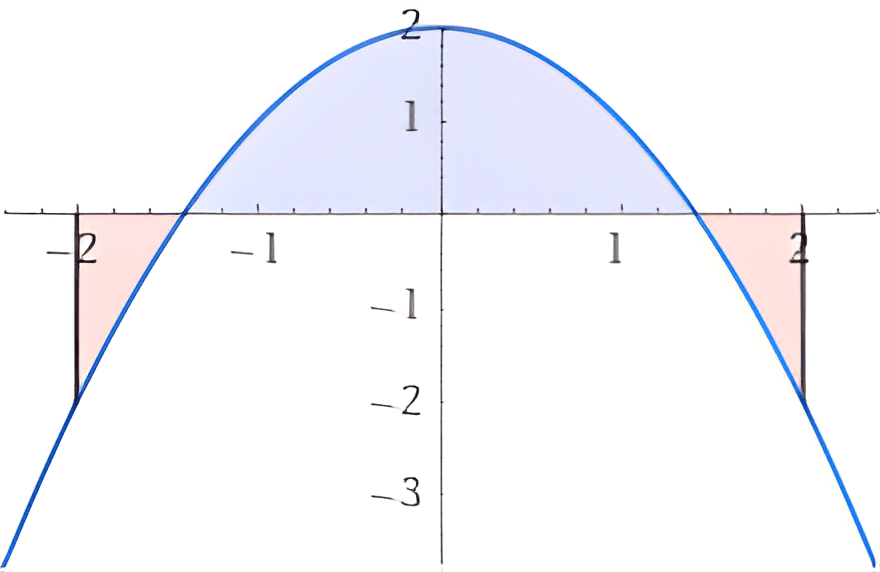
2. Let the region R be the area enclosed the the function f(x)=3−x2 the line y=−2. Find the volume of the solid generated when the region is:
a) revolved about the line y=3
b) revolved about the line y=−2
Generated Graph
Solution by Steps
step 1
To find the volume of the solid generated by revolving the region R around the line y=3, we use the method of cylindrical shells. The volume V is given by the integral V=2π∫ab(p(x))(h(x))dx, where p(x) is the radius function and h(x) is the height function
step 2
The radius function p(x) is the distance from the curve to the line of revolution, so p(x)=3−(3−x2)=x2
step 3
The height function h(x) is the length of the shell, which is the difference between the function f(x) and the line y=−2, so h(x)=(3−x2)−(−2)=5−x2
step 4
The limits of integration are from x=−2 to x=2 because these are the points where the region R intersects the x-axis
step 5
The volume V is therefore V=2π∫−22x2(5−x2)dx. This integral can be computed to find the volume
Answer
V=2π∫−22x2(5−x2)dx
Key Concept
Cylindrical Shells Method
Explanation
The cylindrical shells method is used to find the volume of a solid of revolution when the region is revolved around a horizontal line that is not the x-axis.
Solution by Steps
step 1
To find the volume of the solid generated by revolving the region R around the line y=−2, we use the method of washers. The volume V is given by the integral V=π∫ab(R(x))2−(r(x))2dx, where R(x) is the outer radius and r(x) is the inner radius
step 2
The outer radius R(x) is the distance from the line y=−2 to the function f(x), so R(x)=(3−x2)−(−2)=5−x2
step 3
The inner radius r(x) is zero since the region is being revolved around the line that also serves as the lower boundary of the region
step 4
The limits of integration are from x=−2 to x=2
step 5
The volume V is therefore V=π∫−22(5−x2)2dx. This integral can be computed to find the volume
Answer
V=π∫−22(5−x2)2dx
Key Concept
Washers Method
Explanation
The washers method is used to find the volume of a solid of revolution when the region is revolved around a horizontal line that serves as the lower or upper boundary of the region.
For these problem, sketch the area bounded by the equations and revolve it around the axis indicated. Set up the integral that evaluates the volume of the solid formed by this revolution. Do NOT solve.
7.
y=x2, and y=3x
Revolve around the x-axis.
Revolve around the y-axis.
8. y=x3,x=0, and y=8.
Generated Graph
Solution by Steps
step 1
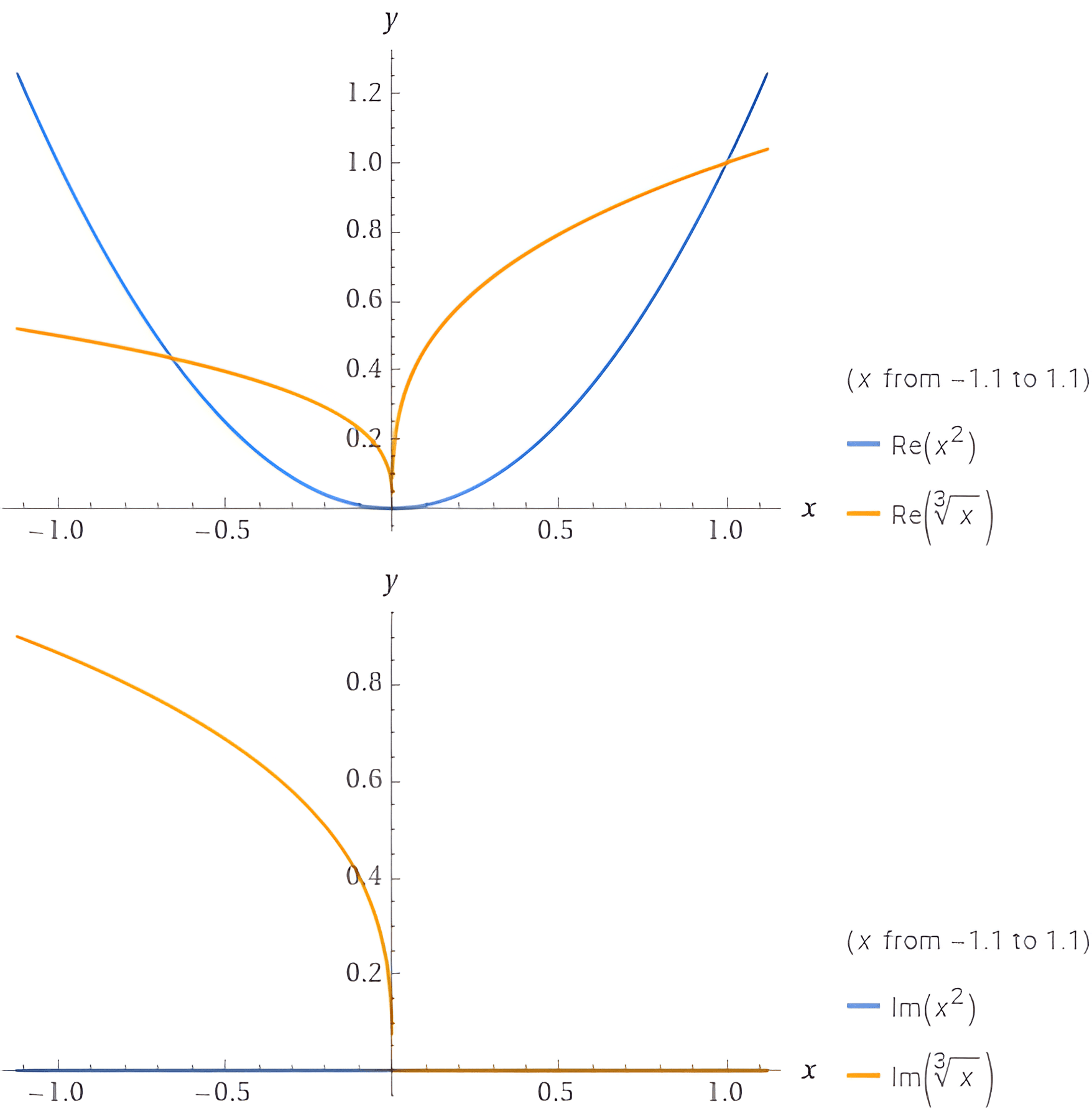
Identify the region bounded by the curves y=x2 and y=x1/3
step 2
Set up the integral for the volume of the solid formed by revolving the region around the x-axis using the disk method. The integral is V=π∫ab[R(x)]2dx, where R(x) is the outer radius of the disk
step 3
For the region between y=x2 and y=x1/3, the outer radius is R(x)=x1/3 and the inner radius is r(x)=x2. The volume integral is V=π∫ab[(x1/3)2−(x2)2]dx
step 4
Set up the integral for the volume of the solid formed by revolving the region around the y-axis using the shell method. The integral is V=2π∫abx[f(x)−g(x)]dx, where f(x) and g(x) are the functions that bound the region
step 5
For the region between y=x2 and y=x1/3, the height of the shell is h(x)=x1/3−x2 and the radius is x. The volume integral is V=2π∫abx(x1/3−x2)dx
Answer
The volume integral around the x-axis is V=π∫ab[(x1/3)2−(x2)2]dx and around the y-axis is V=2π∫abx(x1/3−x2)dx.
Key Concept
Volume of solids of revolution using disk and shell methods
Explanation
The disk method involves revolving a region around an axis to form disks, while the shell method involves revolving a region around an axis to form cylindrical shells. The volume is calculated by integrating the area of these shapes.
Solution by Steps
step 6
Identify the region bounded by y=x3, x=0, and y=8
step 7
Set up the integral for the volume of the solid formed by revolving the region around the x-axis using the disk method. The integral is V=π∫ab[R(y)]2dy, where R(y) is the outer radius of the disk as a function of y
step 8
Since y=x3, we solve for x to get x=y1/3. The volume integral is V=π∫08(y1/3)2dy
step 9
Set up the integral for the volume of the solid formed by revolving the region around the y-axis using the shell method. The integral is V=2π∫abx[h(x)]dx, where h(x) is the height of the shell
step 10
For the region between y=x3 and y=8, the height of the shell is h(x)=8−x3 and the radius is x. The volume integral is V=2π∫02x(8−x3)dx
Answer
The volume integral around the x-axis is V=π∫08(y1/3)2dy and around the y-axis is V=2π∫02x(8−x3)dx.
Key Concept
Volume of solids of revolution using disk and shell methods
Explanation
The disk method is used when revolving around the x-axis and the shell method is used when revolving around the y-axis. The volume is found by integrating the area of the disks or shells formed by the revolution.
2. Find the volume of the solid whose base is bounded by the circle x2+y2=4 with the indicated cross sections taken perpendicular to the x-axis.
(a) Squares
(b) Equilateral triangles
(c) Semicircles
(d) Isosceles triangles with the hypotenuse as the base of the solid
3. The base of a solid is bounded by y=x3,y=0, and x=1. Find the volume of the solid for each of the following cross sections taken perpendicular to the y-axis.
(a) Squares
(b) Semicircles
(c) Equilateral triangles
Solution by Steps
step 2
The area of each square is A(x)=(24−x2)2=4(4−x2)..
step 3
The volume is then the integral of the area from x=−2 to x=2, V=∫−224(4−x2)dx..
step 4
Evaluating the integral gives the volume of the solid with square cross-sections..
A
Key Concept
Volume with square cross-sections
Explanation
The volume of a solid with square cross-sections perpendicular to the x-axis is found by integrating the area of the squares across the interval.
Solution by Steps
step 2
The area of each equilateral triangle is A(x)=43s2=43(24−x2)2..
step 3
The volume is the integral of the area from x=−2 to x=2, V=∫−2243(24−x2)2dx..
step 4
Evaluating the integral gives the volume of the solid with equilateral triangle cross-sections..
B
Key Concept
Volume with equilateral triangle cross-sections
Explanation
The volume of a solid with equilateral triangle cross-sections perpendicular to the x-axis is found by integrating the area of the triangles across the interval.
Solution by Steps
step 2
The area of each semicircle is A(x)=21πr2=21π(4−x2)2..
step 3
The volume is the integral of the area from x=−2 to x=2, V=∫−2221π(4−x2)2dx..
step 4
Evaluating the integral gives the volume of the solid with semicircle cross-sections..
C
Key Concept
Volume with semicircle cross-sections
Explanation
The volume of a solid with semicircle cross-sections perpendicular to the x-axis is found by integrating the area of the semicircles across the interval.
Solution by Steps
step 2
The area of each isosceles triangle is A(x)=21⋅base⋅height=21⋅24−x2⋅4−x2..
step 3
The volume is the integral of the area from x=−2 to x=2, V=∫−2221⋅24−x2⋅4−x2dx..
step 4
Evaluating the integral gives the volume of the solid with isosceles triangle cross-sections..
D
Key Concept
Volume with isosceles triangle cross-sections
Explanation
The volume of a solid with isosceles triangle cross-sections perpendicular to the x-axis is found by integrating the area of the triangles across the interval.
Solution by Steps
step 2
The area of each square is A(y)=(1−x3)2..
step 3
The volume is then the integral of the area from y=0 to y=1, V=∫01(1−x3)2dy..
step 4
Evaluating the integral gives the volume of the solid with square cross-sections..
A
Key Concept
Volume with square cross-sections
Explanation
The volume of a solid with square cross-sections perpendicular to the y-axis is found by integrating the area of the squares across the interval.
Solution by Steps
step 2
The area of each semicircle is A(y)=21πr2=21π(21−x3)2..
step 3
The volume is the integral of the area from y=0 to y=1, V=∫0121π(21−x3)2dy..
step 4
Evaluating the integral gives the volume of the solid with semicircle cross-sections..
B
Key Concept
Volume with semicircle cross-sections
Explanation
The volume of a solid with semicircle cross-sections perpendicular to the y-axis is found by integrating the area of the semicircles across the interval.
Solution by Steps
step 2
The area of each equilateral triangle is A(y)=43s2=43(1−x3)2..
step 3
The volume is the integral of the area from y=0 to y=1, V=∫0143(1−x3)2dy..
step 4
Evaluating the integral gives the volume of the solid with equilateral triangle cross-sections..
C
Key Concept
Volume with equilateral triangle cross-sections
Explanation
The volume of a solid with equilateral triangle cross-sections perpendicular to the y-axis is found by integrating the area of the triangles across the interval.
Practice 1
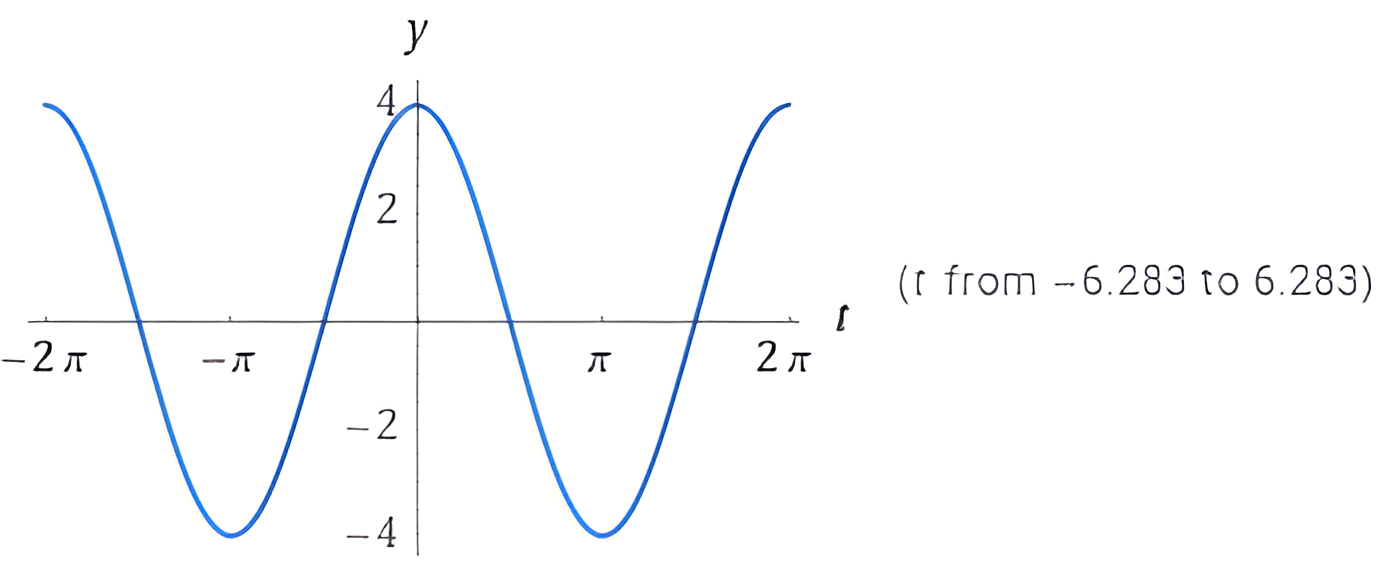
A particle moves in an elliptical path so that its position at any time t≥0 is given by ( 4sint,2cost ).
(a) Find the velocity and acceleration vectors.
(b) Find the velocity, acceleration, speed, and direction of motion at f=π/4.
Generated Graph
Solution by Steps
step 1
To find the velocity vector, we differentiate the position vector components with respect to time t
step 2
The position vector is given by (4sint,2cost). Differentiating each component, we get the velocity vector (4cost,−2sint)
step 3
To find the acceleration vector, we differentiate the velocity vector components with respect to time t
step 4
Differentiating the velocity vector components, we get the acceleration vector (−4sint,−2cost)
Answer
The velocity vector is (4cost,−2sint) and the acceleration vector is (−4sint,−2cost).
Key Concept
Velocity and acceleration vectors are found by differentiating position and velocity vectors, respectively.
Explanation
The velocity vector is the derivative of the position vector with respect to time, and the acceleration vector is the derivative of the velocity vector with respect to time.
Solution by Steps
step 1
To evaluate the velocity at t=4π, we substitute t into the velocity vector
step 2
The velocity vector at t=4π is (4cos(4π),−2sin(4π))
step 3
Simplifying, we get (4⋅22,−2⋅22)
step 4
The simplified velocity vector at t=4π is (22,−2)
step 5
To evaluate the acceleration at t=4π, we substitute t into the acceleration vector
step 6
The acceleration vector at t=4π is (−4sin(4π),−2cos(4π))
step 7
Simplifying, we get (−4⋅22,−2⋅22)
step 8
The simplified acceleration vector at t=4π is (−22,−2)
step 9
To calculate the speed at t=4π, we find the magnitude of the velocity vector
step 10
The speed is (22)2+(−2)2
step 11
Simplifying, we get 8+2
step 12
The speed at t=4π is 10
step 13
To find the direction of motion at t=4π, we look at the sign of the velocity vector components
step 14
Since the x-component is positive and the y-component is negative, the particle is moving in the fourth quadrant
Answer
At t=4π, the velocity vector is (22,−2), the acceleration vector is (−22,−2), the speed is 10, and the direction of motion is in the fourth quadrant.
Key Concept
Velocity, acceleration, speed, and direction of motion at a specific time are found by evaluating the respective vectors and their magnitudes at that time.
Explanation
At t=4π, the velocity and acceleration vectors are evaluated by substituting t into their expressions. The speed is the magnitude of the velocity vector, and the direction of motion is determined by the signs of the velocity vector components.
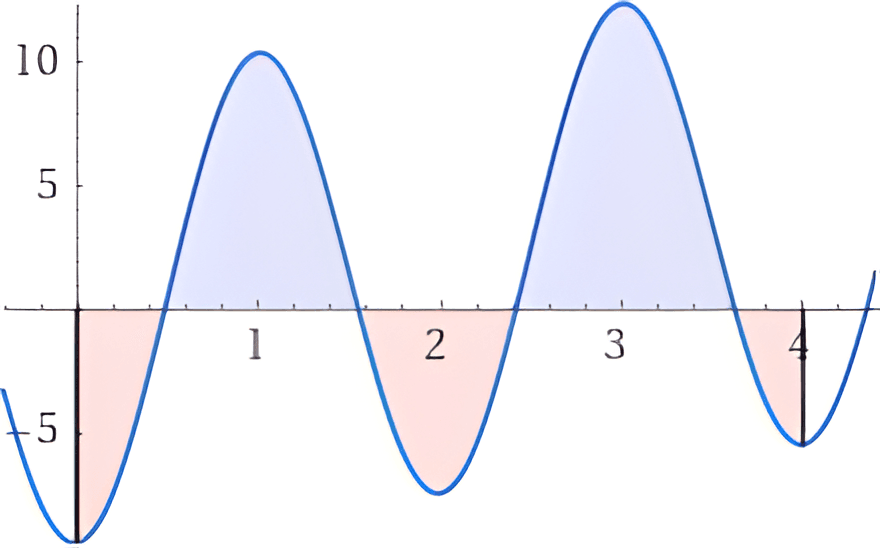
A particle moves in the plane with velocity vecior v(t)=(t−3πcosπt,2t−πsinπt). t:z=0. the particle is at the point (1,5).
(a) Find the position of the particle at t=4.
(b) What is the total distance traveled by the particle from t=0 to t=4 ?
Generated Graph
Solution by Steps
step 1
To find the position of the particle at t=4, we need to integrate the velocity vector components from t=0 to t=4
step 2
The integral of the first component of the velocity vector v(t) is ∫04(t−3πcos(πt))dt, which equals 8
step 3
The integral of the second component of the velocity vector v(t) is ∫04(2t−πsin(πt))dt, which equals 16
step 4
The initial position of the particle is (1,5). To find the position at t=4, we add the integrated components to the initial position
step 5
The position at t=4 is (1+8,5+16)=(9,21)
Answer
The position of the particle at t=4 is (9,21).
Key Concept
Position from Velocity
Explanation
The position of a particle is found by integrating the velocity vector components and adding the result to the initial position.
Solution by Steps
step 1
To find the total distance traveled by the particle from t=0 to t=4, we need to integrate the magnitude of the velocity vector over this interval
step 2
The magnitude of the velocity vector v(t) is given by (t−3πcos(πt))2+(2t−πsin(πt))2
step 3
The integral of the magnitude of v(t) from t=0 to t=4 is ∫04(t−3πcos(πt))2+(2t−πsin(πt))2dt, which equals approximately 33.5327
Answer
The total distance traveled by the particle from t=0 to t=4 is approximately 33.5327 units.
Key Concept
Total Distance Traveled
Explanation
The total distance traveled by a particle is the integral of the magnitude of its velocity vector over the given time interval.
© 2023 AskSia.AI all rights reserved