
AskSia
Plus

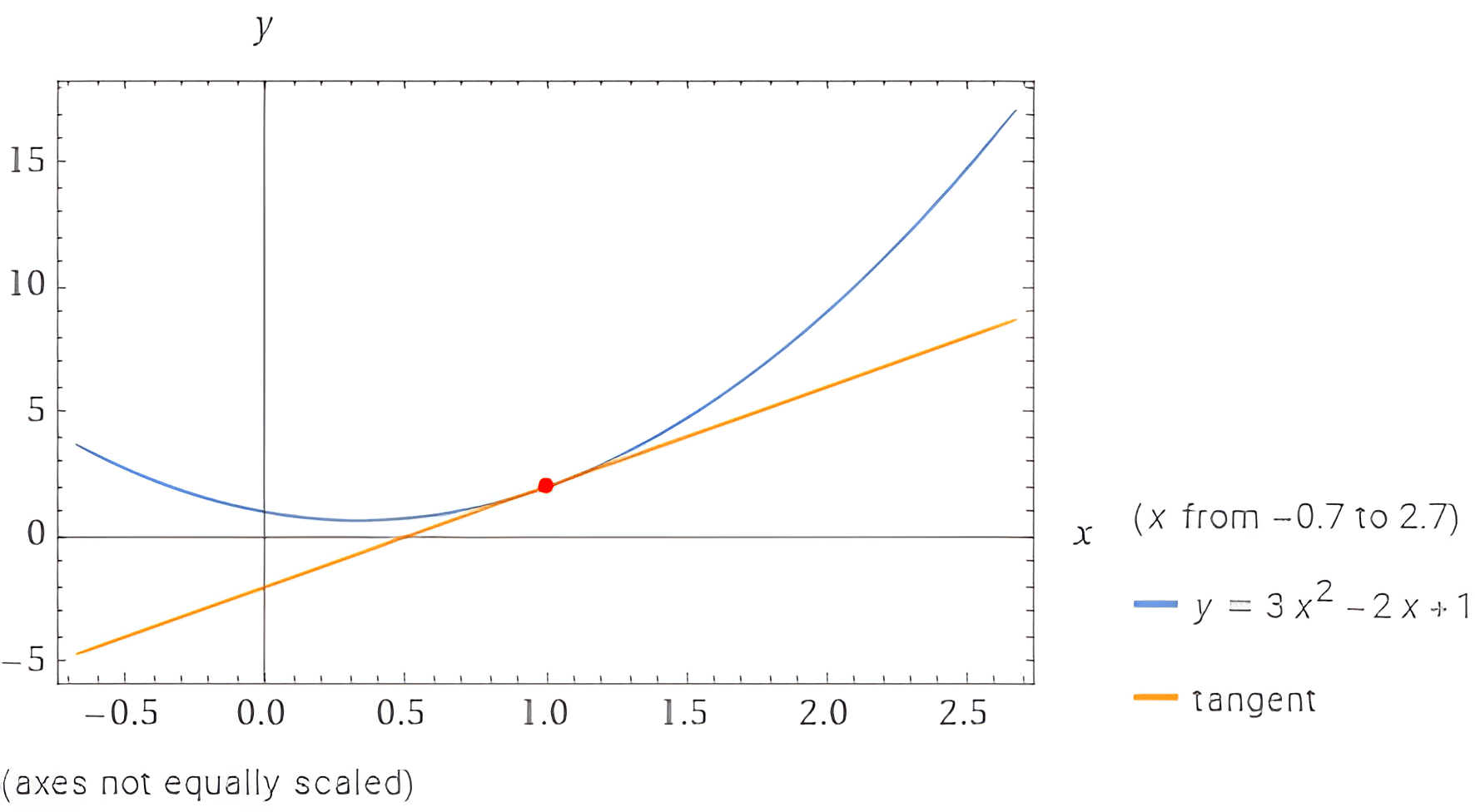
Find the slope of the tangent to the curve y=3x2−2x+1 at x=1.
Mar 22, 2024

Find the slope of the tangent to the curve y=3x2−2x+1 at x=1.

Generated Graph
Solution by Steps
step 1
To find the slope of the tangent line to the curve at a specific point, we need to calculate the derivative of the function
step 2
The derivative of the function y=3x2−2x+1 is found using the power rule
step 3
Differentiating term by term, the derivative is dxdy=6x−2
step 4
To find the slope at x=1, we substitute x=1 into the derivative to get dxdy=6(1)−2
step 5
Simplifying gives us the slope of the tangent line at x=1, which is 4
Answer
The slope of the tangent to the curve at x=1 is 4.
Key Concept
Finding the slope of a tangent line at a point
Explanation
The slope of the tangent line to a curve at a given point is the value of the derivative of the function at that point.
Question 1 (10 marks)
In Homantin district, historical survey results show that 30% of the residents have master's degrees. An investigator randomly selects residents in the district and then interviews them if he or she has a master's degree.
Let X= the no. of residents interviewed up to and including the first resident who has a master's degree.
(a) Determine the most appropriate statistical distribution for X.
[1]
(b) Write down the probability formula for X.
[1]
(c) P(X=3).
(d) P(X>3).
(e) Calculate E(X) and Var(X).
Solution by Steps
step 1
Identify the most appropriate statistical distribution for X
step 2
The most appropriate distribution is the geometric distribution since we are looking for the number of trials until the first success, where success is defined as finding a resident with a master's degree
Answer
Geometric distribution
Key Concept
Geometric Distribution
Explanation
The geometric distribution models the number of trials until the first success in a series of independent Bernoulli trials.
step 1
Write down the probability formula for X in a geometric distribution
step 2
The probability mass function (PMF) for a geometric distribution is P(X=k)=(1−p)k−1p, where p is the probability of success on any given trial
Answer
P(X=k)=(1−p)k−1p
Key Concept
Probability Mass Function
Explanation
The PMF of a geometric distribution gives the probability that the first occurrence of success requires k independent trials.
step 1
Calculate P(X=3) for a geometric distribution with p=0.3
step 2
Substitute k=3 and p=0.3 into the PMF: P(X=3)=(1−0.3)3−1(0.3)
step 3
Simplify the expression: P(X=3)=(0.7)2(0.3)
step 4
Calculate the value: P(X=3)=0.49×0.3
Answer
P(X=3)=0.147
Key Concept
Calculating Specific Probability
Explanation
To find P(X=3), we raise the probability of failure to the power of k−1 and multiply by the probability of success.
step 1
Calculate P(X>3) for a geometric distribution with p=0.3
step 2
Use the complement rule: P(X>3) = 1 - P(X \leq 3)
step 3
Calculate P(X≤3) by summing up P(X=1), P(X=2), and P(X=3)
step 4
Use the PMF for each value: P(X≤3)=0.3+(0.7)(0.3)+(0.7)2(0.3)
step 5
Simplify and calculate P(X≤3): P(X≤3)=0.3+0.21+0.147
step 6
Sum the probabilities: P(X≤3)=0.657
step 7
Calculate P(X>3) : P(X>3) = 1 - 0.657
Answer
P(X>3) = 0.343
Key Concept
Complement Rule
Explanation
The complement rule states that the probability of the complement of an event is equal to one minus the probability of the event itself.
step 1
Calculate E(X) for a geometric distribution with p=0.3
step 2
The expected value E(X) of a geometric distribution is p1
step 3
Substitute p=0.3 into the formula: E(X)=0.31
Answer
E(X)=310 or approximately 3.333
Key Concept
Expected Value
Explanation
The expected value of a geometric distribution is the average number of trials needed to get the first success.
step 1
Calculate Var(X) for a geometric distribution with p=0.3
step 2
The variance Var(X) of a geometric distribution is p21−p
step 3
Substitute p=0.3 into the formula: Var(X)=0.321−0.3
step 4
Simplify and calculate the variance: Var(X)=0.090.7
Answer
Var(X)=970 or approximately 7.778
Key Concept
Variance
Explanation
The variance of a geometric distribution measures the spread of the number of trials needed to get the first success.
© 2023 AskSia.AI all rights reserved