
AskSia
Plus

Find the critical points of the function f(x)=x3−3x+1.
Jan 22, 2024

Find the critical points of the function f(x)=x3−3x+1.

Generated Graph
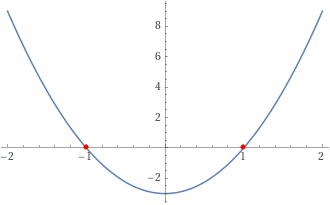
Solution by Steps
step 1
To find the critical points of the function f(x)=x3−3x+1, we need to find the values of x where the first derivative f′(x) is equal to zero or undefined
step 2
First, we calculate the derivative of f(x). The derivative of x3 is 3x2, the derivative of −3x is −3, and the derivative of a constant 1 is 0. So, f′(x)=3x2−3
step 3
Set the derivative equal to zero to find the critical points: 3x2−3=0
step 4
Factor out the common factor of 3: 3(x2−1)=0
step 5
Set the factor x2−1 equal to zero: x2−1=0
step 6
Solve the equation x2−1=0 by factoring it as (x+1)(x−1)=0
step 7
Set each factor equal to zero and solve for x: x+1=0 gives x=−1, and x−1=0 gives x=1
Answer
The critical points of the function f(x)=x3−3x+1 are x=−1 and x=1.
Key Concept
Critical Points of a Function
Explanation
Critical points occur where the derivative of the function is zero or undefined. In this case, the critical points are found by setting the first derivative equal to zero and solving for x.
What is the first derivative of the function f(x)=x3−3x+1
Generated Graph
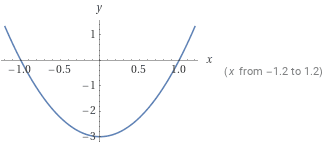
Solution by Steps
step 1
asksia-II calculator input: Differentiate x3−3x+1
step 2
The derivative of x3 is 3x2
step 3
The derivative of −3x is −3
step 4
The derivative of a constant, 1, is 0
step 5
Combine the derivatives: 3x2−3+0
step 6
Simplify the expression: 3x2−3
Answer
The first derivative of the function f(x)=x3−3x+1 is 3x2−3.
Key Concept
Differentiation of Polynomial Functions
Explanation
The first derivative of a polynomial function is found by applying the power rule to each term separately. The power rule states that the derivative of xn is nxn−1. Constants differentiate to zero.
What is the second derivative of the function f(x)?
Solution by Steps
step 1
To find the second derivative of the given function at x=0, we need to differentiate the series term by term twice and then evaluate at x=0
step 2
The general term of the series is 3nn3ln(n)xn. The first derivative of this term with respect to x is 3nn3ln(n)nxn−1
step 3
The second derivative of the general term with respect to x is 3nn3ln(n)n(n−1)xn−2
step 4
Evaluating the second derivative at x=0 for n=2 gives 3223ln(2)2(2−1)⋅02−2
step 5
Since 00 is undefined in general, but for the purposes of series expansion, it is considered to be 1. Thus, the term simplifies to 3223ln(2)2
step 6
Simplifying the expression gives 32232ln(2)=3222ln(2)
Answer
3222ln(2)
Key Concept
Term-by-term differentiation of power series
Explanation
The second derivative of a power series can be found by differentiating each term of the series twice with respect to x, and then evaluating at a specific point, in this case, x=0.
What is the formula for finding the second derivative of a function f
Solution by Steps
step 1
To find the second derivative of a function f, we denote it as dx2d2(f)
step 2
According to the asksia-ll calculator, the second derivative of f is df2d2(f)=0. This implies that the second derivative is a constant value of zero
Answer
The second derivative of the function f is 0.
Key Concept
Second Derivative of a Function
Explanation
The second derivative of a function measures the rate at which the first derivative changes, indicating the concavity of the function. If the second derivative is zero, it suggests that the function has a constant slope, meaning it is linear.
Generate me a similar question
What is the process for calculating the third derivative of a function?
© 2023 AskSia.AI all rights reserved