
AskSia
Plus

Find Re(5+i3i).
Jul 1, 2024



Solution by Steps
step 1
To simplify 5+i3i, multiply the numerator and the denominator by the conjugate of the denominator, 5−i
step 2
5+i3i⋅5−i5−i=(5+i)(5−i)3i(5−i)
step 3
Simplify the denominator: (5+i)(5−i)=(5)2−(i)2=5−(−1)=6
step 4
Simplify the numerator: 3i(5−i)=3i5−3i2=3i5−3(−1)=3i5+3
step 5
Combine the results: 63i5+3=63+63i5=21+2i5
step 6
The real part of 21+2i5 is 21
Answer
The real part is 21.
Key Concept
Simplifying complex fractions
Explanation
To find the real part of a complex fraction, multiply by the conjugate of the denominator and simplify.

Solution by Steps
step 1
To find the polar form of z1=−3+i, we first calculate the magnitude r and the angle θ
step 2
The magnitude r is given by r=(−3)2+12=9+1=10
step 3
The angle θ is given by θ=π−tan−1(31)
step 4
Therefore, the polar form of z1 is z1=10(cos(π−tan−1(31))+isin(π−tan−1(31)))
step 5
To find the polar form of z2=3+4i, we first calculate the magnitude r and the angle θ
step 6
The magnitude r is given by r=(3)2+42=3+16=19
step 7
The angle θ is given by θ=tan−1(34)
step 8
Therefore, the polar form of z2 is z2=19(cos(tan−1(34))+isin(tan−1(34)))
Answer
The polar form of z1 is 10(cos(π−tan−1(31))+isin(π−tan−1(31))).
The polar form of z2 is 19(cos(tan−1(34))+isin(tan−1(34))).
Key Concept
Polar Form of Complex Numbers
Explanation
The polar form of a complex number z=x+yi is given by r(cos(θ)+isin(θ)), where r=x2+y2 is the magnitude and θ=tan−1(xy) is the angle.
why 
Solution by Steps
step 1
The given equation is θ=π−tan−1(31)
step 2
To simplify, we start by adding tan−1(31) to both sides: θ+tan−1(31)=π
step 3
Rearrange the equation to isolate θ: θ=π−tan−1(31)
step 4
Using the identity for the inverse tangent, we can express θ as: θ=π−21ilog(1−3i)+21ilog(1+3i)
Answer
θ=π−21ilog(1−3i)+21ilog(1+3i)
Key Concept
Simplification of inverse tangent expression
Explanation
The given equation θ=π−tan−1(31) can be simplified using the properties of the inverse tangent function and logarithms.


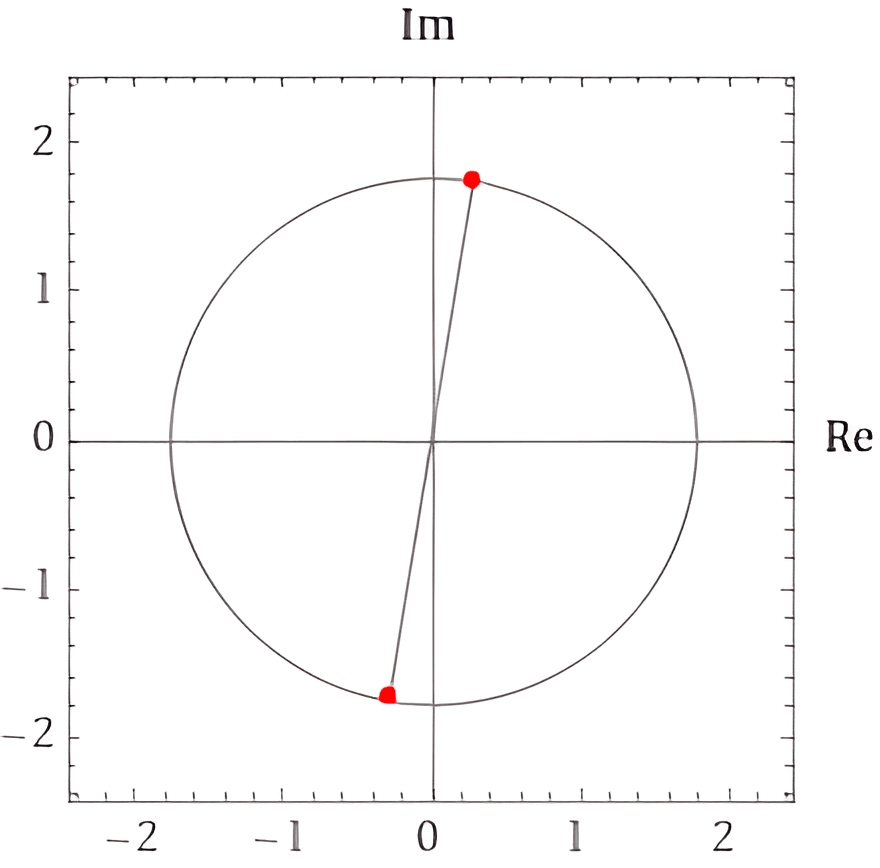
Generated Graph
Solution by Steps
step 1
Convert z1=−3+i to polar form
step 2
The magnitude ∣z1∣=(−3)2+12=10
step 3
The argument θ1=tan−1(−31)+π=π−tan−1(31)
step 4
Therefore, z1=10ei(π−tan−1(1/3))
step 5
Convert z2=3+4i to polar form
step 6
The magnitude ∣z2∣=(3)2+42=19
step 7
The argument θ2=tan−1(34)=tan−1(4/3)
step 8
Therefore, z2=19eitan−1(4/3)
step 9
Calculate (z2)3: (19eitan−1(4/3))3=193/2ei3tan−1(4/3)
step 10
Divide by z1: 10ei(π−tan−1(1/3))193/2ei3tan−1(4/3)=10193/2ei(3tan−1(4/3)−(π−tan−1(1/3)))
step 11
Simplify the magnitude: 10193/2=1919/10
step 12
Simplify the argument: 3tan−1(4/3)−(π−tan−1(1/3))
step 13
Therefore, z1(z2)3=1919/10ei(3tan−1(4/3)−(π−tan−1(1/3)))
Answer
z1(z2)3=1919/10ei(3tan−1(4/3)−(π−tan−1(1/3)))
Key Concept
Polar form of complex numbers
Explanation
To convert a complex number to polar form, we need to find its magnitude and argument. The magnitude is the distance from the origin, and the argument is the angle with the positive real axis.
step 1
Convert z1=−3+i to polar form
step 2
The magnitude ∣z1∣=(−3)2+12=10
step 3
The argument θ1=π−tan−1(31)
step 4
Therefore, z1=10ei(π−tan−1(1/3))
step 5
Find the square roots: z1=410ei(π−tan−1(1/3))/2 and 410ei(π−tan−1(1/3)+2π)/2
step 6
Simplify the arguments: 2π−tan−1(1/3) and 2π−tan−1(1/3)+2π
step 7
Convert back to rectangular form: 101/4(cos(2π−tan−1(1/3))+isin(2π−tan−1(1/3))) and 101/4(cos(2π−tan−1(1/3)+2π)+isin(2π−tan−1(1/3)+2π))
step 8
Therefore, the square roots are approximately 0.28485+1.75532i and −0.28485−1.7553i
Answer
0.28485+1.75532i and −0.28485−1.7553i
Key Concept
Square roots of complex numbers
Explanation
To find the square roots of a complex number, convert it to polar form, take the square root of the magnitude, and halve the argument. Then convert back to rectangular form.
© 2023 AskSia.AI all rights reserved