
AskSia
Plus

Evaluate the indefinite integral
\[
\int\left(e^{5 x}-\frac{3}{x^{2}}+\frac{4}{...
May 18, 2024



Solution by Steps
step 1
We start by integrating each term of the given integral separately:
∫(e5x−x23+x4)dx
step 2
Integrate the first term:
∫e5xdx=5e5x
step 3
Integrate the second term:
∫−x23dx=∫−3x−2dx=3x−1=x3
step 4
Integrate the third term:
∫x4dx=4∫x1dx=4ln∣x∣
step 5
Combine all the integrated terms and add the constant of integration:
∫(e5x−x23+x4)dx=5e5x+x3+4ln∣x∣+C
Answer
5e5x+x3+4ln∣x∣+C
Key Concept
Integration of each term separately
Explanation
To evaluate the indefinite integral, we integrate each term of the given expression separately and then combine the results, adding a constant of integration at the end.

Generated Graph
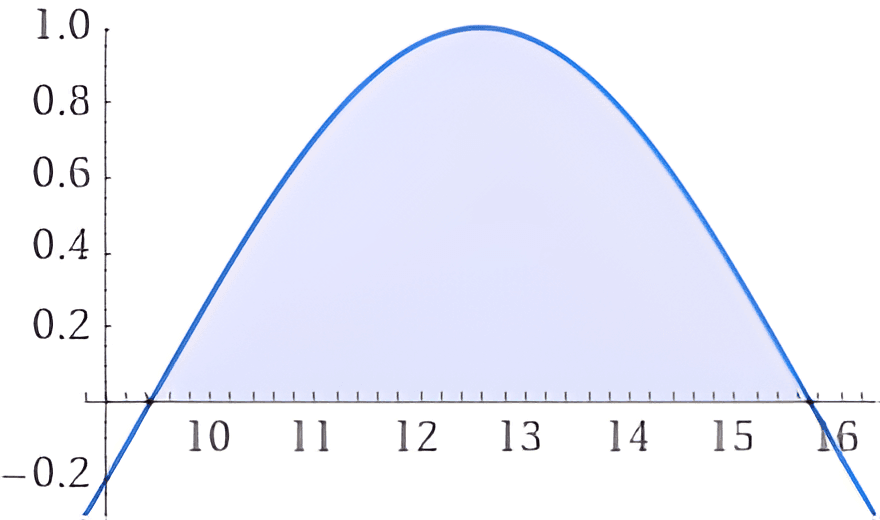
Solution by Steps
step 1
We start by setting up the definite integral:
step 2
∫3π5πcos(2x)dx
step 3
To integrate cos(2x), we use the substitution u=2x, hence du=21dx or dx=2du
step 4
Changing the limits of integration: when x=3π, u=23π; when x=5π, u=25π
step 5
The integral becomes: ∫23π25π2cos(u)du
step 6
Integrate cos(u): ∫2cos(u)du=2sin(u)+C
step 7
Evaluate the definite integral: 2sin(25π)−2sin(23π)
step 8
Since sin(25π)=1 and sin(23π)=−1:
step 9
2(1)−2(−1)=2+2=4
Answer
4
Key Concept
Definite Integral Evaluation
Explanation
The definite integral of cos(2x) from 3π to 5π is evaluated by using substitution and then integrating the resulting function. The final result is 4.

Generated Graph
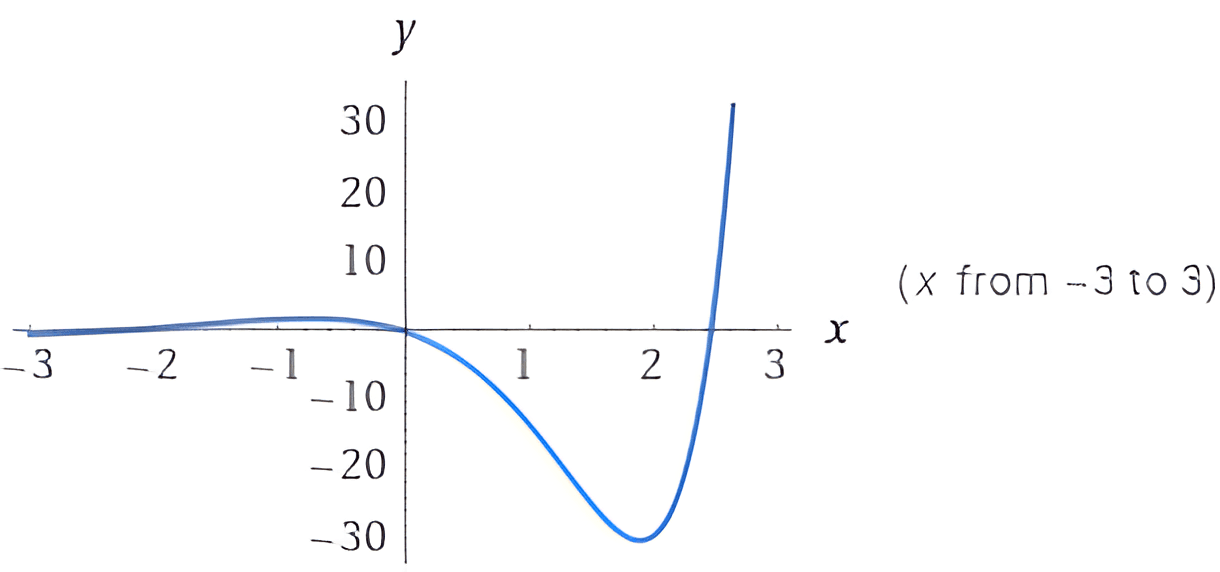
Solution by Steps
step 1
We start by differentiating the given function f(x)=ex(x3−3x2)
step 2
Using the product rule, dxd[u⋅v]=u′⋅v+u⋅v′, where u=ex and v=x3−3x2
step 3
Compute u′=dxd[ex]=ex and v′=dxd[x3−3x2]=3x2−6x
step 4
Applying the product rule: f′(x)=ex⋅(3x2−6x)+ex⋅(x3−3x2)
step 5
Simplify the expression: f′(x)=ex(3x2−6x+x3−3x2)=ex(x3−6x)
Answer
f′(x)=ex(x3−6x)
Solution by Steps
step 1
To find the stationary points, we set f′(x)=0
step 2
Solve ex(x3−6x)=0
step 3
Since ex=0 for all x, we solve x3−6x=0
step 4
Factor the equation: x(x2−6)=0
step 5
Solve for x: x=0, x=6, and x=−6
Answer
The values of x for which the function has a stationary point are x=0, x=6, and x=−6.
Key Concept
Differentiation and Stationary Points
Explanation
To find the derivative of a product of functions, we use the product rule. Stationary points occur where the derivative is zero.
© 2023 AskSia.AI all rights reserved