
AskSia
Plus

Evaluate ∑k=353k
Answer: □
Sep 8, 2024



Solution by Steps
step 1
We start by evaluating the summation sumk=353k. This means we will calculate 33, 34, and 35 and then sum these values
step 2
Calculate 33=27
step 3
Calculate 34=81
step 4
Calculate 35=243
step 5
Now, we sum these results: 27+81+243=351
Answer
351
Key Concept
Summation of powers of a number
Explanation
The summation involves calculating the powers of 3 from k=3 to k=5 and then adding them together to get the final result.

Solution by Steps
step 1
The first three terms of the geometric progression (GP) are given as −1,3,−9. We can identify the first term a=−1 and the common ratio r. To find r, we use the formula r=a1a2=−13=−3
step 2
The general formula for the nth term of a GP is given by an=a⋅rn−1. Here, we need to find the 13th term, so we will substitute n=13, a=−1, and r=−3 into the formula
step 3
Substituting the values, we have a13=−1⋅(−3)13−1=−1⋅(−3)12
step 4
Now, we calculate (−3)12. Since (−3)12=312 (as the exponent is even), we find 312=531441. Thus, a13=−1⋅531441=−531441
Answer
-531441
Key Concept
A geometric progression is defined by a constant ratio between consecutive terms.
Explanation
The 13th term is calculated using the formula for the nth term of a GP, which incorporates the first term and the common ratio. The result shows how the terms grow exponentially based on the common ratio.

Solution by Steps
step 1
The first three terms of the arithmetic series are given as −12,−8,−4. We can identify the first term a=−12 and the common difference d. To find d, we calculate d=−8−(−12)=4
step 2
The formula for the sum of the first n terms of an arithmetic series is given by Sn=2n(2a+(n−1)d). Here, we need to find the sum of the first 45 terms, so n=45
step 3
Substituting the values into the formula: S45=245(2(−12)+(45−1)(4))
step 4
Simplifying the expression: S45=245(−24+44)=245(20)=45⋅10=450
Answer
450
Key Concept
The sum of an arithmetic series can be calculated using the formula for the sum of the first n terms.
Explanation
The answer is derived by identifying the first term and common difference, then applying the sum formula for arithmetic series. The final sum of the first 45 terms is 450.

Solution by Steps
step 1
We need to find the sum of all integers from 300 to 700 that are divisible by 7. First, we identify the smallest integer greater than or equal to 300 that is divisible by 7, which is 301
step 2
Next, we find the largest integer less than or equal to 700 that is divisible by 7, which is 700
step 3
The integers divisible by 7 between 301 and 700 form an arithmetic sequence where the first term a=301 and the last term l=700. The common difference d=7
step 4
To find the number of terms n in this sequence, we use the formula for the n-th term of an arithmetic sequence: l=a+(n−1)d. Solving for n: 700=301+(n−1)⋅7 gives n=58
step 5
The sum Sn of the first n terms of an arithmetic series is given by Sn=2n(a+l). Substituting the values: S58=258(301+700)=29⋅1001=29029
Answer
29029
Key Concept
Sum of an arithmetic series
Explanation
The sum of integers divisible by a number within a range can be calculated using the properties of arithmetic sequences. Here, we identified the first and last terms, calculated the number of terms, and applied the sum formula.

Solution by Steps
step 1
We know that in an arithmetic series, the nth term can be expressed as Tn=a+(n−1)d, where a is the first term and d is the common difference. Given T3=59 and T11=155, we can set up two equations: a+2d=59 and a+10d=155
step 2
Subtract the first equation from the second to eliminate a: (a+10d)−(a+2d)=155−59, which simplifies to 8d=96. Thus, we find d=12
step 3
Now, substitute d=12 back into the first equation: a+2(12)=59, which gives a+24=59. Therefore, a=35
step 4
The formula for the sum of the first n terms of an arithmetic series is given by Sn=2n(2a+(n−1)d). We need to find n such that Sn=3255
step 5
Setting up the equation: 3255=2n(2(35)+(n−1)(12)). This simplifies to 3255=2n(70+12n−12), or 3255=2n(12n+58)
step 6
Multiplying both sides by 2 to eliminate the fraction: 6510=n(12n+58). Rearranging gives 12n2+58n−6510=0
step 7
We can solve this quadratic equation using the quadratic formula n=2a−b±b2−4ac, where a=12, b=58, and c=−6510
step 8
Calculating the discriminant: b2−4ac=582−4(12)(−6510)=3364+313680=317044. Thus, n=24−58±317044
step 9
Approximating 317044≈563.1, we find n=24−58±563.1. The positive solution gives n≈24505.1≈21.04. Since n must be a whole number, we round to n=21
Answer
21
Key Concept
An arithmetic series is defined by a first term and a common difference, allowing us to find any term and the sum of the series.
Explanation
We determined the first term and common difference, then used the sum formula to find the number of terms needed to reach a specific sum.

Generated Graph
Solution by Steps
step 1
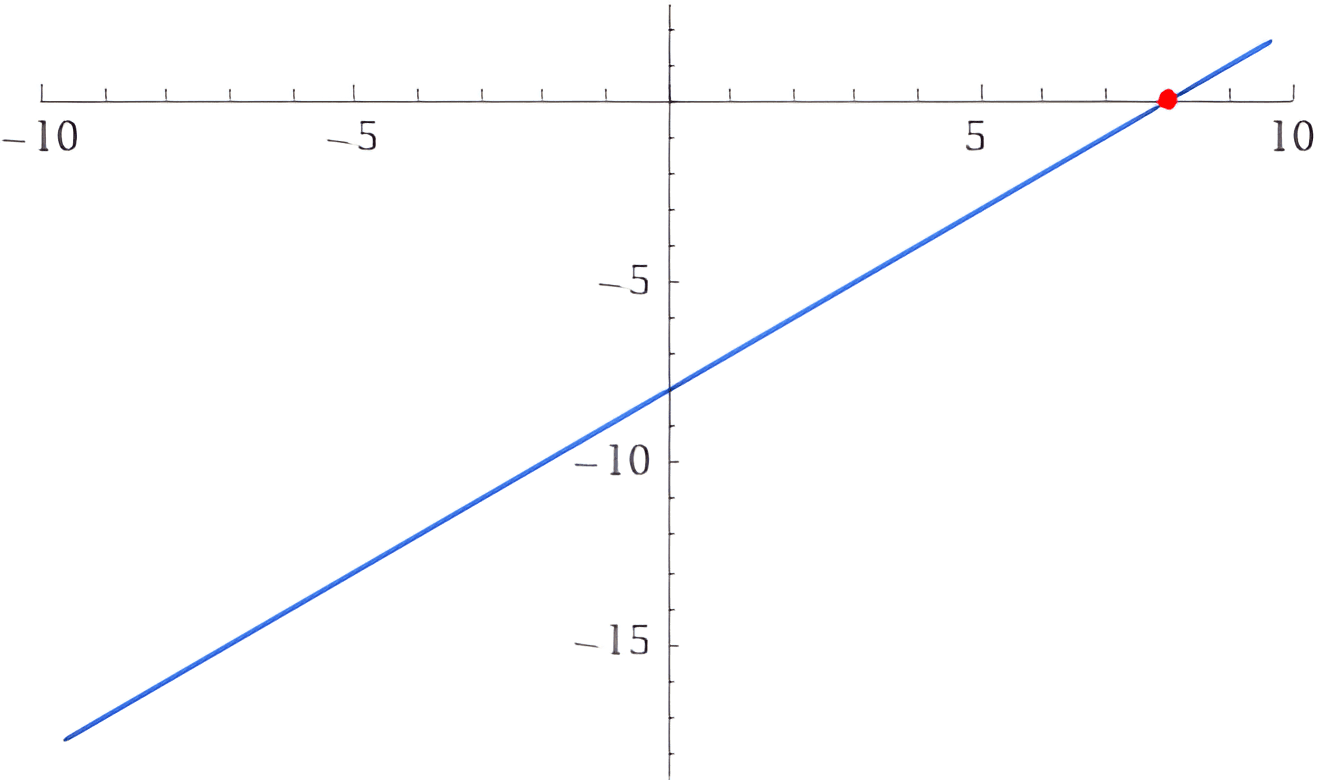
We know that the terms 5, (4+x), and 17 are part of an arithmetic sequence. In an arithmetic sequence, the difference between consecutive terms is constant. Thus, we can set up the equation: (4+x)−5=17−(4+x)
step 2
Simplifying the equation from step 1 gives us: (4+x)−5=17−4−x. This simplifies to x−1=13−x
step 3
Adding x to both sides results in: 2x−1=13. Adding 1 to both sides gives us 2x=14
step 4
Dividing both sides by 2 yields: x=7
Answer
7
Key Concept
Arithmetic Sequence
Explanation
In an arithmetic sequence, the difference between consecutive terms is constant, allowing us to set up equations to find unknown terms. Here, we found x by establishing the relationship between the terms.

Generated Graph
Solution by Steps
step 1
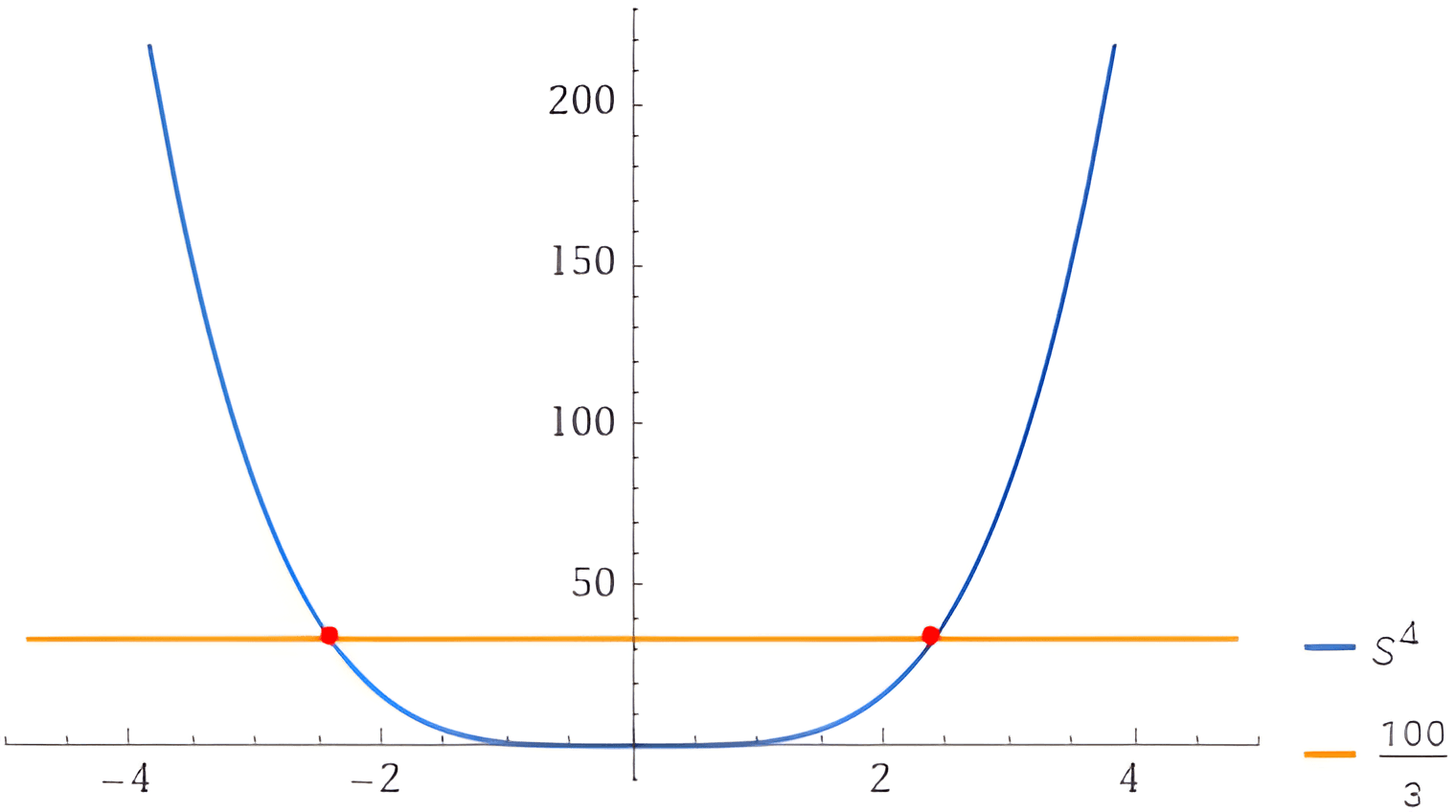
We start with the formula for Sn: Sn=61n(n+1)(2n+1). To find Tn, we use the definition Tn=Sn−Sn−1. Thus, we need to calculate S4 and S3
step 2
Calculate S4: S4=61⋅4⋅(4+1)⋅(2⋅4+1)=61⋅4⋅5⋅9=6180=30
step 3
Calculate S3: S3=61⋅3⋅(3+1)⋅(2⋅3+1)=61⋅3⋅4⋅7=684=14
step 4
Now, we find T4: T4=S4−S3=30−14=16
Answer
16
Key Concept
Understanding the relationship between the sums of sequences and their differences.
Explanation
The value of T4 is derived from the difference between the sums of the first four and three terms of the sequence, leading to the result of 16.

Generated Graph
Solution by Steps
step 2
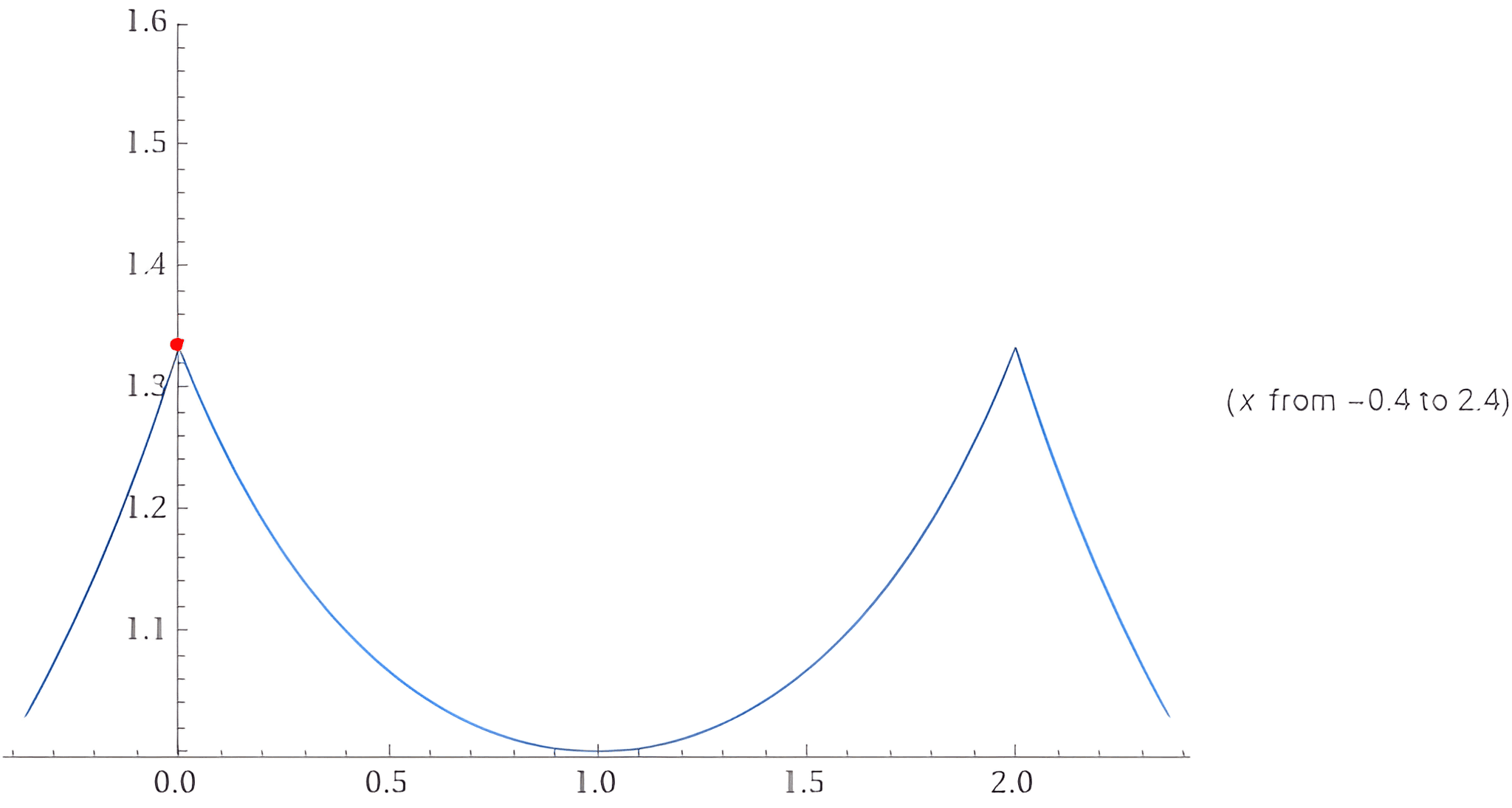
The common ratio r of the series can be expressed as r=(x+21)(x+21)=2 for the second term and r=2(x+21) for subsequent terms. Thus, we need |2\left(x + \frac{1}{2}\right)| < 1
step 3
This inequality simplifies to -1 < 2\left(x + \frac{1}{2}\right) < 1 . Dividing the entire inequality by 2 gives -\frac{1}{2} < x + \frac{1}{2} < \frac{1}{2}
step 4
Subtracting 21 from all parts of the inequality results in -1 < x < 0 . Thus, the range of x that allows the limiting sum to exist is -1 < x < 0
[1] Answer
C
Key Concept
Convergence of Geometric Series
Explanation
A geometric series converges if the absolute value of the common ratio is less than one. This condition helps determine the valid range for the variable in the series.

Solution by Steps
step 1
The truck travels 200 meters to the first location, then returns to the base. The total distance for this trip is 200+200=400 meters
step 2
The truck then travels 150 meters to the second location, returns to the base, adding another 150+150=300 meters
step 3
Finally, the truck travels 5 kilometers (or 5000 meters) to the last location and returns to the base, adding 5000+5000=10000 meters
step 4
Now, we sum all the distances traveled: 400+300+10000=10600 meters
step 5
To convert meters to kilometers, we divide by 1000: 10600÷1000=10.6 kilometers
Answer
10.6
Key Concept
Understanding distance traveled in a round trip scenario.
Explanation
The total distance is calculated by summing the distances for each trip to and from the base, then converting the final result from meters to kilometers.

Solution by Steps
step 1
Leinad deposits $1000 at the beginning of each year for 25 years at an 8% interest rate compounded annually. The future value of these deposits can be calculated using the formula for the future value of a series: \( FV = P \cdot \frac{(1 + r)^n - 1}{r} \), where \( P \) is the annual deposit, \( r \) is the interest rate, and \( n \) is the number of deposits
step 2
For the first 10 years, the future value is calculated as follows: FV10=1000⋅0.08(1+0.08)10−1. This gives us FV10=1000⋅0.08(1.08)10−1. Calculating (1.08)10≈2.1589, we find FV10≈1000⋅0.082.1589−1≈1000⋅14.48625≈14486.25
step 3
At the beginning of the 11th year, Leinad transfers this amount to another bank with a 9% interest rate. The future value of this amount after 15 more years is calculated using the formula FV=PV⋅(1+r)n, where PV is the present value. Thus, FV15=14486.25⋅(1+0.09)15. Calculating (1.09)15≈4.367, we find FV15≈14486.25⋅4.367≈63200.56
step 4
Rounding to the nearest dollar, the total amount Leinad will have at the end of 25 years is approximately 63201
Answer
63201
Key Concept
Future value of a series with compound interest
Explanation
The answer is derived from calculating the future value of annual deposits compounded at different interest rates over specified periods. The total amount reflects the growth of the initial deposits over time.
© 2023 AskSia.AI all rights reserved