
AskSia
Plus

Determine whether Rolle's Theorem can be applied to the function f(x) = cos(pi x...
Jul 15, 2024

Determine whether Rolle's Theorem can be applied to the function f(x) = cos(pi x) on the closed interval [negative 1 over 4, 1 over 4]. If Rolle's Theorem can be applied, find all numbers c in the open interval (negative 1 over 4, 1 over 4) such that f prime (c) = 0.
Question 1 options:
Rolle's Theorem applies; c = 0
Rolle's Theorem applies; c = negative 1 over 8, 1 over 8
Rolle's Theorem applies; c = 0, negative 1 over 8, 1 over 8
Rolle's Theorem applies; c = 1 over 8
Rolle's Theorem does not apply.

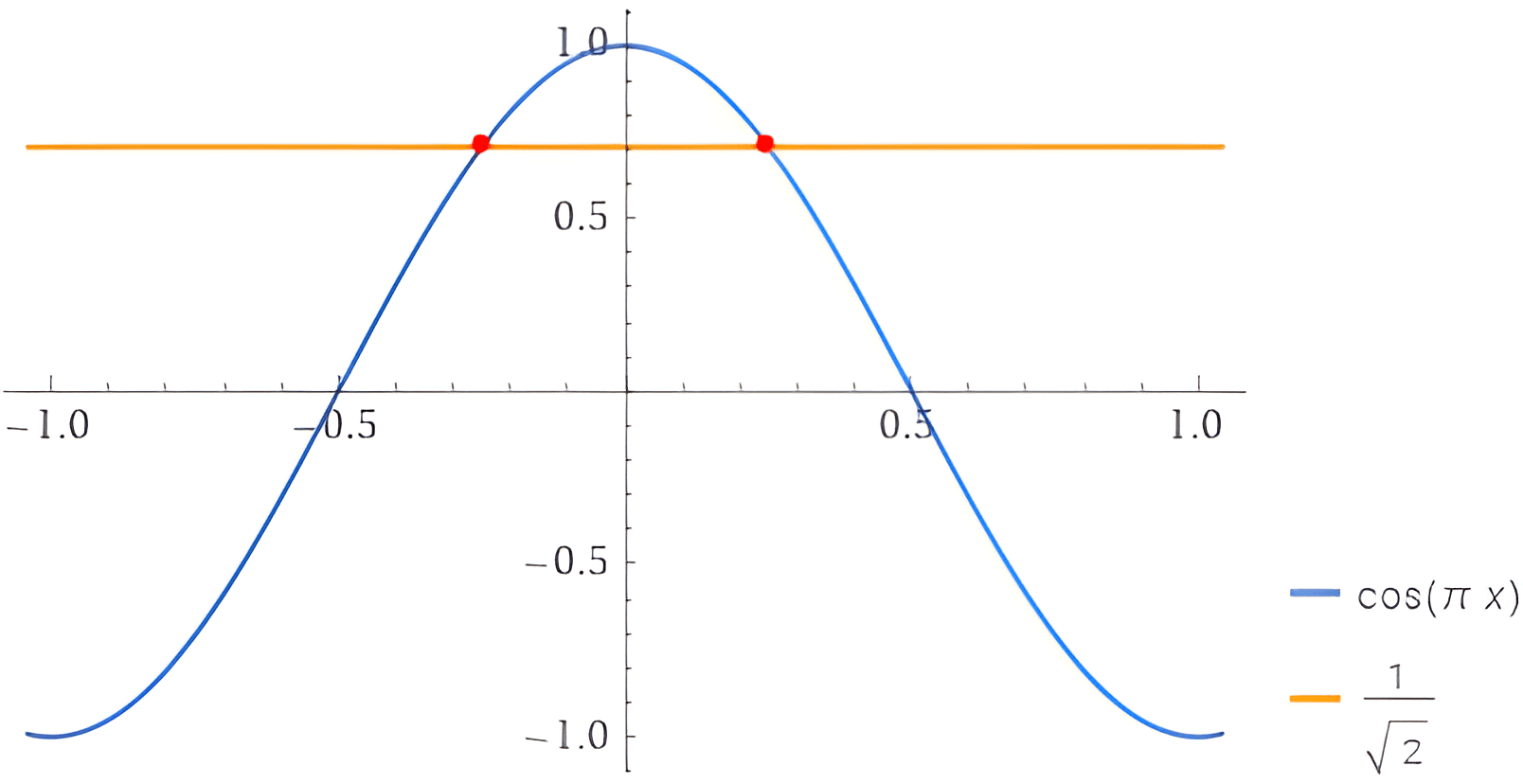
Generated Graph
Solución por Pasos
paso 1
Verificamos si se cumplen las condiciones del Teorema de Rolle para la función f(x)=cos(πx) en el intervalo cerrado [−41,41]
paso 2
La función f(x)=cos(πx) es continua en [−41,41] y derivable en el intervalo abierto (−41,41]
paso 3
Evaluamos f en los extremos del intervalo:
f(−41)=cos(π(−41))=cos(−4π)=22
f(41)=cos(π(41))=cos(4π)=22
Como f(−41)=f(41), se cumple la tercera condición del Teorema de Rolle
paso 4
Calculamos la derivada de f(x):
f′(x)=dxdcos(πx)=−πsin(πx)
Buscamos los valores de c en el intervalo abierto (−41,41) donde f′(c)=0:
−πsin(πc)=0
sin(πc)=0
Los valores de c que satisfacen esta ecuación en el intervalo dado son:
πc=nπ⟹c=n
Donde n es un número entero. En el intervalo (−41,41), los valores posibles de c son c=0
Respuesta
Rolle's Theorem applies; c=0
Concepto Clave
Teorema de Rolle
Explicación
El Teorema de Rolle establece que si una función es continua en un intervalo cerrado, derivable en el intervalo abierto, y toma el mismo valor en los extremos del intervalo, entonces existe al menos un punto en el intervalo abierto donde la derivada de la función es cero. En este caso, la función f(x)=cos(πx) cumple con todas estas condiciones en el intervalo [−41,41], y el valor de c donde f′(c)=0 es c=0.
Determine whether Rolle's Theorem can be applied to the function f(x) = cos(pi x) on the closed interval [negative 1 over 4, 1 over 4]. If Rolle's Theorem can be applied, find all numbers c in the open interval (negative 1 over 4, 1 over 4) such that f prime (c) = 0.
Question 1 options:
Rolle's Theorem applies; c = 0
Rolle's Theorem applies; c = negative 1 over 8, 1 over 8
Rolle's Theorem applies; c = 0, negative 1 over 8, 1 over 8
Rolle's Theorem applies; c = 1 over 8
Rolle's Theorem does not apply.
Solution by Steps
step 1
To determine if Rolle's Theorem can be applied, we first check if the function f(x)=cos(πx) is continuous on the closed interval [−41,41]. Since cos(πx) is a trigonometric function, it is continuous everywhere, including on [−41,41]
step 2
Next, we check if f(x)=cos(πx) is differentiable on the open interval (−41,41). Again, since cos(πx) is differentiable everywhere, it is differentiable on (−41,41)
step 3
We now check if f(a)=f(b), where a=−41 and b=41. We have f(−41)=cos(−4π)=22 and f(41)=cos(4π)=22. Since f(−41)=f(41), the conditions for Rolle's Theorem are satisfied
step 4
According to Rolle's Theorem, there exists at least one c in the open interval (−41,41) such that f′(c)=0. We find f′(x) by differentiating f(x)=cos(πx): f′(x)=−πsin(πx)
step 5
We set f′(c)=0 to find the values of c: −πsin(πc)=0. This simplifies to sin(πc)=0. The solutions to sin(πc)=0 in the interval (−41,41) are c=0
Answer
Rolle's Theorem applies; c=0
Key Concept
Rolle's Theorem
Explanation
Rolle's Theorem states that if a function is continuous on a closed interval, differentiable on the open interval, and the function values at the endpoints of the interval are equal, then there exists at least one point in the open interval where the derivative of the function is zero.
why is not -1/8,1/8
Solution by Steps
step 1
To apply Rolle's Theorem, we need to ensure that the function f(x)=cos(πx) is continuous on the closed interval [−1/4,1/4] and differentiable on the open interval (−1/4,1/4)
step 2
We also need to check that f(−1/4)=f(1/4). Since f(x)=cos(πx), we have f(−1/4)=cos(−π/4)=cos(π/4)=f(1/4)
step 3
Since f(x) meets the conditions of Rolle's Theorem, there must be at least one c in the open interval (−1/4,1/4) such that f′(c)=0
step 4
The derivative of f(x) is f′(x)=−πsin(πx). Setting this equal to zero, we get −πsin(πc)=0, which simplifies to sin(πc)=0
step 5
The solutions to sin(πc)=0 are c=k where k is an integer. In the interval (−1/4,1/4), the only integer is 0. Therefore, c=0 is the only solution
step 6
The values −1/8 and 1/8 are not solutions because sin(π⋅−1/8)=0 and sin(π⋅1/8)=0
Answer
The only valid solution for c in the interval (−1/4,1/4) is c=0.
Key Concept
Rolle's Theorem
Explanation
Rolle's Theorem guarantees that if a function is continuous on a closed interval, differentiable on an open interval, and the function values at the endpoints of the interval are equal, then there is at least one point in the open interval where the derivative is zero. In this case, c=0 is the only such point.
Determine whether the Mean Value Theorem can be applied to the function f(x) = x^3 on the closed interval [0, 2]. If the Mean Value Theorem can be applied, find all numbers c in the open interval (0, 2) such that f prime (c) = (f(2) minus f(0)) over (2 minus 0).
Question 2 options:
MVT applies; negative 2sqrt(3) over 3
MVT applies; 0.5
MVT applies; 2sqrt(3) over 3
MVT applies; 1
MVT does not apply
Solution by Steps
step 1
To determine if the Mean Value Theorem (MVT) can be applied to the function f(x)=x3 on the closed interval [0,2], we first need to check if f(x) is continuous on [0,2] and differentiable on (0,2)
step 2
The function f(x)=x3 is a polynomial, which is continuous and differentiable everywhere. Therefore, f(x) is continuous on [0,2] and differentiable on (0,2)
step 3
Since f(x) meets the conditions of the MVT, we can apply the theorem. According to the MVT, there exists at least one number c in the open interval (0,2) such that f′(c)=2−0f(2)−f(0)
step 4
Calculate f(2) and f(0): f(2)=23=8 and f(0)=03=0
step 5
Compute the average rate of change: 2−0f(2)−f(0)=2−08−0=4
step 6
Find the derivative of f(x): f′(x)=3x2
step 7
Set f′(c)=4: 3c2=4
step 8
Solve for c: c2=34, so c=±34=±323
step 9
Since c must be in the open interval (0,2), we discard the negative value. Thus, c=323
Answer
MVT applies; 323
Key Concept
Mean Value Theorem (MVT)
Explanation
The MVT states that for a function continuous on a closed interval and differentiable on the open interval, there exists at least one point where the instantaneous rate of change (derivative) equals the average rate of change over the interval.
Determine whether Rolle's Theorem can be applied to f(x) = negative x^2 + 22x on the closed interval [0, 22]. If Rolle's Theorem can be applied, find all values of c in the open interval (0, 22) such that f prime (c) = 0.
Question 3 options:
Rolle's Theorem applies; c = 10, c = 11
Rolle's Theorem applies; c = 4, c = 10
Rolle's Theorem applies; c = 11
Rolle's Theorem applies; c = 4
Rolle's Theorem does not apply
Solution by Steps
step 1
To determine if Rolle's Theorem can be applied, we first check if the function f(x)=−x2+22x is continuous on the closed interval [0,22] and differentiable on the open interval (0,22)
step 2
The function f(x)=−x2+22x is a polynomial, which is continuous and differentiable everywhere. Therefore, it is continuous on [0,22] and differentiable on (0,22)
step 3
Next, we check if f(0)=f(22)
step 4
Calculate f(0): f(0)=−(0)2+22(0)=0
step 5
Calculate f(22): f(22)=−(22)2+22(22)=−484+484=0
step 6
Since f(0)=f(22)=0, all conditions for Rolle's Theorem are satisfied
step 7
To find the values of c in the open interval (0,22) such that f′(c)=0, we first find the derivative f′(x)
step 8
The derivative of f(x)=−x2+22x is f′(x)=−2x+22
step 9
Set f′(x)=0 and solve for x: −2x+22=0⟹2x=22⟹x=11
step 10
Therefore, the value of c in the open interval (0,22) such that f′(c)=0 is c=11
Answer
Rolle's Theorem applies; c=11
Key Concept
Rolle's Theorem
Explanation
Rolle's Theorem states that if a function is continuous on a closed interval, differentiable on the open interval, and the function values at the endpoints of the interval are equal, then there exists at least one point in the open interval where the derivative is zero.
Determine whether Rolle's Theorem can be applied to f(x) = (x^2 minus 16) over x on the closed interval [negative 16, 16]. If Rolle's Theorem can be applied, find all values of c in the open interval (negative 16, 16) such that f prime (c) = 0.
Question 4 options:
c = 2
c = 3, c = 4
c = 4, c = 2
c = 3
Rolle's Theorem does not apply
Solution by Steps
step 1
To apply Rolle's Theorem, we need to check if the function f(x)=xx2−16 is continuous on the closed interval [−16,16] and differentiable on the open interval (−16,16)
step 2
The function f(x)=xx2−16 can be simplified to f(x)=x−x16 for x=0
step 3
Check continuity: f(x) is continuous on [−16,16] except at x=0. Since 0 is within the interval, f(x) is not continuous on the entire interval
step 4
Since f(x) is not continuous on the closed interval [−16,16], Rolle's Theorem does not apply
Answer
Rolle's Theorem does not apply
Key Concept
Continuity and differentiability conditions for Rolle's Theorem
Explanation
Rolle's Theorem requires the function to be continuous on the closed interval and differentiable on the open interval. Since f(x) is not continuous at x=0, the theorem does not apply.
Find a function f that has derivative f prime (x) = 6x + 2 and with graph passing through the point (negative 5, 2).
Question 5 options:
f(x) = negative (2 over 25)x^2
f(x) = 6x^2 + 2x minus 61
f(x) = 3x^2 + 2x minus 60
f(x) = 3x^2 + 2x minus 63
f(x) = negative (2 over 5)x
Generated Graph
Solution by Steps
step 1
To find a function f(x) that has a derivative f′(x)=6x+2 and passes through the point (−5,2), we first integrate the derivative
step 2
The integral of 6x+2 is 3x2+2x+C, where C is the constant of integration
step 3
We now use the point (−5,2) to find the value of C. Substituting x=−5 and f(x)=2 into the equation f(x)=3x2+2x+C, we get: 2=3(−5)2+2(−5)+C
step 4
Simplifying the equation: 2=75−10+C⟹2=65+C⟹C=2−65⟹C=−63
step 5
Therefore, the function f(x) is f(x)=3x2+2x−63
Answer
f(x)=3x2+2x−63
Key Concept
Integration to find the original function
Explanation
To find a function with a given derivative, we integrate the derivative and use any given points to solve for the constant of integration.
Determine whether Rolle's Theorem can be applied to the function f(x) = x^2 minus 14x + 40 on the closed interval [4, 10]. If Rolle's Theorem can be applied, find all values of c in the open interval (4, 10) such that f prime (c) = 0.
Question 6 options:
Rolle's Theorem applies; c = 7
Rolle's Theorem applies; c = 8.5
Rolle's Theorem applies; c = 5.5
Rolle's Theorem applies; c = negative 7
Rolle's Theorem does not apply
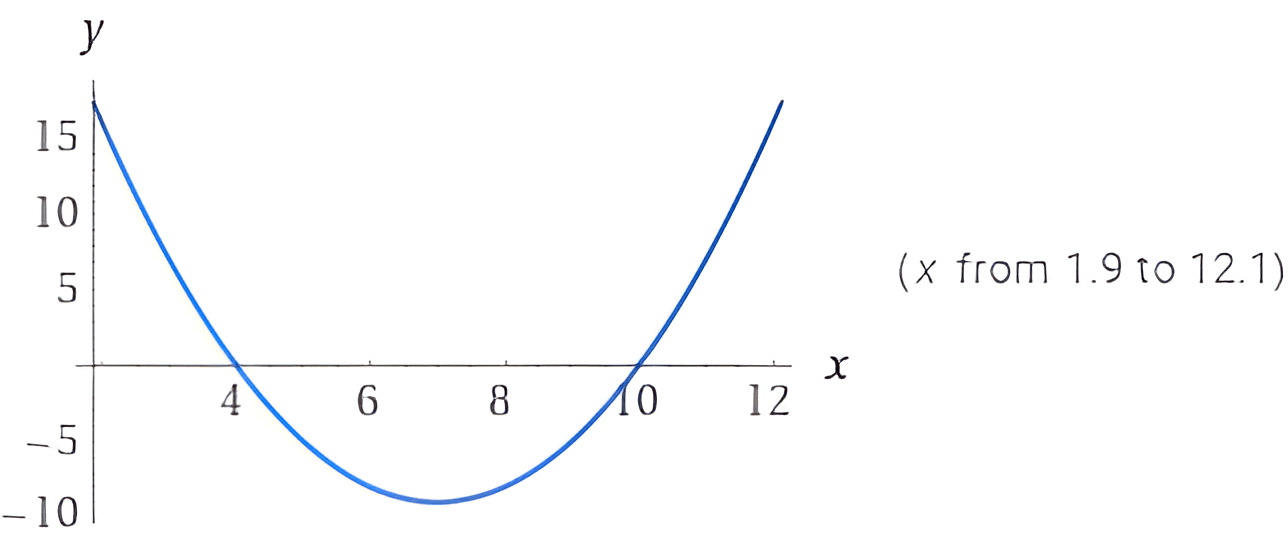
Generated Graph
Solution by Steps
step 1
To determine if Rolle's Theorem can be applied to the function f(x)=x2−14x+40 on the closed interval [4,10], we first need to check if f(x) is continuous on [4,10] and differentiable on (4,10)
step 2
The function f(x)=x2−14x+40 is a polynomial, which is continuous and differentiable everywhere. Therefore, f(x) is continuous on [4,10] and differentiable on (4,10)
step 3
Next, we need to check if f(4)=f(10)
step 4
Calculate f(4): f(4)=42−14⋅4+40=16−56+40=0
step 5
Calculate f(10): f(10)=102−14⋅10+40=100−140+40=0
step 6
Since f(4)=f(10)=0, all conditions for Rolle's Theorem are satisfied
step 7
According to Rolle's Theorem, there exists at least one c in the open interval (4,10) such that f′(c)=0
step 8
Find f′(x): f′(x)=2x−14
step 9
Set f′(x)=0 and solve for x: 2x−14=0⟹2x=14⟹x=7
step 10
Therefore, c=7 is the value in the open interval (4,10) where f′(c)=0
Answer
Rolle's Theorem applies; c=7
Key Concept
Rolle's Theorem
Explanation
Rolle's Theorem states that if a function is continuous on a closed interval, differentiable on the open interval, and the function values at the endpoints of the interval are equal, then there exists at least one point in the open interval where the derivative of the function is zero.
Determine whether the Mean Value Theorem can be applied to the function f(x) = 2sin(x) + sin(2x) on the closed interval [8pi, 9pi]. If the Mean Value Theorem can be applied, find all numbers c in the open interval (8pi, 9pi) such that f prime (c) = (f(9pi) minus f(8pi)) over (9pi minus 8pi).
Question 7 options:
MVT applies; 17pi over 2
MVT applies; 25pi over 4
MVT applies; 25pi over 6
MVT applies; 25pi over 3
MVT does not apply
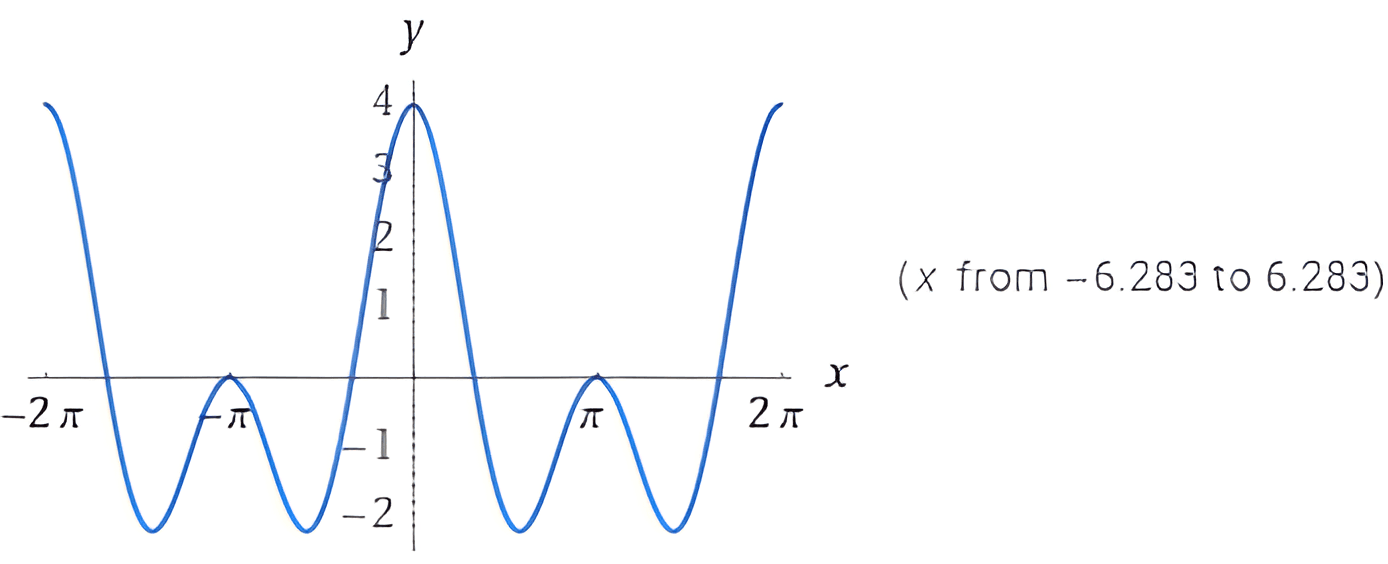
Generated Graph
Solution by Steps
step 1
To determine if the Mean Value Theorem (MVT) can be applied to the function f(x)=2sin(x)+sin(2x) on the closed interval [8π,9π], we first need to check if f(x) is continuous on [8π,9π] and differentiable on (8π,9π]. Since f(x) is a trigonometric function, it is continuous and differentiable everywhere
step 2
Next, we calculate f(9π) and f(8π):
f(9π)=2sin(9π)+sin(18π)=0
f(8π)=2sin(8π)+sin(16π)=0
Thus, f(9π)−f(8π)=0
step 3
The Mean Value Theorem states that there exists at least one c in (8π,9π) such that:
f′(c)=9π−8πf(9π)−f(8π)=π0=0
We need to find c such that f′(c)=0
step 4
Differentiate f(x):
f′(x)=dxd(2sin(x)+sin(2x))=2cos(x)+2cos(2x)
Set f′(c)=0:
2cos(c)+2cos(2c)=0
cos(c)+cos(2c)=0
Using the double-angle identity cos(2c)=2cos2(c)−1, we get:
cos(c)+2cos2(c)−1=0
2cos2(c)+cos(c)−1=0
Solve the quadratic equation for cos(c):
cos(c)=4−1±1+8=4−1±3
cos(c)=21orcos(c)=−1
Since c is in (8π,9π), cos(c)=21 is the valid solution
step 5
Find c such that cos(c)=21 in (8π,9π):
c=2kπ±3π
For c in (8π,9π), we get:
c=8π+3π=325π
Thus, c=325π is the solution
Answer
MVT applies; 325π
Key Concept
Mean Value Theorem (MVT)
Explanation
The MVT states that for a continuous and differentiable function on a closed interval, there exists at least one point where the derivative equals the average rate of change over that
Determine whether the Mean Value Theorem can be applied to the function f(x) = x^2on the closed interval [negative 6, 2]. If the Mean Value Theorem can be applied, find all numbers c in the open interval (negative 6, 2) such that f prime (c) = (f(2) minus f(negative 6)) over (2 minus (negative 6)).
Question 8 options:
MVT applies; c = negative 2
MVT applies; c = negative 1
MVT applies; c = negative 4
MVT applies; c = negative 3
MVT applies; c = 0
Solution by Steps
step 1
To determine if the Mean Value Theorem (MVT) can be applied, we need to check if the function f(x)=x2 is continuous on the closed interval [−6,2] and differentiable on the open interval (−6,2)
step 2
The function f(x)=x2 is a polynomial, which is continuous and differentiable everywhere. Therefore, f(x) is continuous on [−6,2] and differentiable on (−6,2)
step 3
Since f(x) meets the conditions of the MVT, we can apply the theorem. According to the MVT, there exists at least one number c in the open interval (−6,2) such that f′(c)=2−(−6)f(2)−f(−6)
step 4
Calculate f(2) and f(−6): f(2)=22=4 and f(−6)=(−6)2=36
step 5
Compute the difference quotient: 2−(−6)f(2)−f(−6)=2+64−36=8−32=−4
step 6
Find f′(x): f′(x)=2x
step 7
Set f′(c)=−4: 2c=−4⟹c=−2
step 8
Verify that c=−2 is in the open interval (−6,2). Since −2 is within (−6,2), it satisfies the conditions of the MVT
Answer
MVT applies; c=−2
Key Concept
Mean Value Theorem (MVT)
Explanation
The Mean Value Theorem states that for a function continuous on a closed interval and differentiable on the open interval, there exists at least one point where the derivative equals the average rate of change over the interval.
© 2023 AskSia.AI all rights reserved