
AskSia
Plus

Determine the critical points of the function f(x)=x4−4x2+3.
Mar 25, 2024

Determine the critical points of the function f(x)=x4−4x2+3.

Generated Graph
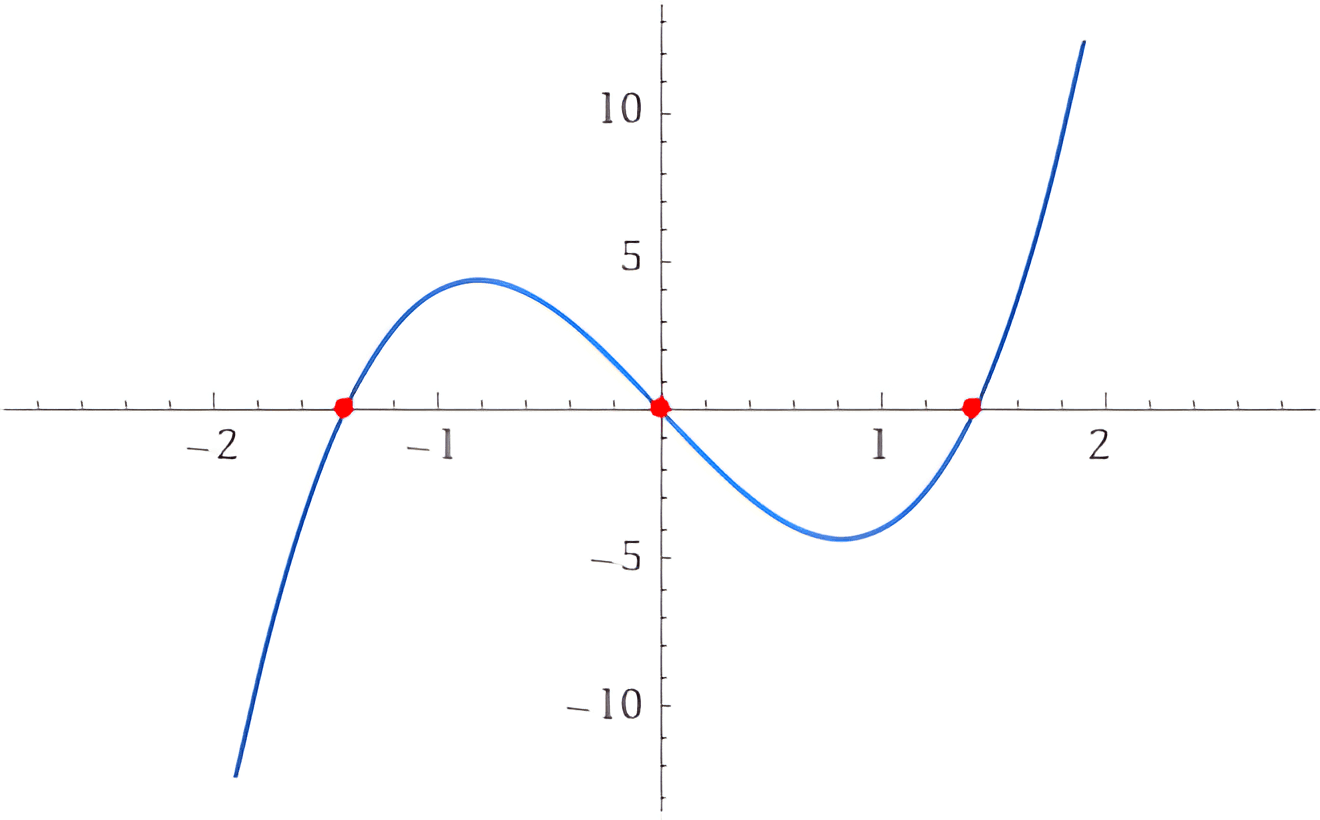
Solution by Steps
step 1
To find the critical points of the function f(x)=x4−4x2+3, we first need to find its derivative and set it equal to zero
step 2
The derivative of f(x) is f′(x)=dxd(x4−4x2+3)
step 3
Calculating the derivative, we get f′(x)=4x3−8x
step 4
Setting the derivative equal to zero gives us 4x3−8x=0
step 5
Factoring out 4x from the equation, we have 4x(x2−2)=0
step 6
Setting each factor equal to zero gives us x=0 and x2−2=0
step 7
Solving x2−2=0 gives us x=±2
step 8
Therefore, the critical points are x=0 and x=±2
Answer
The critical points of the function f(x)=x4−4x2+3 are x=0 and x=±2.
Key Concept
Critical Points of a Function
Explanation
Critical points of a function occur where its derivative is zero or undefined. In this case, the derivative is zero at x=0 and x=±2.
Solve for x in x = e^(x/4)
Solution by Steps
step 1
To solve the equation x=ex/4, we need to isolate the variable x. However, this equation is transcendental and cannot be solved using elementary algebraic methods
step 2
We can use numerical methods or graphing techniques to approximate the solution for x. One common numerical method is the Newton-Raphson method
step 3
Alternatively, we can graph both sides of the equation y=x and y=ex/4 and look for the intersection point(s)
Answer
The exact solution for x cannot be expressed in terms of elementary functions. Numerical methods or graphing can be used to approximate the solution.
Key Concept
Transcendental Equation
Explanation
The equation x=ex/4 is transcendental because it involves an exponent that is a function of the variable. Such equations do not have solutions that can be expressed in terms of elementary functions and typically require numerical methods to solve.
12. Determine the 1317th derivative of the following functions. You MUST show work by finding at least the first 4 derivatives.
a) f(x)=41e2x−1
b) f(x)=256−1cos(7−4x)
Solution by Steps
step 1
To find the nth derivative of f(x)=41e2x−1, we first recognize that the derivative of e2x−1 with respect to x is 2e2x−1
step 2
The first derivative of f(x) is f′(x)=41⋅2e2x−1=21e2x−1
step 3
The second derivative of f(x) is f′′(x)=21⋅2e2x−1=e2x−1
step 4
The third derivative of f(x) is f′′′(x)=2e2x−1
step 5
The fourth derivative of f(x) is f′′′′(x)=4e2x−1
step 6
We notice a pattern that each derivative is multiplied by 2, so the nth derivative will be 2n⋅41e2x−1
step 7
Substituting n=1317, the 1317th derivative at x=0 is 21317⋅41e2⋅0−1=21317⋅41e−1
Answer
21317⋅4e1
Key Concept
Finding the nth derivative of an exponential function
Explanation
The nth derivative of an exponential function ekx is knekx, and evaluating at x=0 gives knek⋅0.
Solution by Steps
step 1
To find the nth derivative of f(x)=256−1cos(7−4x), we use the fact that the derivatives of cosine function alternate between cosine and sine functions, with a change in sign depending on the order of the derivative
step 2
The first derivative of f(x) is f′(x)=2561⋅4sin(7−4x)
step 3
The second derivative of f(x) is f′′(x)=2561⋅42cos(7−4x)
step 4
The third derivative of f(x) is f′′′(x)=256−1⋅43sin(7−4x)
step 5
The fourth derivative of f(x) is f′′′′(x)=256−1⋅44cos(7−4x)
step 6
We notice a pattern that each derivative is multiplied by 4, and the function alternates between sine and cosine. The sign changes based on the order of the derivative
step 7
Since 1317 is odd, the 1317th derivative will be a sine function, and since the derivative order is 41317, the sign will be positive
step 8
The 1317th derivative at x=0 is 2561⋅41317sin(7)
Answer
2561⋅41317sin(7)
Key Concept
Finding the nth derivative of a trigonometric function
Explanation
The nth derivative of cos(kx) or sin(kx) involves powers of k and alternates between sine and cosine functions, with the sign determined by the order of the derivative.
Container B
5. Water drains out of two different containers at constant rates. Information about the volume of water in the containers over time is given below.
\begin{tabular}{|c|c|}
\hline Time (min) & Volume (L) \\
\hline 1 & 54 \\
\hline 3 & 32 \\
\hline 5 & 10 \\
\hline
\end{tabular}
a. Out of which container is the water draining at a faster rate? Justify your answer.
b. Write an equation to model the water loss in each container
c. Suppose the volume of container A was changed to 80 L and the rate stays the same.
- Describe how the graph would change.
- Describe how the equation would change.
d. Suppose the rate of container B changed to −14 L/min.
- Describe how the equation would change.
- Describe how the table of values would change.
Solution by Steps
step 1
To find the rate at which water is draining from the containers, we calculate the change in volume over the change in time
step 2
For Container B, the volume decreases from 54L to 32L in 2 minutes, and then to 10L in another 2 minutes
step 3
The rate of change from 54L to 32L is 3min−1min32L−54L=2min−22L=−11minL
step 4
The rate of change from 32L to 10L is 5min−3min10L−32L=2min−22L=−11minL
step 5
Since the rate of change is constant, we can model the water loss with a linear equation
step 6
The equation for Container B is V(t)=−11t+C, where C is the initial volume at t=0
step 7
Using the point (1, 54), we find C by solving 54=−11(1)+C, giving C=65
step 8
The equation for Container B is V(t)=−11t+65
step 9
If the volume of Container A is changed to 80L and the rate stays the same, the graph would shift upwards, but the slope would remain the same
step 10
The equation for Container A would change by increasing the y-intercept to reflect the new initial volume, while the slope remains unchanged
step 11
If the rate of Container B changed to -14L/min, the slope of the equation would become steeper, reflecting a faster rate of water loss
step 12
The table of values for Container B would show a greater decrease in volume for each time interval
Answer
a. Without information about Container A, we cannot determine which container is draining faster.
b. The equation for Container B is V(t)=−11t+65.
c. The graph for Container A would shift upwards, and the equation would have a higher y-intercept.
d. The equation for Container B would have a steeper slope, and the table of values would show a larger decrease per minute.
Key Concept
Linear equations and rates of change
Explanation
The rate of change in volume over time for a container draining water can be modeled with a linear equation, where the slope represents the rate of water loss, and the y-intercept represents the initial volume. Changes in the rate or initial volume affect the slope and y-intercept, respectively.
6. A house building company is calculating the price to hire the following tradespeople.
Let h represent the number of houses.
Let C represent the cost for h houses in thousands of dollars.
- Electrician: C=12 h
- Carpenter: C=10 h+8
a) Explain what the slope (rate of change) and y-intercept (initial value) represents for the Electrician.
b) Determine an equation for the combined total cost of both tradespeople in terms of the number of homes built.
c) Use the equation from part b) to determine how many homes this company could outfit with $500000.
d) State the point of intersection (POI), and explain which contractor is the most expensive before, at, and after the POI.
Generated Graph
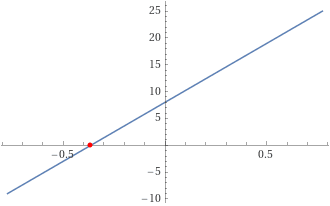
Solution by Steps
step 1
Identify the slope and y-intercept for the Electrician's cost equation C=12h
step 2
The slope (rate of change) is 12, representing the cost in thousands of dollars per house
step 3
The y-intercept is 0, indicating there is no initial cost when h=0
Answer
The slope is 12 and the y-intercept is 0.
Key Concept
Slope and Y-Intercept
Explanation
The slope represents the cost per house, and the y-intercept represents the initial cost.
Solution by Steps
step 1
Combine the cost equations for the Electrician and Carpenter to form a single equation
step 2
Add the individual costs: CElectrician=12h and CCarpenter=10h+8
step 3
The combined cost equation is C=(12h)+(10h+8)
step 4
Simplify the equation: C=22h+8
Answer
The combined total cost equation is C=22h+8.
Key Concept
Combining Linear Equations
Explanation
The combined cost is found by adding the costs for each tradesperson.
Solution by Steps
step 1
Use the combined cost equation to determine the number of homes that can be outfitted with $500,000
step 2
Convert $500,000 to thousands of dollars: \( 500 \) (since \( C \) is in thousands of dollars)
step 3
Set the combined cost equation equal to 500: 22h+8=500
step 4
Solve for h: h=22500−8
step 5
Calculate the value of h: h=22492
step 6
Simplify the fraction: h=22.36363636
Answer
The company could outfit approximately 22 homes with $500,000.
Key Concept
Solving for a Variable
Explanation
To find the number of homes, set the total cost equal to the budget and solve for h.
Solution by Steps
step 1
Determine the point of intersection (POI) for the cost equations of the Electrician and Carpenter
step 2
Set the cost equations equal to each other: 12h=10h+8
step 3
Solve for h: 2h=8
step 4
Calculate the value of h: h=4
step 5
Find the cost at the POI by substituting h=4 into either equation: C=12(4) or C=10(4)+8
step 6
Calculate the cost: C=48 (in thousands of dollars)
Answer
The POI is at h=4 houses and C=48 thousand dollars.
Key Concept
Point of Intersection (POI)
Explanation
The POI is where the costs for both tradespeople are equal. Before the POI, the Carpenter is more expensive; at the POI, they cost the same; after the POI, the Electrician is more expensive.
© 2023 AskSia.AI all rights reserved