
AskSia
Plus

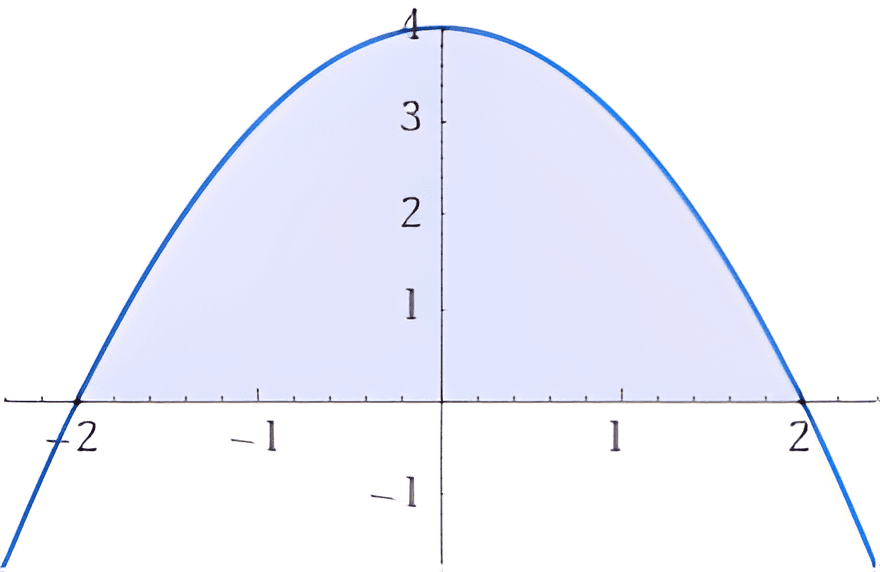
Determine the area under the curve y=4−x2 from x=−2 to x=2.
Apr 30, 2024

Determine the area under the curve y=4−x2 from x=−2 to x=2.

Generated Graph
Solution by Steps
step 1
Calculate the definite integral of the function 4−x2 from −2 to 2
step 2
The antiderivative of 4−x2 is 4x−3x3
step 3
Evaluate the antiderivative at the upper limit of integration: 4(2)−323=8−38=324−38=316
step 4
Evaluate the antiderivative at the lower limit of integration: 4(−2)−3(−2)3=−8−3−8=−8+38=−324+38=−316
step 5
Subtract the value of the antiderivative at the lower limit from the value at the upper limit: 316−(−316)=316+316=332
Answer
332 or approximately 10.667
Key Concept
Definite Integration
Explanation
The area under the curve y=4−x2 from x=−2 to x=2 is found by evaluating the definite integral of the function over the given interval.
© 2023 AskSia.AI all rights reserved