
AskSia
Plus

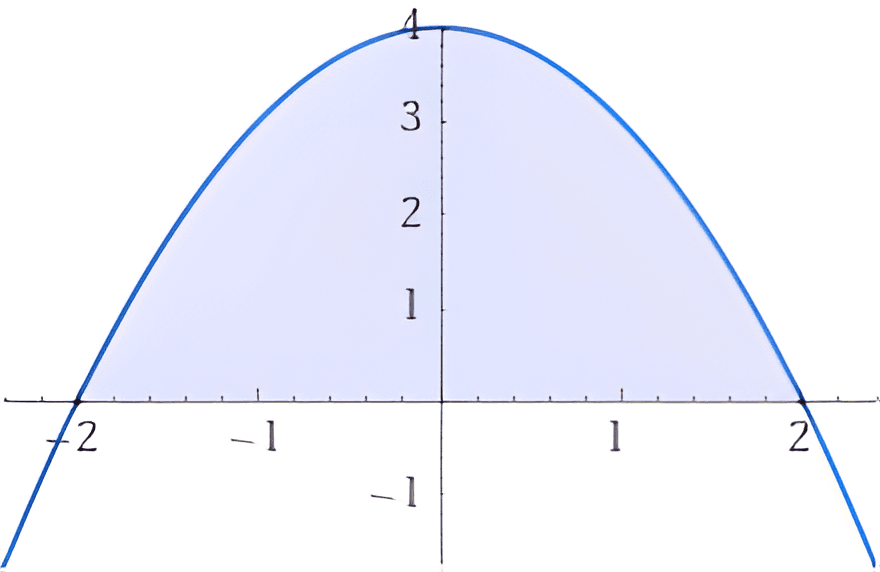
Determine the area under the curve y=4−x2 from x=−2 to x=2.
Apr 5, 2024

Determine the area under the curve y=4−x2 from x=−2 to x=2.

Generated Graph
Solution by Steps
step 1
Calculate the definite integral of the function y=4−x2 from x=−2 to x=2
step 2
The antiderivative of 4−x2 is 4x−3x3 plus a constant
step 3
Evaluate the antiderivative at the upper limit x=2 to get 4(2)−323=8−38
step 4
Evaluate the antiderivative at the lower limit x=−2 to get 4(−2)−3(−2)3=−8+38
step 5
Subtract the value of the antiderivative at the lower limit from the value at the upper limit to find the definite integral: (8−38)−(−8+38)
step 6
Simplify the expression to get 16−316
step 7
Convert the mixed number to an improper fraction: 16=348, so 348−316=332
Answer
The area under the curve y=4−x2 from x=−2 to x=2 is 332 or approximately 10.667.
Key Concept
Definite Integral as Area Under the Curve
Explanation
The definite integral of a function between two limits gives the area under the curve of the function between those two points. In this case, the area under y=4−x2 from x=−2 to x=2 is calculated using the antiderivative of the function.
What is the formula for finding the area under a curve defined by y=f(x) from x=a to x=b in terms of integration?
Solution by Steps
step 1
Identify the function to be integrated and the limits of integration
step 2
The formula for finding the area under the curve y=f(x) from x=a to x=b is given by the definite integral ∫abf(x)dx
step 3
Apply the formula to the given function and limits
Answer
The area under the curve y=f(x) from x=a to x=b is ∫abf(x)dx.
Key Concept
Definite Integral
Explanation
The definite integral of a function from x=a to x=b represents the area under the curve of that function over the interval [a, b].
Generate me a similar question
What is the process for determining the area under the curve described by y=2x+3 from x=0 to x=4 in terms of integration?
no
Solution by Steps
step 1
To find the area under the curve y=2x+3 from x=0 to x=4, we set up the definite integral
step 2
The definite integral is ∫04(2x+3)dx
step 3
We find the antiderivative of 2x+3, which is x2+3x
step 4
We evaluate the antiderivative at the upper and lower limits of integration: [(x2+3x)04]
step 5
Plugging in the limits, we get [(42+3(4))−(02+3(0))]
step 6
Simplifying, we find [16+12]−[0], which equals 28
Answer
The area under the curve y=2x+3 from x=0 to x=4 is 28 square units.
Key Concept
Definite Integral to Find Area
Explanation
The area under a curve y=f(x) from x=a to x=b is found by evaluating the definite integral ∫abf(x)dx. The result gives the total area between the curve and the x-axis within the specified interval.
© 2023 AskSia.AI all rights reserved