
AskSia
Plus

Context:
The use of vibration in engineering can be an effective tool to produc...
Jun 6, 2024

Context:
The use of vibration in engineering can be an effective tool to produce a result. For example, some
companies will use vibration between 0.1 and 100 Hz frequency to provide customers with a sense of
motion either in the context of movies or in attraction park. However, vibration in the context of driving
a vehicle is a problem that can lead to physical problems to the driver. One has to think of Formula One
drivers having lower back pain due to uncontrolled vibration of the bottom of the car, or to truck drivers
sitting in their vehicle for up to 10 hours straight. This is a well-documented domain that is still
undergoing some development. Also, unwanted vibration applied to mechanical or electronic device can
lead to premature failure.
Therefore, it is crucial that an engineer has some knowledge of basic vibration.
Problem:
You are making a seat for a truck driver. The seats is on the top of a soft spring (assume the seats to be
without a mass and consider only one spring, k = 1.5 kN/m), encapsulated inside a plastic wrap for
security, the wrap giving a damping numerically equal to the velocity. Consider the system at rest when
nobody is sitting on the seat.
Assume the truck driver has a mass of 90 kg.
a) What should be the minimum length of the spring for the system to actually exist? Explain.
b) Write the ordinary differential equation describing the system of driver, spring and damping.
c) Solve the system to find the equation of motion.
d) What is the natural frequency of that system?
Clearly state all your hypothesis!
please answer question a) b) c) d)

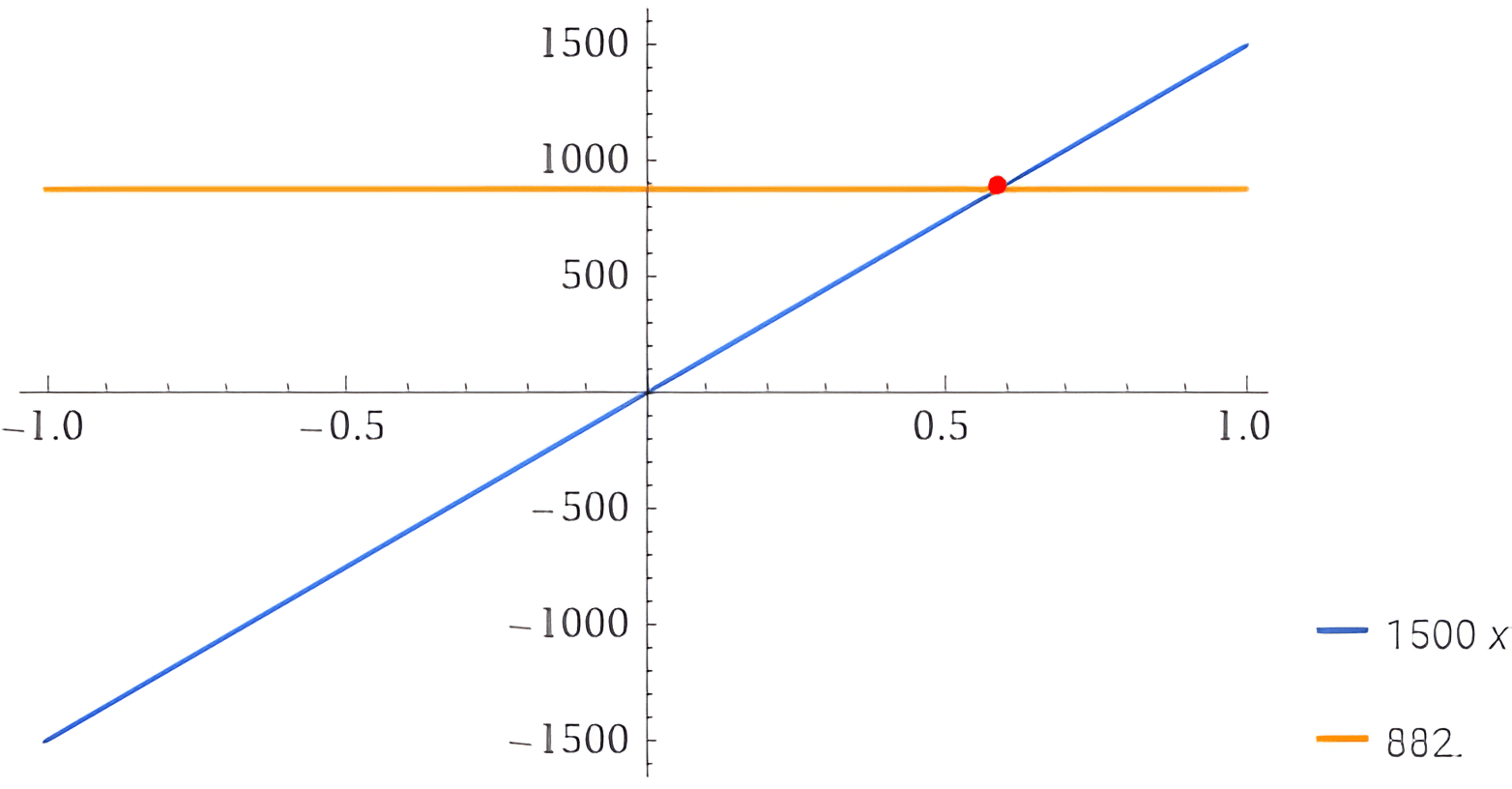
Generated Graph
Solution by Steps
step 1
To determine the minimum length of the spring for the system to exist, we need to consider the equilibrium position where the spring force balances the weight of the driver
step 2
The spring force is given by Hooke's Law: Fs=k⋅x, where k=1.5×10³N/m and x is the compression length
step 3
The weight of the driver is Fg=m⋅g, where m=90kg and g=9.8m/s2
step 4
Setting the spring force equal to the weight: 1.5×10³⋅x=90⋅9.8
step 5
Solving for x: x=1.5×10390⋅9.8=0.588m
Answer
The minimum length of the spring should be 0.588 meters.
step 1
The ordinary differential equation (ODE) describing the system includes the mass, damping, and spring constants
step 2
The general form of the ODE is m⋅y′′(t)+c⋅y′(t)+k⋅y(t)=0
step 3
Substituting the given values: m=90kg, c=90Ns/m, and k=1.5×10³N/m
step 4
The ODE becomes 90⋅y′′(t)+90⋅y′(t)+1.5×10³⋅y(t)=0
Answer
The ODE is 90⋅y′′(t)+90⋅y′(t)+1.5×10³⋅y(t)=0.
step 1
To solve the ODE, we use the characteristic equation: 90r2+90r+1.5×103=0
step 2
Dividing through by 90: r2+r+901.5×103=0
step 3
Simplifying: r2+r+16.6667=0
step 4
Solving the quadratic equation: r=2−1±1−4⋅16.6667
step 5
This simplifies to: r=2−1±−65.6668=2−1±i65.6668
step 6
The general solution is: y(t)=e−t/2(C1cos(265.6668t)+C2sin(265.6668t))
Answer
The equation of motion is y(t)=e−t/2(C1cos(265.6668t)+C2sin(265.6668t)).
step 1
The natural frequency ωn is given by ωn=mk
step 2
Substituting the given values: k=1.5×10³N/m and m=90kg
step 3
ωn=901.5×103=16.6667≈4.08rad/s
Answer
The natural frequency of the system is approximately 4.08 rad/s.
Key Concept
Vibration Analysis in Mechanical Systems
Explanation
Understanding the dynamics of a mass-spring-damper system is crucial for designing systems that can mitigate unwanted vibrations, ensuring both comfort and longevity of mechanical components.
© 2023 AskSia.AI all rights reserved