
AskSia
Plus

Consider the function f(x)=acos(bx), with a,b∈Z+.The f...
Dec 1, 2024



Solution by Steps
step 1
The value of a is determined by the maximum amplitude of the cosine function, which is 5. Thus, a=5
step 2
The period of the function f(x)=acos(bx) is given by the formula b2π. Observing the graph, it completes 4 full cycles from −43π to 25π, which is a total length of 25π+43π=420π+6π=426π=213π. Therefore, the period is 213π÷4=813π
step 3
Setting the period equal to b2π, we have b2π=813π. Solving for b, we get b=13π2π⋅8=1316
step 4
To find f(6π), we substitute x=6π into the function: f(6π)=5cos(1316⋅6π). Calculating the argument, 7816π=398π. Thus, f(6π)=5cos(398π)
Answer
a=5, b=1316, and f(6π)=5cos(398π)
Key Concept
The amplitude and period of a cosine function are key characteristics that define its shape and behavior.
Explanation
The amplitude a represents the maximum height of the wave, while the period b determines how frequently the wave oscillates over a given interval. The evaluation of f(6π) provides a specific value of the function at that point.

Generated Graph
Solution by Steps
step 1
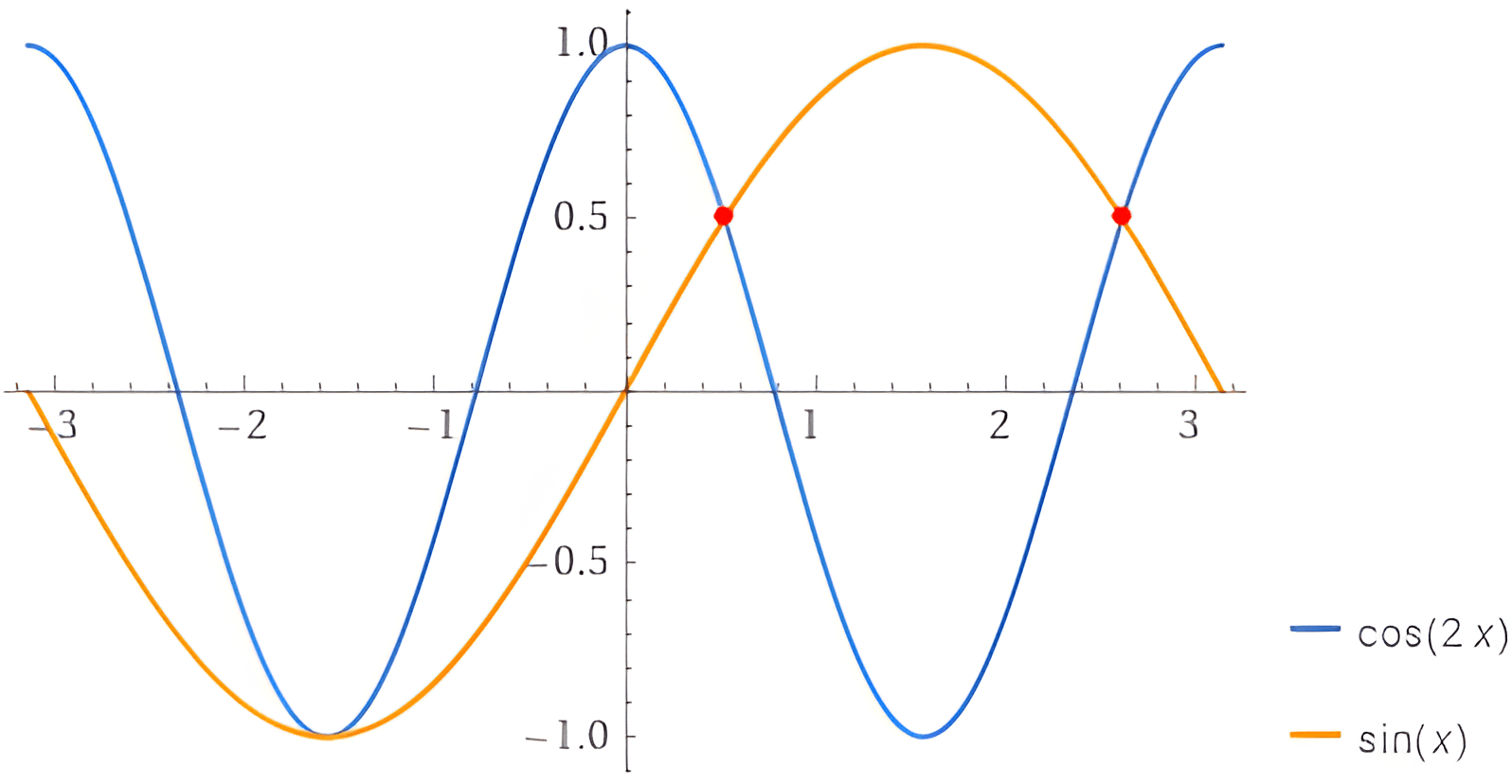
To show that the equation cos2x=sinx can be written in the form 2sin2x+sinx−1=0, we use the double angle identity: cos2x=1−2sin2x. Thus, we can rewrite the equation as: 1−2sin2x=sinx
step 2
Rearranging the equation gives us: 2sin2x+sinx−1=0. This is the required form
step 3
To solve the equation 2sin2x+sinx−1=0, we can use the quadratic formula: sinx=frac−bpmsqrtb2−4ac2a, where a=2, b=1, and c=−1
step 4
Substituting the values into the quadratic formula gives: sinx=frac−1pmsqrt12−4(2)(−1)2(2)=frac−1pmsqrt1+84=frac−1pm34. Thus, we have two solutions: sinx=frac12 and sinx=−1
step 5
Solving for x in the interval [−pi,pi]: For sinx=frac12, x=fracpi6 and x=frac5pi6. For sinx=−1, x=−fracpi2. Thus, the solutions are: x=fracpi6,frac5pi6,−fracpi2
Answer
The solutions to the equation cos2x=sinx in the interval [−pi,pi] are x=fracpi6,frac5pi6,−fracpi2.
Key Concept
The relationship between trigonometric identities and quadratic equations allows us to transform and solve trigonometric equations.
Explanation
By using the double angle identity and the quadratic formula, we can find the values of x that satisfy the original equation within the specified interval.

Solution by Steps
step 1
To solve the equation sin(q⋅q2π)=0, we note that sin(x)=0 at x=nπ, where n is any integer. Thus, we have q⋅q2π=nπ
step 2
This simplifies to 2π=nπ, leading to n=2. Therefore, all values of q are solutions
step 3
For the equation sin(q⋅q4π)=0, we again use the fact that sin(x)=0 at x=nπ. Thus, we have q⋅q4π=nπ
step 4
This simplifies to 4π=nπ, leading to n=4. Therefore, all values of q are solutions
Answer
All values of q are solutions for both equations.
Key Concept
The sine function has zeros at integer multiples of π.
Explanation
Since both equations reduce to finding integer multiples of π, all values of q satisfy the equations.


Solution by Steps
step 1
To find sinθ given cosθ=32, we use the identity sin2θ+cos2θ=1. Thus, we have:
step 2
Therefore, sinθ=95=35
step 3
To find sin2θ, we use the double angle formula: sin2θ=2sinθcosθ. Substituting the values we found:
Answer
sinθ=35 and sin2θ=945
Key Concept
Trigonometric identities and double angle formulas are essential for finding sine and cosine values.
Explanation
We used the Pythagorean identity to find sinθ and the double angle formula to find sin2θ.
Solution by Steps
step 1
To show that b=43a, we can use the Law of Sines in triangle ABC. We know that sin2θa=sinθb. Thus, we can express b in terms of a:
step 2
Substituting the values of sinθ and sin2θ we found earlier:
Answer
b=43a
Key Concept
The Law of Sines relates the sides of a triangle to the sines of its angles.
Explanation
We derived the relationship between sides a and b using the sine values we calculated.
Solution by Steps
step 1
To find sin∠CAD, we note that ∠CAD=2θ. Thus, we can use the value we found for sin2θ:
Answer
sin∠CAD=945
Key Concept
The sine of double angles can be calculated using the double angle formula.
Explanation
We directly used the previously calculated value of sin2θ to find sin∠CAD.
Solution by Steps
step 1
To find the area of triangle DAC, we can use the formula for the area of a triangle: Area=21⋅base⋅height. Here, we can take a as the base and sin∠CAD as the height:
step 2
Simplifying the area expression gives us:
Answer
Area of triangle DAC = 92a5
Key Concept
The area of a triangle can be calculated using the base and height.
Explanation
We used the base a and the height derived from sin∠CAD to find the area.

Generated Graph
Solution by Steps
step 1
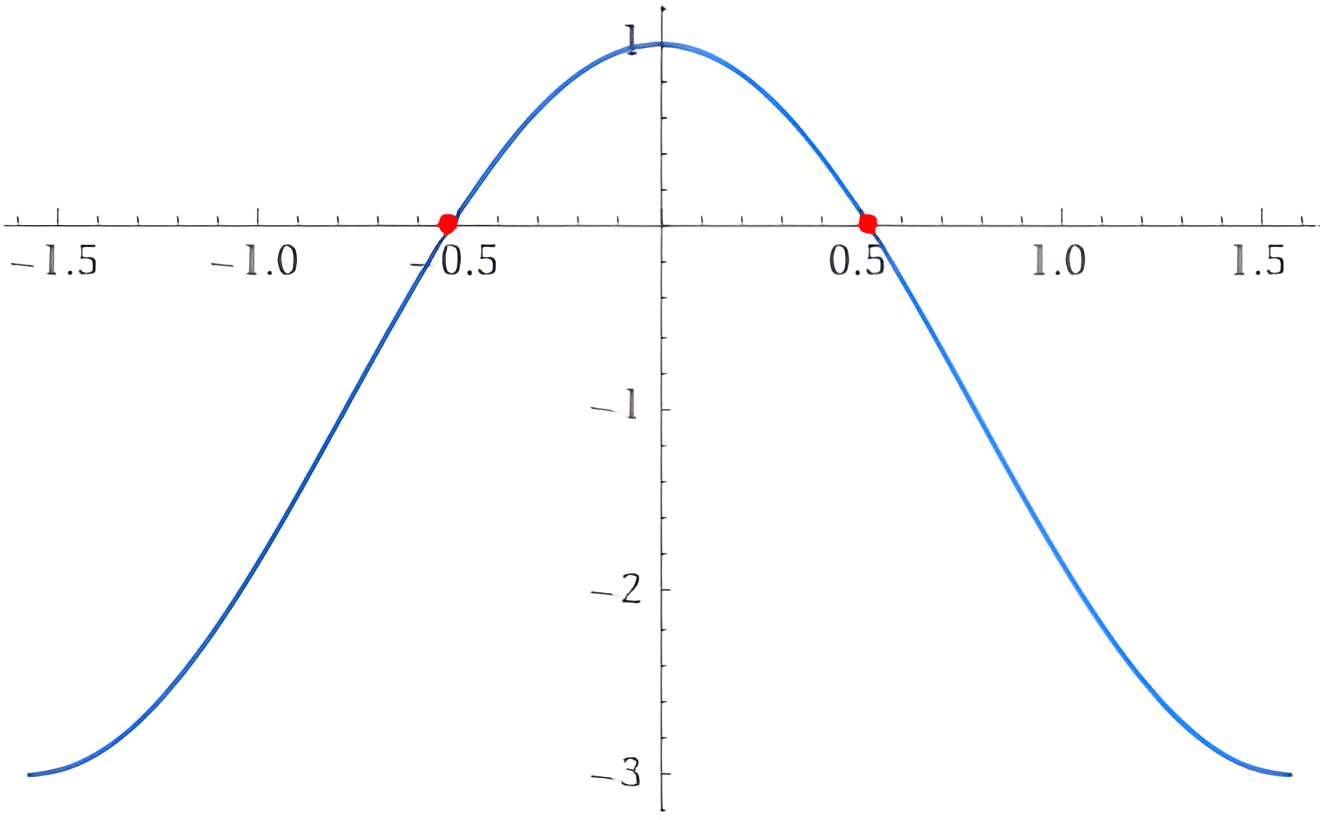
To find the roots of the equation f(x)=cos2x−3sin2x=0, we can rewrite it as cos2x=3sin2x. Using the identity cos2x=1−sin2x, we substitute to get 1−sin2x=3sin2x
step 2
Rearranging gives us 1=4sin2x, leading to sin2x=41. Thus, sinx=21 or sinx=−21
step 3
The solutions for x in the interval 0≤x≤π are x=6π and x=65π. Therefore, the roots are x=6π and x=65π
step 4
To find f′(x), we differentiate f(x)=cos2x−3sin2x. Using the chain rule, we have f′(x)=−2cosxsinx−6sinxcosx=−8sinxcosx
step 5
Setting f′(x)=0 gives −8sinxcosx=0. This implies sinx=0 or cosx=0
step 6
The solutions for x where sinx=0 are x=0 and x=π, and for cosx=0, x=2π. Thus, the coordinates of the points where f′(x)=0 are (0,f(0)),(2π,f(2π)),(π,f(π))
step 7
The values of f(0)=1, f(2π)=−3, and f(π)=1. Therefore, the coordinates are (0,1),(2π,−3),(π,1)
step 8
To sketch the graph of y=f(x), plot the points (0,1),(2π,−3),(π,1) and note the behavior of the function between these points. The graph will intersect the y-axis at (0,1) and (π,1), and will dip to (−3) at (2π)
Answer
Roots: x=6π,65π; Critical points: (0,1),(2π,−3),(π,1)
Key Concept
Finding roots and critical points of a trigonometric function
Explanation
The roots are found by setting the function to zero, and critical points are determined by finding where the derivative equals zero. The graph behavior is analyzed based on these points.

Solution by Steps
step 1
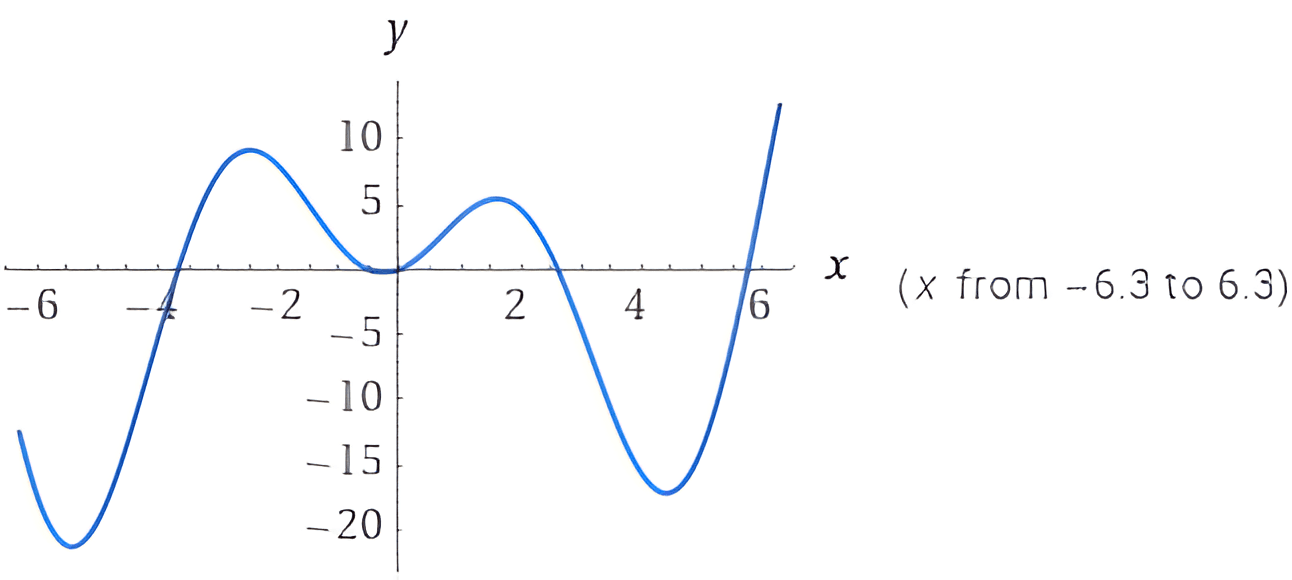
To find the transformations from f(x)=4sinx+2.5 to g(x)=4sin(x−23π)+2.5+q, we note that the first transformation is a horizontal shift to the right by 23π, and the second transformation is a vertical shift upwards by q
step 2
To find the y-intercept of g(x), we evaluate g(0): g(0)=4sin(0−23π)+2.5+q. Since sin(−23π)=−1, we have g(0)=4(−1)+2.5+q=−4+2.5+q=q−1.5
step 3
Given that g(x)≥7, we set up the inequality: q−1.5≥7. Solving for q gives us q≥8.5. Thus, the smallest value of r (the y-intercept) is r=8.5
Answer
The smallest value of r is 8.5.
Key Concept
Transformations of functions and finding intercepts
Explanation
The transformations involve horizontal and vertical shifts, and the y-intercept is determined by evaluating the function at x=0. The inequality helps find the minimum value of r.

Generated Graph
Solution by Steps
step 1
To find the composition of the functions, we substitute g(x) into f(x): (f∘g)(x)=f(g(x))=f(2x)=3sin(2x)+cos(2x)
step 2
We can simplify f(2x) using the double angle formulas: sin(2x)=2sin(x)cos(x) and cos(2x)=cos2(x)−sin2(x). Thus, f(2x)=3(2sin(x)cos(x))+(cos2(x)−sin2(x))
step 3
This gives us (f∘g)(x)=23sin(x)cos(x)+cos2(x)−sin2(x)
step 4
To solve the equation (f∘g)(x)=2cos(2x), we set 23sin(x)cos(x)+cos2(x)−sin2(x)=2cos(2x). Using cos(2x)=cos2(x)−sin2(x), we can rewrite the equation
step 5
Rearranging gives us 23sin(x)cos(x)=2(cos2(x)−sin2(x))−(cos2(x)−sin2(x)). Simplifying leads to 23sin(x)cos(x)=cos2(x)−sin2(x)
step 6
We can solve this equation for x in the interval [0,π] using numerical or graphical methods to find the solutions
Answer
The solutions for x in the interval [0,π] are x=6π,65π.
Key Concept
Function composition and solving trigonometric equations
Explanation
The composition of functions involves substituting one function into another, and solving trigonometric equations often requires using identities and algebraic manipulation.

Solution by Steps
step 1
To solve the equation cos(2x+3π)=21, we first recognize that 21 corresponds to an angle of 4π or 47π. Thus, we set up the equations: 2x+3π=4π+2kπ and 2x+3π=47π+2kπ for k∈Z
step 2
Solving the first equation: 2x=4π−3π+2kπ. Finding a common denominator (12), we have 4π=123π and 3π=124π, so 2x=123π−4π+2kπ=−12π+2kπ. Thus, x=−6π+4kπ
step 3
Solving the second equation: 2x=47π−3π+2kπ. Again, using a common denominator (12), we have 47π=1221π and 3π=124π, so 2x=1221π−4π+2kπ=1217π+2kπ. Thus, x=617π+4kπ
step 4
The least positive value of x occurs when k=0. From the first equation, x=−6π is negative, so we discard it. From the second equation, x=617π is positive. Therefore, the least positive value of x is 617π
Answer
617π
Key Concept
Solving trigonometric equations involves finding angles that satisfy the given conditions.
Explanation
The solution process includes recognizing corresponding angles for cosine values and solving for x while ensuring the least positive solution is found.
Solution by Steps
step 1
To show that 2x−3−x−16=x−12x2−5x−3, we start by simplifying the left-hand side. We can combine the terms over a common denominator: 2x−3=x−1(2x−3)(x−1)
step 2
Expanding the left-hand side: (2x−3)(x−1)=2x2−2x−3x+3=2x2−5x+3. Thus, we have x−12x2−5x+3
step 3
Now, we can rewrite the left-hand side as x−12x2−5x+3−6=x−12x2−5x−3. This shows that both sides are equal, confirming the identity
Answer
The identity is proven.
Key Concept
Proving algebraic identities requires manipulation and simplification of expressions.
Explanation
By expanding and simplifying both sides of the equation, we can demonstrate their equivalence.
Solution by Steps
step 1
To solve the equation 2sin(2θ)−3−sin(2θ)−16=0, we first rearrange it to isolate the fraction: 2sin(2θ)−3=sin(2θ)−16
step 2
Cross-multiplying gives us (2sin(2θ)−3)(sin(2θ)−1)=6. Expanding this results in 2sin2(2θ)−2sin(2θ)−3sin(2θ)+3=6
step 3
Simplifying leads to 2sin2(2θ)−5sin(2θ)−3=0. We can solve this quadratic equation using the quadratic formula: sin(2θ)=2a−b±b2−4ac where a=2,b=−5,c=−3
step 4
Calculating the discriminant: b2−4ac=(−5)2−4(2)(−3)=25+24=49. Thus, sin(2θ)=45±7. This gives us sin(2θ)=3 or sin(2θ)=−21. The first case is not possible since sine values are between -1 and 1
step 5
For sin(2θ)=−21, we find 2θ=67π+2kπ or 2θ=611π+2kπ. Dividing by 2 gives θ=127π+kπ or θ=1211π+kπ. Considering 0≤θ≤π, we find θ=127π and θ=1211π
Answer
θ=127π,1211π
Key Concept
Solving trigonometric equations often involves using identities and the quadratic formula.
Explanation
The process includes isolating terms, applying the quadratic formula, and considering the range of solutions for θ.
Solution by Steps
step 1
To show that sin(2x)+cos(2x)−1=2sin(x)(cos(x)−sin(x)), we start with the left-hand side and use the double angle identities: sin(2x)=2sin(x)cos(x) and cos(2x)=cos2(x)−sin2(x)
step 2
Substituting these identities gives us 2sin(x)cos(x)+(cos2(x)−sin2(x))−1. Simplifying this results in 2sin(x)cos(x)+cos2(x)−sin2(x)−1
step 3
We can rewrite cos2(x)−1=−sin2(x), leading to 2sin(x)cos(x)−sin2(x). Factoring out sin(x) gives sin(x)(2cos(x)−sin(x))
step 4
Thus, we have 2sin(x)(cos(x)−sin(x)), confirming the identity
Answer
The identity is proven.
Key Concept
Proving trigonometric identities requires the application of known identities and algebraic manipulation.
Explanation
By substituting double angle identities and simplifying, we can demonstrate the equivalence of both sides of the equation.
Solution by Steps
step 1
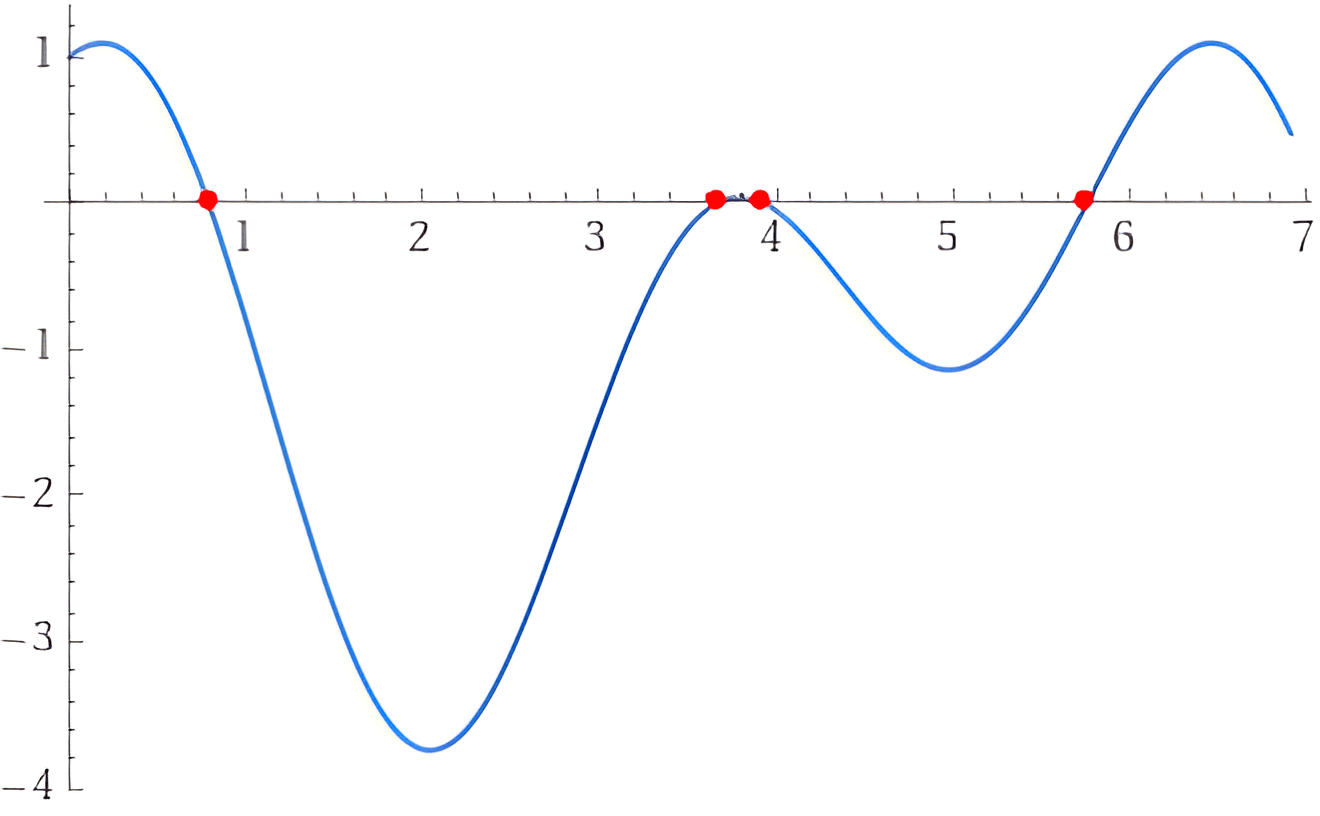
To solve the equation sin(2x)+cos(2x)−1+cos(x)−sin(x)=0, we can use the double angle identities: sin(2x)=2sin(x)cos(x) and cos(2x)=cos2(x)−sin2(x)
step 2
Substituting these identities gives us 2sin(x)cos(x)+(cos2(x)−sin2(x))−1+cos(x)−sin(x)=0. Simplifying this results in 2sin(x)cos(x)+cos2(x)−sin2(x)+cos(x)−sin(x)−1=0
step 3
We can rearrange the equation to isolate terms: cos2(x)−1+2sin(x)cos(x)+cos(x)−sin(x)−sin2(x)=0. Using cos2(x)−1=−sin2(x), we have −sin2(x)+2sin(x)cos(x)+cos(x)−sin(x)=0
step 4
This can be factored or solved using numerical methods or graphing to find the values of x in the interval 0 < x < 2\pi . The solutions can be found to be x=4π,43π,45π,47π
Answer
x=4π,43π,45π,47π
Key Concept
Solving trigonometric equations often involves using identities and algebraic manipulation.
Explanation
The process includes substituting known identities, rearranging, and solving for x within the specified interval.

Generated Graph
Solution by Steps
step 1
To show that sin2x+cos2x−1=2sinx(cosx−sinx), we start with the left-hand side: sin2x+cos2x−1. Using the double angle identities, we have sin2x=2sinxcosx and cos2x=cos2x−sin2x. Thus, we can rewrite the expression as 2sinxcosx+(cos2x−sin2x)−1. Simplifying gives 2sinxcosx+cos2x−sin2x−1=2sinx(cosx−sinx)
step 2
To solve sin2x+cos2x−1+cosx−sinx=0 for 0 < x < 2\pi , we substitute the identity from step 1 into the equation: 2sinx(cosx−sinx)+cosx−sinx=0. Factoring out cosx−sinx gives (cosx−sinx)(2sinx+1)=0. This leads to two cases: cosx−sinx=0 and 2sinx+1=0
step 3
For the first case cosx−sinx=0, we find tanx=1, which gives x=4π+nπ. Within the interval 0 < x < 2\pi , the solutions are x=4π and x=45π
step 4
For the second case 2sinx+1=0, we have sinx=−21. The solutions for this equation in the interval 0 < x < 2\pi are x=67π and x=611π
step 5
Combining all solutions, we find x=4π,45π,67π,611π as the final answers
Answer
The solutions are x=4π,45π,67π,611π
Key Concept
Trigonometric identities and solving equations
Explanation
The solution involves using trigonometric identities to simplify the equation and then solving for x within the specified interval.

Solution by Steps
step 1
To rewrite the equation 2cos2x+5sinx=4, we use the identity cos2x=1−sin2x
step 2
Substituting the identity into the equation gives us: 2(1−sin2x)+5sinx=4
step 3
Expanding this results in: 2−2sin2x+5sinx=4
step 4
Rearranging the equation leads to: −2sin2x+5sinx+2−4=0, which simplifies to 2sin2x−5sinx+2=0
step 5
Now, we solve the quadratic equation 2sin2x−5sinx+2=0 using the quadratic formula: sinx=2a−b±b2−4ac, where a=2, b=−5, and c=2
step 6
Calculating the discriminant: b2−4ac=(−5)2−4(2)(2)=25−16=9
step 7
Applying the quadratic formula gives: sinx=45±3
step 8
This results in two possible values: sinx=48=2 (not valid) and sinx=42=21
step 9
The valid solution sinx=21 corresponds to angles x=6π and x=65π within the interval 0≤x≤2π
Answer
The solutions are x=6π and x=65π
Key Concept
Trigonometric identities and quadratic equations
Explanation
We transformed the original equation using the identity for cosine and solved the resulting quadratic equation to find the angles that satisfy the equation.


© 2023 AskSia.AI all rights reserved