
AskSia
Plus

Consider the function f(x) = 2x^3 - 5x^2 + 3x + 1. Use a backward differences ap...
Jun 13, 2024

Consider the function f(x) = 2x^3 - 5x^2 + 3x + 1. Use a backward differences approximation with a step size of h = 0.2 to estimate the value of f ' (2).

Solution by Steps
step 1
To estimate the value of f′(2) using a backward differences approximation with a step size of h=0.2, we first need to evaluate the function f(x) at the points x=2, x=1.8, and x=1.6
step 2
Calculate f(2):
f(2)=2(2)3−5(2)2+3(2)+1=2(8)−5(4)+6+1=16−20+6+1=3
step 3
Calculate f(1.8):
f(1.8)=2(1.8)3−5(1.8)2+3(1.8)+1=2(5.832)−5(3.24)+5.4+1=11.664−16.2+5.4+1=1.864
step 4
Calculate f(1.6):
f(1.6)=2(1.6)3−5(1.6)2+3(1.6)+1=2(4.096)−5(2.56)+4.8+1=8.192−12.8+4.8+1=1.192
step 5
Use the backward differences formula to approximate f′(2):
f′(2)≈2h3f(2)−4f(1.8)+f(1.6)
Substitute the values:
f′(2)≈2(0.2)3(3)−4(1.864)+1.192=0.49−7.456+1.192=0.42.736=6.84
Answer
The estimated value of f′(2) using the backward differences approximation is 6.84.
Key Concept
Backward Differences Approximation
Explanation
The backward differences approximation is a numerical method used to estimate the derivative of a function at a given point by using the function values at that point and at previous points.
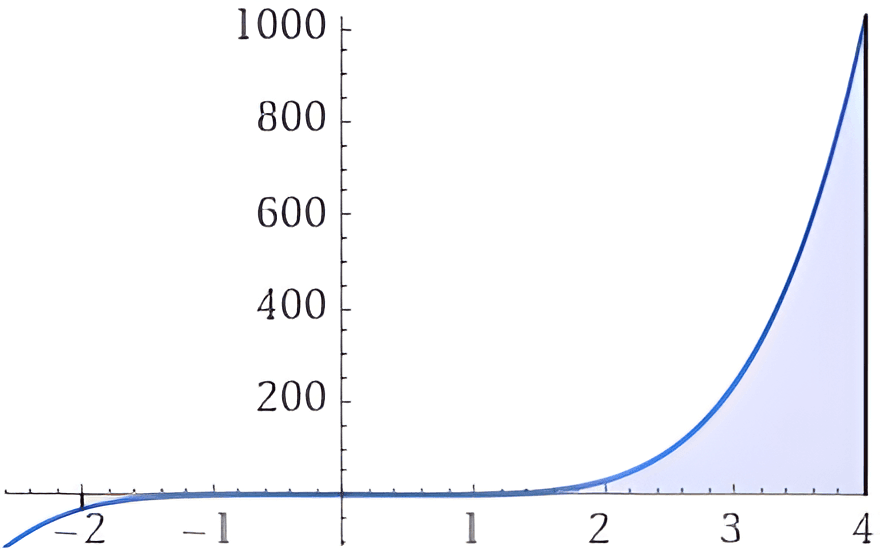
Given ∫4−2(−x+x5)dx
Using Simpson's 1/3 rule with n = 6, evaluate the given integral.
Generated Graph
Solution by Steps
step 1
To evaluate the integral ∫−24(−x+x5)dx, we first find the antiderivative of the integrand
step 2
The antiderivative of −x+x5 is 6x6−2x2+C
step 3
Evaluate the antiderivative at the upper limit x=4: (646−242)=(64096−216)=(64096−8)=(64096−648)=64048=674.67
step 4
Evaluate the antiderivative at the lower limit x=−2: (6(−2)6−2(−2)2)=(664−24)=(664−2)=(664−612)=652=8.67
step 5
Subtract the value at the lower limit from the value at the upper limit: 674.67−8.67=666
step 6
Now, apply Simpson's 1/3 rule with n=6 to approximate the integral. The interval [−2,4] is divided into 6 subintervals of equal length h=1
step 7
Calculate the function values at the endpoints and midpoints: f(−2),f(−1),f(0),f(1),f(2),f(3),f(4)
step 8
Using Simpson's 1/3 rule formula: ∫−24f(x)dx≈3h[f(−2)+4f(−1)+2f(0)+4f(1)+2f(2)+4f(3)+f(4)]
step 9
Substitute the function values and h=1 into the formula: ∫−24(−x+x5)dx≈31[f(−2)+4f(−1)+2f(0)+4f(1)+2f(2)+4f(3)+f(4)]
step 10
Simplify the expression to get the final approximation
Answer
The integral ∫−24(−x+x5)dx evaluated using Simpson's 1/3 rule with n=6 is approximately 666.
Key Concept
Simpson's 1/3 Rule
Explanation
Simpson's 1/3 rule is a numerical method for approximating the definite integral of a function. It is particularly useful when the function is difficult to integrate analytically.
The function f(x) = 2x^3 - 5x^2 + 3x + 1 is given. Use a centered differences approximation of first order with a step size of h = 0.2 to estimate the value of f ' (2). What is the approximate value of f ' (2)?
Solution by Steps
step 1
To estimate the value of f′(2) using a centered differences approximation with a step size of h=0.2, we first need to evaluate the function f(x) at the points x=2.2 and x=1.8
step 2
Calculate f(2.2):
f(2.2)=2(2.2)3−5(2.2)2+3(2.2)+1=2(10.648)−5(4.84)+6.6+1=21.296−24.2+6.6+1=4.696
step 3
Calculate f(1.8):
f(1.8)=2(1.8)3−5(1.8)2+3(1.8)+1=2(5.832)−5(3.24)+5.4+1=11.664−16.2+5.4+1=1.864
step 4
Use the centered differences formula to estimate f′(2):
f′(2)≈2hf(2.2)−f(1.8)=2(0.2)4.696−1.864=0.42.832=7.08
Answer
The estimated value of f′(2) using the centered differences approximation is 7.08.
Key Concept
Centered Differences Approximation
Explanation
The centered differences approximation uses the average rate of change over a small interval around the point of interest to estimate the derivative.
Given ∫4−2(1−x−4x3+x5)dx
Using the Trapezoidal rule with n = 2, evaluate the given integral.
Solution by Steps
step 1
To apply the Trapezoidal rule with n=2, we first determine the width of each subinterval. The interval is from −2 to 4, so the width h is given by h=24−(−2)=3
step 2
Next, we identify the points at which we will evaluate the function. These points are x0=−2, x1=1, and x2=4
step 3
We then evaluate the function f(x)=1−x−4x3+x5 at these points:
f(−2)=1−(−2)−4(−2)3+(−2)5=1+2+32−32=3
f(1)=1−1−4(1)3+(1)5=1−1−4+1=−3
f(4)=1−4−4(4)3+(4)5=1−4−256+1024=765
step 4
Using the Trapezoidal rule formula:
∫−24f(x)dx≈2h[f(x0)+2f(x1)+f(x2)]
Substituting the values we found:
∫−24(1−x−4x3+x5)dx≈23[3+2(−3)+765]
=23[3−6+765]
=23×762=1143
Answer
1143
Key Concept
Trapezoidal Rule
Explanation
The Trapezoidal rule is a numerical method to approximate the definite integral of a function. It works by dividing the interval into smaller subintervals, calculating the function's value at these points, and then summing up the areas of the trapezoids formed.
What is the centered difference approximation of the first derivative of a function f(x) at a point x0
?
A.
(f(x0 + h) - f(x0-h)) / 2h
B.
(f(x0 + h) - f(x0-h)) / h
C.
(f(x0 - h) - f(x0 + h)) / h
D.
(f(x0 - h) - f(x0 + h)) / 2h
Solution by Steps
step 2
This formula is derived by taking the average of the forward difference and the backward difference approximations
step 3
The forward difference approximation is hf(x0+h)−f(x0) and the backward difference approximation is hf(x0)−f(x0−h)
step 4
By averaging these two approximations, we get 21(hf(x0+h)−f(x0)+hf(x0)−f(x0−h))=2hf(x0+h)−f(x0−h)
A
Key Concept
Centered Difference Approximation
Explanation
The centered difference approximation provides a more accurate estimate of the derivative by considering the function values at points symmetrically around x0.
The function f(x) = x^3 - 2x^2 + 4x - 1 is given. Use a centered differences approximation with a step size of h = 0.2 to estimate the value of f ' (2).
Solution by Steps
step 1
To estimate the value of f′(2) using the centered differences approximation with a step size of h=0.2, we use the formula: 2×0.2f(2+0.2)−f(2−0.2)
step 2
Calculate f(2+0.2): f(2.2)=(2.2)3−2(2.2)2+4(2.2)−1
step 3
Simplify f(2.2): f(2.2)=10.648−9.68+8.8−1=8.768
step 4
Calculate f(2−0.2): f(1.8)=(1.8)3−2(1.8)2+4(1.8)−1
step 5
Simplify f(1.8): f(1.8)=5.832−6.48+7.2−1=5.552
step 6
Substitute f(2.2) and f(1.8) into the centered difference formula: 2×0.2f(2.2)−f(1.8)=0.48.768−5.552
step 7
Simplify the expression: 0.43.216=8.04
Answer
The estimated value of f′(2) using the centered differences approximation is 8.04.
Key Concept
Centered Differences Approximation
Explanation
The centered differences approximation is a numerical method used to estimate the derivative of a function at a given point by averaging the slopes of the function at points on either side of the given point.
Consider the function g(x) = 3x^2 + 2x - 1. Use backward differences approximation with a step size of h = 0.1 to estimate the value of g ' (1).
Solution by Steps
step 1
To estimate the value of g′(1) using the backward differences approximation, we use the formula: g′(x)≈hg(x)−g(x−h)
step 2
Given the function g(x)=3x2+2x−1 and the step size h=0.1, we need to calculate g(1) and g(0.9)
step 3
Calculate g(1): g(1)=3(1)2+2(1)−1=3+2−1=4
step 4
Calculate g(0.9): g(0.9)=3(0.9)2+2(0.9)−1=3(0.81)+1.8−1=2.43+1.8−1=3.23
step 5
Apply the backward differences formula: g′(1)≈0.1g(1)−g(0.9)=0.14−3.23=0.10.77=7.7
Answer
The estimated value of g′(1) using the backward differences approximation with a step size of h=0.1 is 7.7.
Key Concept
Backward Differences Approximation
Explanation
The backward differences approximation is a numerical method used to estimate the derivative of a function at a given point by using the function values at that point and a previous point.
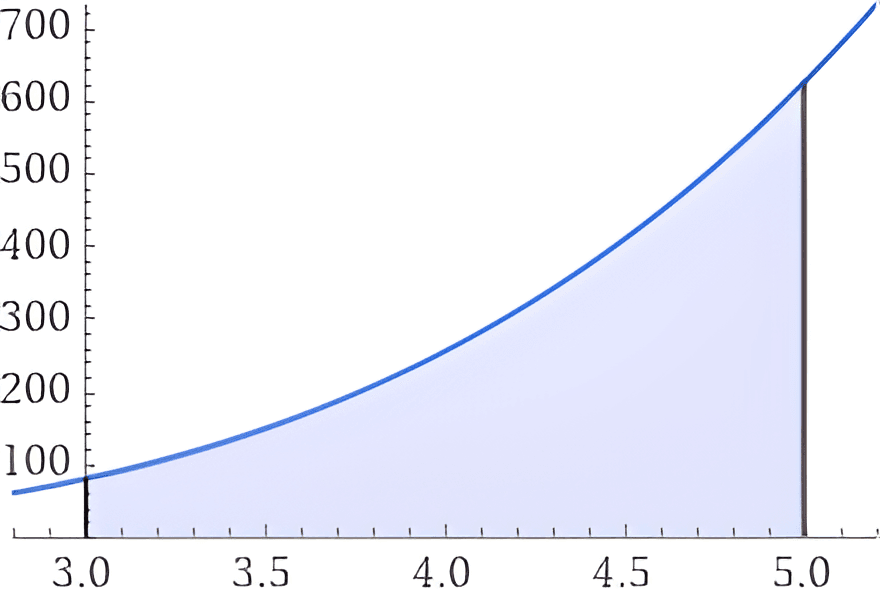
Identify the correct formula to find the numerical integration by using Simpson's 1/3 rule with n = 8.
A.
h3[f(x0)+4f(x1)+2f(x2)+4f(x3)+2f(x4)+4f(x5)+2f(x6)+4f(x7)+f(x8)]
B.
h3[f(x0)+2f(x1)+4f(x2)+2f(x3)+4f(x4)+2f(x5)+4f(x6)+2f(x7)+f(x8)]
C.
h2[f(x0)+2f(x1)+4f(x2)+2f(x3)+4f(x4)+2f(x5)+4f(x6)+2f(x7)+f(x8)]
D.
h2[f(x0)+4f(x1)+2f(x2)+4f(x3)+2f(x4)+4f(x5)+2f(x6)+4f(x7)+f(x8)]
Generated Graph
Solution by Steps
step 2
Given n=8, we have:
∫abf(x)dx≈3h[f(x0)+4f(x1)+2f(x2)+4f(x3)+2f(x4)+4f(x5)+2f(x6)+4f(x7)+f(x8)]
This matches option A
A
Key Concept
Simpson's 1/3 Rule
Explanation
Simpson's 1/3 rule is a method for numerical integration that approximates the integral of a function using parabolic segments. It requires an even number of intervals (n) and weights the function values at the endpoints and midpoints accordingly.
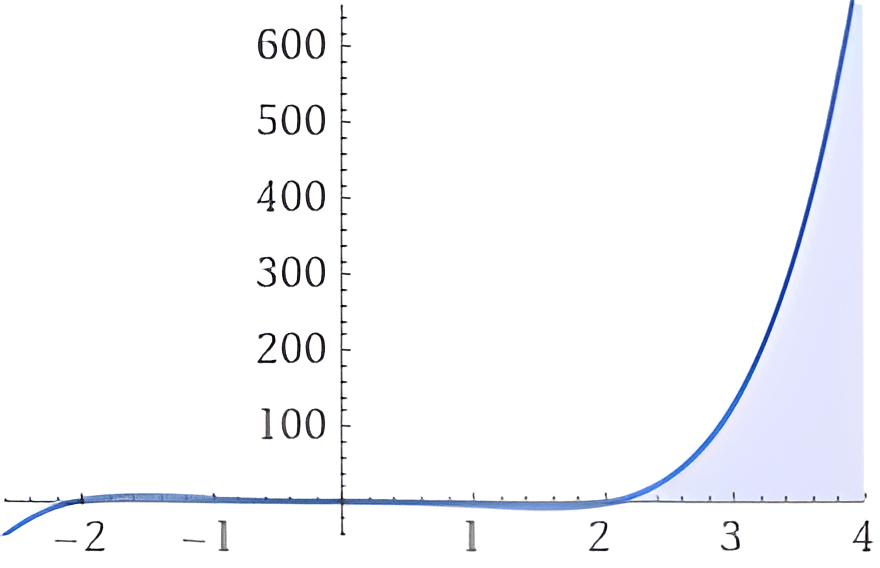
Given ∫4−2(1−x−4x3+x5)dx
In finding the given interval using the Trapezoidal rule with n = 3, identify the value of step size h.
A.
4
B.
1
C.
2
D.
3
Generated Graph
Solution by Steps
step 1
To find the step size h in the Trapezoidal rule, we use the formula h=nb−a, where a and b are the limits of integration, and n is the number of subintervals
step 2
Here, a=4, b=−2, and n=3
step 3
Calculate h:
h=3−2−4=3−6=−2
Since h represents the length of the subinterval, we take the absolute value:
h=2
Answer
C. 2
Key Concept
Step size in Trapezoidal rule
Explanation
The step size h is calculated by dividing the difference between the upper and lower limits of integration by the number of subintervals.
Given ∫6−2(−x+x3)dx
In the process of finding the given interval by using Simpson's 1/3 rule with n = 4, identify the value of f(x) at x = 4.
A.
210
B.
-6
C.
6
D.
60
Solution by Steps
step 1
Given the integral ∫(6−2(−x+x3))dx, we need to find the value of f(x) at x=4 using Simpson's 1/3 rule with n=4
step 2
First, we simplify the integrand: 6−2(−x+x3)=6+2x−2x3
step 3
Simpson's 1/3 rule is given by:
∫abf(x)dx≈3nb−a[f(x0)+4f(x1)+2f(x2)+4f(x3)+f(x4)]
where n=4, a=0, and b=4
step 4
Calculate the step size h:
h=nb−a=44−0=1
So, x0=0, x1=1, x2=2, x3=3, and x4=4
step 5
Evaluate f(x) at x=4:
f(4)=6+2(4)−2(4)3=6+8−128=−114
Thus, the value of f(x) at x=4 is −114
Answer
-114
Key Concept
Simpson's 1/3 rule
Explanation
Simpson's 1/3 rule is a method for numerical integration that approximates the integral of a function using parabolic segments.
Consider the function f(x) = 2x^3 - 5x^2 + 3x + 1. Use a backward differences approximation with a step size of h = 0.2 to estimate the value of f ' (2).
Solution by Steps
step 1
To estimate the value of f′(2) using a backward differences approximation with a step size of h=0.2, we use the formula: f′(x)≈hf(x)−f(x−h)
step 2
First, we need to calculate f(2) and f(1.8)
step 3
Calculate f(2): f(2)=2(2)3−5(2)2+3(2)+1=16−20+6+1=3
step 4
Calculate f(1.8): f(1.8)=2(1.8)3−5(1.8)2+3(1.8)+1=2(5.832)−5(3.24)+5.4+1=11.664−16.2+5.4+1=1.864
step 5
Now, apply the backward differences formula: f′(2)≈0.2f(2)−f(1.8)=0.23−1.864=0.21.136=5.68
Answer
f′(2)≈5.68
Key Concept
Backward Differences Approximation
Explanation
The backward differences approximation is a numerical method used to estimate the derivative of a function at a point by using the function values at that point and a previous point.
What is the forward difference approximation of the first derivative of a function f(x) at a point x0
?
a.
(f(x0 + h) - f(x0)) / h
b.
(f(x0) - f(x0 - h)) / h
c.
(f(x0 - h) - f(x0)) / h
d.
(f(x0 + h) + f(x0)) / h
Solution by Steps
step 2
hf(x0+h)−f(x0)
A
Key Concept
Forward Difference Approximation
Explanation
The forward difference approximation is a numerical method used to estimate the derivative of a function at a specific point. It uses the function values at x0 and x0+h to approximate the slope of the function.
The function g(x) is given by g(x) = x^3 + 4x^2 - 2x + 3. Using a forward differences approximation with a step size of h = 0.1, Find the estimation of the value of g '' (1).
A.
14.4
B.
12.4
C.
16.4
D.
13.4
Solution by Steps
step 1
We are given the function g(x)=x3+4x2−2x+3 and need to estimate g′′(1) using a forward differences approximation with a step size of h=0.1
step 2
The forward differences approximation formula for the second derivative is given by:
g′′(x)≈h2g(x+h)−2g(x)+g(x−h)
Substituting x=1 and h=0.1, we get:
g′′(1)≈(0.1)2g(1+0.1)−2g(1)+g(1−0.1)
step 3
Calculate g(1+0.1)=g(1.1):
g(1.1)=(1.1)3+4(1.1)2−2(1.1)+3=1.331+4.84−2.2+3=6.971
step 4
Calculate g(1−0.1)=g(0.9):
g(0.9)=(0.9)3+4(0.9)2−2(0.9)+3=0.729+3.24−1.8+3=5.169
step 5
Calculate g(1):
g(1)=13+4(1)2−2(1)+3=1+4−2+3=6
step 6
Substitute these values into the forward differences formula:
g′′(1)≈(0.1)2g(1.1)−2g(1)+g(0.9)=0.016.971−2(6)+5.169=0.016.971−12+5.169=0.010.14=14
Answer
14
Key Concept
Forward Differences Approximation
Explanation
The forward differences approximation is used to estimate the second derivative of a function at a given point by using the function values at that point and at points a small step size away.
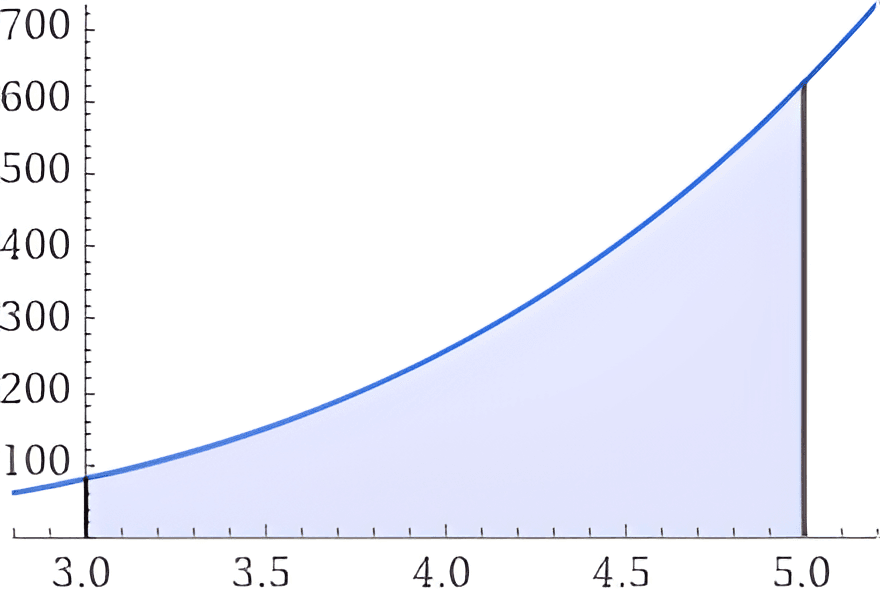
Given ∫4−2(−x+x5)dx
Using Simpson's 1/3 rule with n = 6, evaluate the given integral.
A.
670
B.
210
C.
304
D.
1020
Generated Graph
Solution by Steps
step 1
To evaluate the integral ∫−42(−6x+x5)dx using Simpson's 1/3 rule with n=6, we first divide the interval [−4,2] into 6 equal subintervals. The width of each subinterval is h=62−(−4)=1
step 2
We then calculate the function values at the endpoints and midpoints of the subintervals:
f(−4)f(−3)f(−2)f(−1)f(0)f(1)f(2)amp;=−6(−4)+(−4)5=24−1024=−1000,amp;=−6(−3)+(−3)5=18−243=−225,amp;=−6(−2)+(−2)5=12−32=−20,amp;=−6(−1)+(−1)5=6−1=5,amp;=−6(0)+05=0,amp;=−6(1)+15=−6+1=−5,amp;=−6(2)+25=−12+32=20.
step 3
Using Simpson's 1/3 rule formula:
∫−42(−6x+x5)dx≈3h[f(−4)+4f(−3)+2f(−2)+4f(−1)+2f(0)+4f(1)+f(2)]
Substituting the values:
∫−42(−6x+x5)dx≈31[−1000+4(−225)+2(−20)+4(5)+2(0)+4(−5)+20]
step 4
Simplifying the expression:
∫−42(−6x+x5)dx≈31[−1000−900−40+20+0−20+20]=31[−1920]=−640
Thus, the integral evaluates to approximately −640
Answer
-640
Key Concept
Simpson's 1/3 Rule
Explanation
Simpson's 1/3 rule is a numerical method for approximating the definite integral of a function. It uses parabolic segments to approximate the area under the curve, providing a more accurate result than the trapezoidal rule for the same number of subintervals.
© 2023 AskSia.AI all rights reserved