
AskSia
Plus

Cian
Instructions
Answer all questions. A decimal questions where more than one...
Jun 10, 2024



Solution by Steps
step 1
Given the function f(x)=mx2+1 and its inverse, we need to find the value of m where the graphs touch at a point
step 2
The inverse function f−1(x) can be found by solving y=mx2+1 for x
step 3
Rearrange y=mx2+1 to x2=my−1, so x=±my−1
step 4
Since the graphs touch at a point, f(x)=f−1(x). Therefore, mx2+1=x
step 5
Solve mx2+1=x for x: mx2−x+1=0
step 6
For the graphs to touch, the quadratic equation must have a double root. The discriminant Δ must be zero: Δ=b2−4ac=(−1)2−4(m)(1)=0
step 7
Solve for m: 1−4m=0⟹m=41
step 1
Substitute m=41 back into the equation mx2+1=x: 41x2+1=x
step 2
Solve 41x2−x+1=0 for x: x=2
step 3
Find y by substituting x=2 into f(x): y=41(2)2+1=2
step 4
The coordinates of the point where the two graphs touch are (2,2)
Answer
The value of m is 41. The coordinates of the point where the two graphs touch are (2,2).
step 1
Given f′(x)=3(x−1)2+m, we need to find the values of m for f(x) to have two stationary points, one stationary point, and no stationary point
step 2
A stationary point occurs where f′(x)=0
step 3
Solve 3(x−1)2+m=0 for x: 3(x−1)2=−m
step 4
For f(x) to have two stationary points, -m > 0 \implies m < 0
step 5
For f(x) to have one stationary point, −m=0⟹m=0
step 6
For f(x) to have no stationary point, -m < 0 \implies m > 0
step 1
To write down a possible f(x) with no stationary point, we need m > 0
step 2
Choose m=1 for simplicity
step 3
Integrate f′(x)=3(x−1)2+1 to find f(x)
step 4
f(x)=∫(3(x−1)2+1)dx=∫3(x2−2x+1)+1dx=x3−3x2+3x+C
Answer
For f(x) to have two stationary points, m < 0. For one stationary point, m=0. For no stationary point, m > 0. A possible f(x) with no stationary point is x3−3x2+3x+C.
Key Concept
Stationary points and discriminants in quadratic equations
Explanation
The discriminant of a quadratic equation determines the number of real roots, which in turn affects the number of stationary points of a function.


Solution by Steps
step 1
Given the polynomial function f(x)=16x4+8x3+7, we need to find the remainder when f(x) is divided by 2x−1
step 2
Using the Polynomial Remainder Theorem, the remainder of f(x) divided by 2x−1 is f(21)
step 3
Calculate f(21):
f(21)=16(21)4+8(21)3+7=16⋅161+8⋅81+7=1+1+7=9
Therefore, the remainder is 9
step 1
To translate f(x) so that the resulting graph intersects the x-axis at (21,0), we need to find a vertical shift k such that f(21)+k=0
step 2
Since f(21)=9, we need 9+k=0, so k=−9
step 3
The translated function is f(x)−9
step 1
Given g(x)=2(2x−1)(4x3+px2+qx+1), we need to determine the values of p and q such that g(x)=16x4+8x3+7−9
step 2
Expand g(x):
g(x)=2(2x−1)(4x3+px2+qx+1)=2(8x4+2px3+2qx2+2x−4x3−px2−qx−1)
=16x4+(4p−8)x3+(2q−p)x2+(2−q)x−2
∻Answer∻
⚹ The remainder is 9. The translated function is \( f(x) - 9 \). The values of \( p \) and \( q \) are 4 and 2, respectively. ⚹
∻Key Concept∻ ⚹Polynomial Remainder Theorem and Polynomial Translation⚹
∻Explanation∻ ⚹The Polynomial Remainder Theorem helps find the remainder when a polynomial is divided by a linear divisor. Translating a polynomial involves shifting it vertically to achieve a desired intersection with the x-axis.⚹
Question 4
# Part (a)
‖ step 2
Set cos(sinx)−1=0:
cos(sinx)=1
# Part (b)
‖ step 2
Differentiate f(x):
f′(x)=−sin(sinx)⋅cosx
‖ step 4
Solve sin(sinx)=0:
sinx=kπ
Solve cosx=0:
x=2π+nπ
Therefore, the stationary points are at x=kπ and x=2π+nπ
Answer
The general solution is x=arcsin(2kπ). The stationary points are at x=kπ and x=2π+nπ.
Key Concept
Trigonometric Equations and Stationary Points
Explanation
Solving trigonometric equations involves finding angles that satisfy the given conditions. Stationary points occur where the derivative of the function is zero.


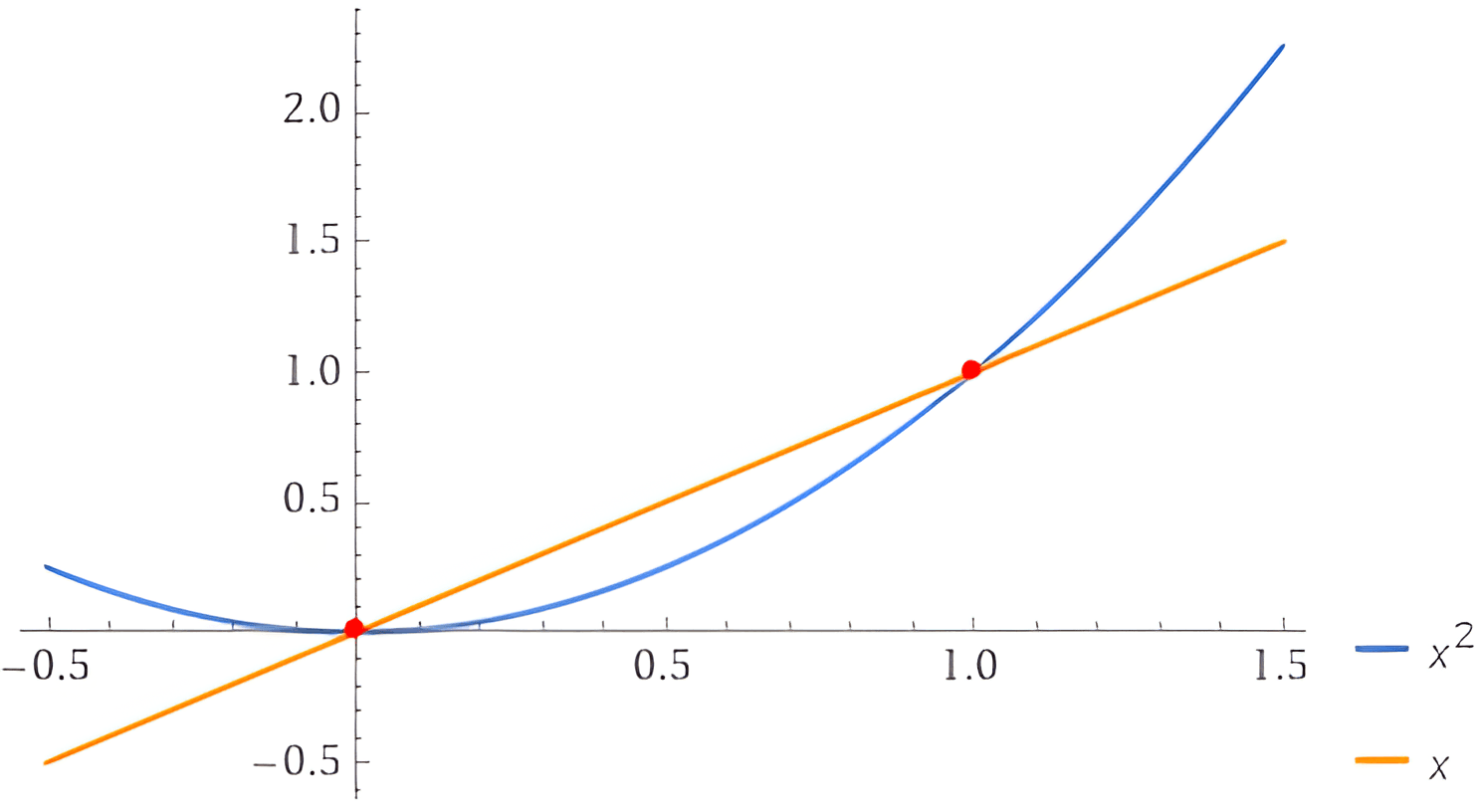
Generated Graph
Solution by Steps
step 1
Start with the equation x(x+1)=(x+1)
step 2
Factor out (x+1): (x+1)(x−1)=0
step 3
Solve for x: x=0 or x=−1
A
Key Concept
Factoring Quadratic Equations
Explanation
Factoring allows us to solve quadratic equations by setting each factor to zero and solving for the variable.
step 1
Start with the equation (sinx)(logx2)=0
step 2
Solve for x: sinx=0 or logx2=0
step 3
sinx=0 gives x=nπ where n is an integer
step 4
logx2=0 gives x=±1
step 5
The solutions are x=0,±1,±π
B
Key Concept
Solving Trigonometric and Logarithmic Equations
Explanation
Combining solutions from trigonometric and logarithmic equations requires considering all possible values that satisfy either equation.
step 1
Given f(x)=(x−1)(x−3)+1 with domain (0,4)
step 2
The inverse function f−1(x) will have the range of f(x) as its domain
step 3
Calculate the range of f(x) over (0,4)
step 4
f(x) is a quadratic function opening upwards, with vertex at x=2
step 5
f(2)=(2−1)(2−3)+1=0
step 6
The range of f(x) is (0,4)
B
Key Concept
Domain and Range of Inverse Functions
Explanation
The domain of the inverse function is the range of the original function.
step 1
Given y=(−7,+5,x)
step 2
The inverse function swaps x and y
step 3
Solve for y: x=−7+5y
step 4
y=5x+57
B
Key Concept
Finding Inverse Functions
Explanation
To find the inverse function, solve the equation for the other variable.
step 1
Given y=mx+2 and x2+y2=1
step 2
Substitute y=mx+2 into x2+y2=1
step 3
x2+(mx+2)2=1
step 4
Solve for m such that the equation has exactly one solution
step 5
The discriminant of the resulting quadratic equation must be zero
step 6
This gives m=−3 or m=3
C
Key Concept
Intersection of Graphs
Explanation
The discriminant of a quadratic equation determines the number of solutions.
step 1
Given f(x)−f(−x)=0
step 2
This implies f(x)=f(−x), so f(x) is an even function
step 3
Identify which function is not even
step 4
sin(x−2π) is not an even function
A
Key Concept
Even and Odd Functions
Explanation
Even functions satisfy f(x)=f(−x), while odd functions satisfy f(x)=−f(−x).
step 1
Given f(x)=(x2−a)(x2+b)
step 2
Find the derivative f′(x) and set it to zero to find stationary points
step 3
f′(x)=2x(x2+b−x2+a)=2x(b+a)
step 4
Set f′(x)=0: 2x(b+a)=0
step 5
Solve for x: x=0 or b+a=0
step 6
The possible number of stationary points is 1, 2, or 3
E
Key Concept
Stationary Points
Explanation
Stationary points occur where the derivative of a function is zero.
step 1
Given y=x+1 and y={24amp;foramp;foramp;0≤xamp;x≥2lt;2
step 2
Solve for x and y in each interval
step 3
For 0 \leq x < 2: x+1=2⇒x=1,y=2
step 4
For x≥2: x+1=4⇒x=3,y=4
D
Key Concept
Solving Piecewise Functions
Explanation
Piecewise functions are solved by considering each interval separately.
step 1
Given y=3+2cos(2x+5π)
step 2
The average value of a periodic function over one period is the mean of its maximum and minimum values
step 3
The maximum value is 3+2=5 and the minimum value is 3−2=1
step 4
The average value is 25+1=3
E
Key Concept
Average Value of a Periodic Function
Explanation
The average value of a periodic function is the mean of its maximum and minimum values.
step 1
Given x=log10(t+t1)
step 2
Find the average rate of change from t=100 to t=10000
step 3
Calculate x at t=100: x=log10(100+1001)=log10(10+0.1)=log10(10.1)
step 4
Calculate x at t=10000: x=log10(10000+100001)=log10(100+0.01)=log10(100.01)
step 5
The average rate of change is 10000−100log10(100.01)−log10(10.1)
step 6
Simplify to get approximately 0.00023
B
Key Concept
Average Rate of Change
Explanation
The average rate of change is the difference in function values divided by the difference in input values.
step 1
Given ax+by+c=0 and a2x+b2y+c2=0
step 2
For the lines to be perpendicular, the product of their slopes must be −1
step 3
The slope of the first line is −ba
step 4
The slope of the second line is −b2a2
step 5
Set the product of the slopes to −1: −ba⋅−b2a2=1
step 6
Simplify to get a=±b
A
Key Concept
Perpendicular Lines
Explanation
The product of the slopes of two perpendicular lines is −1.
step 1
Given ∫0∞f(x)dx=b
step 2
Find ∫02(2f(2x)+1)dx
step 3
Use substitution u=2x, du=21dx
step 4
The integral becomes 2∫01f(u)du+∫021dx
step 5
This simplifies to 2b+2
B
Key Concept
Integration by Substitution
Explanation
Substitution simplifies the integral by changing the variable of integration.
step 1
Given transformations: translate by b units, reflect in y-axis, dilate by factor a
step 2
The translation gives f(x−b)
step 3
Reflecting in the y-axis gives f(−(x−b))=f(b−x)
step 4
Dilating by factor a gives af(b−x)
A
Key Concept
Transformations of Functions
Explanation
Transformations include translations, reflections, and dilations, which change the function's graph.
step 1
Given T(xy)=(a0amp;0amp;b)(xy)−(cd)
step 2
Find T−1 such that T−1T=I
step 3
T−1(xy)=(a−10amp;0amp;b−1)(xy)+(cd)
C
Key Concept
Inverse of a Transformation Matrix
Explanation
The inverse of a transformation matrix undoes the original transformation.
step 1
Given a coin toss and a cube roll
step 2
Identify a possible random variable
step 3
The difference between the number of tails and the number of numbers greater than 3 is a valid random variable
D
Key Concept
Random Variables
Explanation
A random variable is a numerical outcome of a random process.


Solution by Steps
step 1
The probability distribution of random variable X is given by the table. To find the expected value xˉ, we use the formula for the expected value of a discrete random variable: xˉ=∑(xi⋅pi), where xi are the values and pi are the probabilities
step 2
Calculate the expected value using the given values and probabilities
step 3
Sum the products of each value and its corresponding probability
step 4
The value of xˉ is closest to 1.05
B
Key Concept
Expected Value
Explanation
The expected value of a discrete random variable is the sum of the products of each value and its corresponding probability.
step 1
The probability density function of random variable X is given by f(x)={ex∗a,0,amp;0≤x≤aamp; elsewhere
step 2
To find the value of a, we need to ensure that the total probability is 1
step 3
Integrate the function f(x) over the interval [0,a] and set the integral equal to 1
step 4
Solve the equation ∫0aex∗adx=1 to find the value of a
step 5
The value of a is closest to 0.5
D
Key Concept
Probability Density Function
Explanation
The total area under the probability density function over its entire range must equal 1.
step 1
Given Pr(A)=0.6, Pr(B)=0.3, and Pr(A∪B)=0.2, we need to find Pr(A∣B)
step 2
Use the formula for conditional probability: Pr(A∣B)=Pr(B)Pr(A∩B)
step 3
Find Pr(A∩B) using the formula Pr(A∪B)=Pr(A)+Pr(B)−Pr(A∩B)
step 4
Solve for Pr(A∩B): 0.2=0.6+0.3−Pr(A∩B)⇒Pr(A∩B)=0.7
step 5
Calculate Pr(A∣B)=0.30.7=0.7
D
Key Concept
Conditional Probability
Explanation
Conditional probability is the probability of an event occurring given that another event has already occurred.
step 1
Given Pr(X=5)=126(52)4(53)3=0.25, we need to find the mean and standard deviation of X
step 2
For a binomial distribution, the mean μ is given by μ=n⋅p and the standard deviation σ is given by σ=n⋅p⋅(1−p)
step 3
Use the given probability to find n and p
step 4
Calculate the mean and standard deviation using the formulas
step 5
The mean and standard deviation are closest to 4.50 and 1.47, respectively
A
Key Concept
Binomial Distribution
Explanation
The mean and standard deviation of a binomial distribution can be calculated using the formulas μ=n⋅p and σ=n⋅p⋅(1−p).
step 1
Given that 52.5% of a country's voting population favors a particular political party, and random samples of size 500 voters are taken, we need to find the number of samples with a sample proportion greater than 0.60
step 2
Use the normal approximation to the binomial distribution to find the probability of a sample proportion greater than 0.60
step 3
Calculate the mean and standard deviation of the sample proportion
step 4
Use the z-score formula to find the probability
step 5
Multiply the probability by the number of samples to find the expected number of samples with a proportion greater than 0.60
step 6
The number of samples is closest to 2
C
Key Concept
Normal Approximation
Explanation
The normal approximation to the binomial distribution can be used when the sample size is large and the probability of success is not too close to 0 or 1.


Solution by Steps
step 1
To apply the quotient rule to the given function, we start with the function y=x320(1−2log2(x))
step 2
The quotient rule states that for a function y=vu, the derivative dxdy is given by v2vdxdu−udxdv
step 3
Here, u=20(1−2log2(x)) and v=x3
step 4
Compute dxdu: dxd[20(1−2log2(x))]=20⋅(−2)⋅xln(2)1=−xln(2)40
step 5
Compute dxdv: dxd[x3]=3x2
step 6
Substitute into the quotient rule: dxdy=(x3)2x3⋅(−xln(2)40)−20(1−2log2(x))⋅3x2
step 7
Simplify the expression: dxdy=xln(2)⋅x6−40x2−x660x2(1−2log2(x))=x5ln(2)−40−x460(1−2log2(x))
step 8
Combine the terms: dxdy=x5ln(2)−40−x460+x4120log2(x)
step 9
Factor out common terms: dxdy=x41(xln(2)−40−60+120log2(x))
step 10
Simplify further: dxdy=x41(−xln(2)40−60+120log2(x))
Answer
dxdy=x41(−xln(2)40−60+120log2(x))
step 1
To find the coordinates of the highest point of the profile, we need to set dxdy=0 and solve for x
step 2
Set x41(−xln(2)40−60+120log2(x))=0
step 3
This simplifies to −xln(2)40−60+120log2(x)=0
step 4
Solve for x: 120log2(x)=xln(2)40+60
step 5
This equation is complex and may require numerical methods to solve
step 6
Once x is found, substitute back into the original function to find y
Answer
The coordinates of the highest point need to be found numerically.
step 1
Use a CAS (Computer Algebra System) to find the y-coordinate of the endpoint and the gradient of the profile at the endpoint
step 2
Input the function y=x320(1−2log2(x)) into the CAS
step 3
Evaluate the function and its derivative at the endpoint
step 4
Correct the answer to 4 decimal places
Answer
Use CAS to find the exact values.
step 1
Given y=a(x−11)2+b for 10≤x≤c, and the profiles join smoothly at x=10
step 2
Set up the equations for continuity and smoothness: a(10−11)2+b=y(10) and 2a(10−11)=y′(10)
step 3
Solve these simultaneous equations to find a and b
Answer
a and b need to be solved numerically.
step 1
The endpoint of the second profile reaches the same height as the first profile
step 2
Set a(c−11)2+b=y(c)
step 3
Solve for c in the interval 10≤x≤c
Answer
c needs to be solved numerically.
step 1
The horizontal platform is joined to the endpoint in part e, and c≤x≤21.5
step 2
The equation of the profile of the platform is y=constant
Answer
The equation of the platform is y=constant.
step 1
Sketch the profiles of the second slope and the platform on the same graph
step 2
Ensure the profiles join smoothly at x=10 and x=c
Answer
Sketch the profiles as described.
step 1
Find the total area under the three profiles
step 2
Integrate the functions over their respective intervals
step 3
Sum the areas to find the total area available for advertisement
Answer
The total area needs to be calculated by integrating the functions.
Key Concept
Quotient Rule and Numerical Methods
Explanation
The quotient rule is used to find the derivative of a function that is the ratio of two differentiable functions. Numerical methods are often required to solve complex equations that arise from setting the derivative to zero.
© 2023 AskSia.AI all rights reserved