
AskSia
Plus

Calculate the volume of the solid obtained by rotating the region enclosed by $y...
Oct 16, 2024

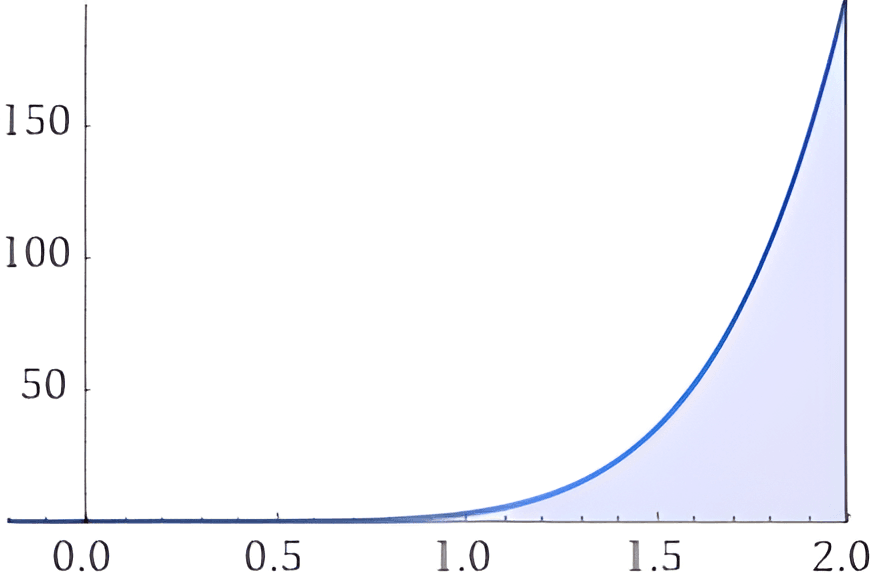
Calculate the volume of the solid obtained by rotating the region enclosed by y=x3, y=0, x=0, and x=2 around the x-axis.

Generated Graph
Solution by Steps
step 1
To find the volume of the solid obtained by rotating the region enclosed by y=x3, y=0, x=0, and x=2 around the x-axis, we use the disk method. The volume V is given by the integral: V=π∫02(x3)2dx
step 2
Simplifying the integral, we have: V=π∫02x6dx
step 3
Evaluating the integral: V=π[7x7]02=π(727−0)=π(7128)
step 4
Therefore, the volume of the solid is: V=7128π≈57.446
Answer
The volume of the solid is 7128π or approximately 57.446 cubic units.
Key Concept
The disk method is used to find the volume of solids of revolution by integrating the area of circular disks.
Explanation
The volume is calculated by integrating the area of disks formed by rotating the function around the x-axis, leading to the final result.

Solution by Steps
step 1
To find the derivative of the expression given, we start with the expression: fracdd=left(intlnleft(intright)right)2zln(z)+intleft(frac1zright)
step 2
We need to differentiate each part of the expression. The first part involves the integral of the logarithm, and the second part is the integral of frac1z
step 3
The derivative of the first part can be computed using the Fundamental Theorem of Calculus, while the second part simplifies to ln(z)
step 4
Therefore, the overall derivative is given by combining the results from the differentiation of both parts
Answer
The derivative of the expression is fracdd=2zln(z)+ln(z)
Key Concept
Understanding how to differentiate integrals and logarithmic functions is crucial in calculus.
Explanation
The answer combines the results of differentiating the integral expressions, applying the Fundamental Theorem of Calculus and properties of logarithms.
© 2023 AskSia.AI all rights reserved