
AskSia
Plus

Calculate the volume of the solid formed by rotating the area between y=x2 ...
Apr 18, 2024

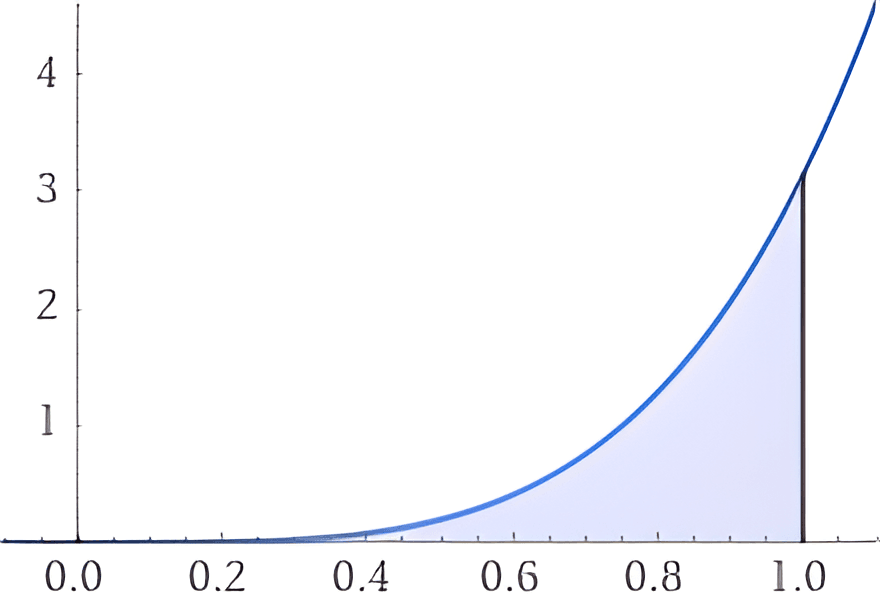
Calculate the volume of the solid formed by rotating the area between y=x2 and y=0 around the x-axis from x=0 to x=1.

Generated Graph
Solution by Steps
step 1
To find the volume of the solid formed by rotating the area between y=x2 and y=0 around the x-axis, we use the disk method
step 2
The volume V of the solid is given by the integral V=∫abπr2dx, where r is the radius of the disk at a given x, which is y=x2 in this case
step 3
Substituting y=x2 into the formula, we get V=∫01π(x2)2dx=∫01πx4dx
step 4
Using the asksia-ll calculator result, we integrate to find the volume: ∫01πx4dx=5πx501
step 5
Evaluating the integral from 0 to 1, we get 5π(1)5−5π(0)5=5π
Answer
The volume of the solid is 5π cubic units.
Key Concept
Disk Method for Volume
Explanation
The disk method involves integrating the area of circular disks along the axis of revolution to find the volume of the solid formed.
Find the Laurent series for the function 1z+z2 in each of the following domains: (a) 0<|z|<1 (b) 1<|z| (c) 0<|z+1|<1 (d) 1<|z+1| ,
Solution by Steps
step 1
To find the Laurent series for the function z+z21 around z=0 for 0<|z|<1, we first rewrite the function to separate the terms
step 2
We factor out z from the denominator to get z(1+z)1
step 3
Next, we perform partial fraction decomposition to get z1−1+z1
step 4
We then expand 1+z1 as a geometric series for |z|<1, which gives 1+z1=1−z+z2−z3+…
step 5
The Laurent series for 0<|z|<1 is then z1−(1−z+z2−z3+…)
Answer
z1−1+z−z2+z3−…
Key Concept
Laurent series expansion in annular regions
Explanation
For 0<|z|<1, we can expand the function as a Laurent series by using partial fraction decomposition and geometric series expansion.
step 1
To find the Laurent series for the function z+z21 around z=0 for |z|>1, we first rewrite the function to separate the terms
step 2
We factor out z2 from the denominator to get z2(1+z1)1
step 3
Next, we expand 1+z11 as a geometric series for |\frac{1}{z}|<1, which is equivalent to |z|>1
step 4
The geometric series expansion gives 1+z11=1−z1+z21−z31+…
step 5
The Laurent series for |z|>1 is then z21−z31+z41−z51+…
Answer
z21−z31+z41−z51+…
Key Concept
Laurent series expansion outside the unit circle
Explanation
For |z|>1, we expand the function as a Laurent series by factoring out z2 and using a geometric series expansion for the reciprocal of z.
step 1
To find the Laurent series for the function z+z21 around z=−1 for 0<|z+1|<1, we first perform a substitution w=z+1
step 2
The function becomes (w−1)+w21, which simplifies to w2−11
step 3
We then perform partial fraction decomposition to get 21(w−11−w+11)
step 4
Next, we expand w−11 and w+11 as geometric series for |w-1|<1 and |w+1|>1, respectively
step 5
The Laurent series for 0<|z+1|<1 is then 21((−w1−w21−w31−…)−(w1−w21+w31−…))
Answer
−w21−w42−w62−… where w=z+1
Key Concept
Laurent series expansion around a shifted pole
Explanation
For 0<|z+1|<1, we use the substitution w=z+1 and expand the function as a Laurent series using partial fraction decomposition and geometric series expansion.
step 1
To find the Laurent series for the function z+z21 around z=−1 for |z+1|>1, we first perform a substitution w=z+1
step 2
The function becomes (w−1)+w21, which simplifies to w2−11
step 3
We then perform partial fraction decomposition to get 21(w−11−w+11)
step 4
Next, we expand w−11 and w+11 as geometric series for |w-1|>1 and |w+1|<1, respectively
step 5
The Laurent series for |z+1|>1 is then 21((w1+w21+w31+…)−(−w1+w21−w31+…))
Answer
w1+w32+w52+… where w=z+1
Key Concept
Laurent series expansion around a shifted pole outside the unit circle
Explanation
For |z+1|>1, we use the substitution w=z+1 and expand the function as a Laurent series using partial fraction decomposition and geometric series expansion.
© 2023 AskSia.AI all rights reserved